We read your photo as:

Find the transfer function of the signal flow graph shown below.

Computer Science

ScanSolve AI Answer

Step-by-step solution

6 steps

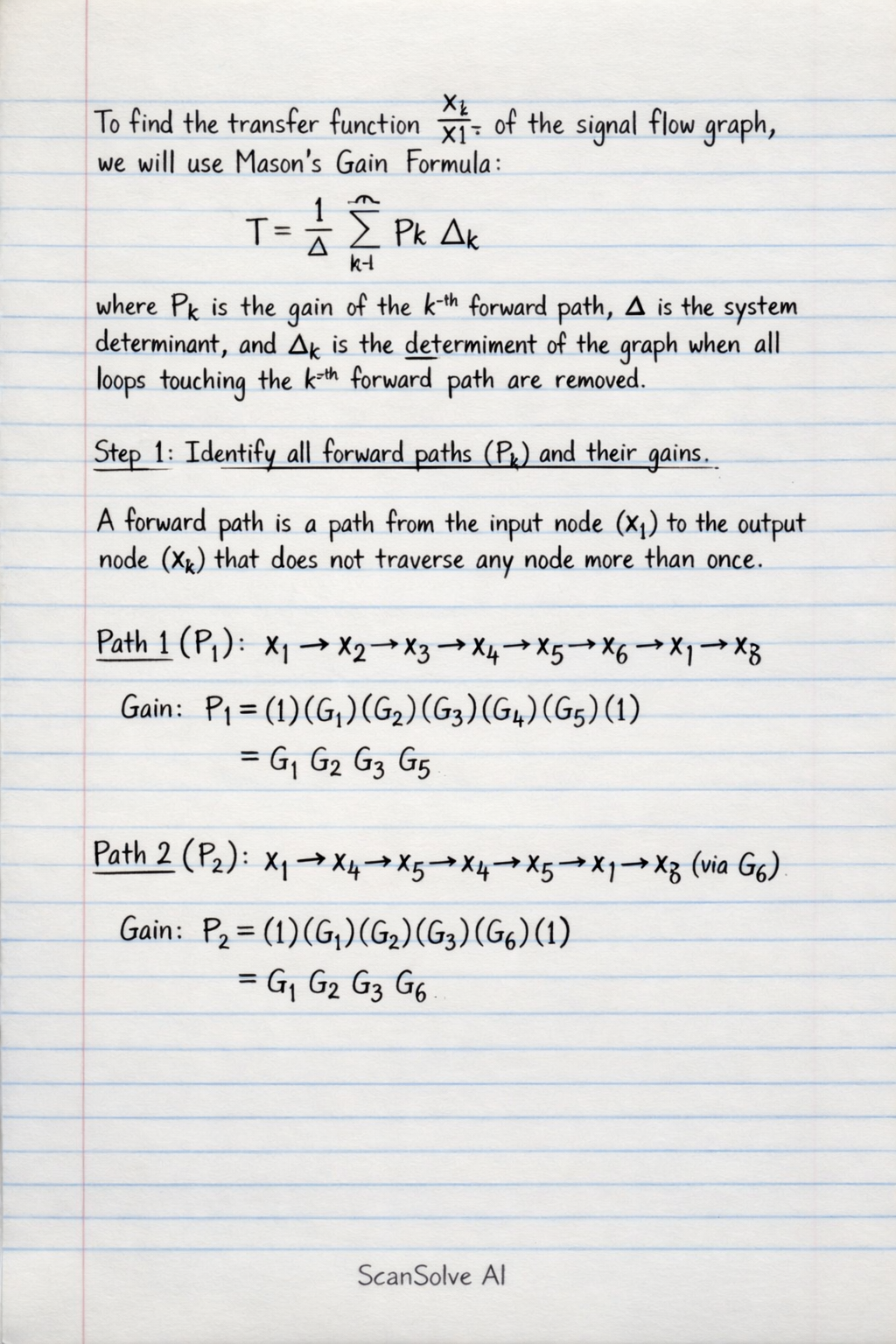
To find the transfer function x8x1\frac{x_8}{x_1} of the signal flow graph, we will use Mason's Gain Formula:

T=1Δ∑k=1NPkΔkT = \frac{1}{\Delta} \sum_{k=1}^{N} P_k \Delta_k

where PkP_k is the gain of the kk-th forward path, Δ\Delta is the system determinant, and Δk\Delta_k is the determinant of the graph when all loops touching the kk-th forward path are removed.

  1. Identify all forward paths (PkP_k) and their gains.

    A forward path is a path from the input node (x1x_1) to the output node (x8x_8) that does not traverse any node more than once.

    • Path 1 (P1P_1): x1→x2→x3→x4→x5→x6→x7→x8x_1 \to x_2 \to x_3 \to x_4 \to x_5 \to x_6 \to x_7 \to x_8

      • The gain is the product of the branch gains along this path: P1=(1)(G1)(G2)(G3)(G4)(G5)(1)=G1G2G3G4G5P_1 = (1)(G_1)(G_2)(G_3)(G_4)(G_5)(1) = G_1 G_2 G_3 G_4 G_5
    • Path 2 (P2P_2): x1→x2→x3→x4→x5→x7→x8x_1 \to x_2 \to x_3 \to x_4 \to x_5 \to x_7 \to x_8 (via G6G_6)

      • The gain is the product of the branch gains along this path: P2=(1)(G1)(G2)(G3)(G6)(1)=G1G2G3G6P_2 = (1)(G_1)(G_2)(G_3)(G_6)(1) = G_1 G_2 G_3 G_6
  2. Identify all individual loops (LiL_i) and their gains.

    A loop is a path that starts and ends at the same node, traversing no other node more than once.

    • Loop 1 (L1L_1): x2→x3→x2x_2 \to x_3 \to x_2

      • L1=G1⋅(−H1)=−G1H1L_1 = G_1 \cdot (-H_1) = -G_1 H_1
    • Loop 2 (L2L_2): x3→x4→x3x_3 \to x_4 \to x_3

      • L2=G2⋅(−H2)=−G2H2L_2 = G_2 \cdot (-H_2) = -G_2 H_2
    • Loop 3 (L3L_3): x4→x5→x4x_4 \to x_5 \to x_4

      • L3=G3⋅(−H3)=−G3H3L_3 = G_3 \cdot (-H_3) = -G_3 H_3
    • Loop 4 (L4L_4): x2→x3→x4→x5→x6→x2x_2 \to x_3 \to x_4 \to x_5 \to x_6 \to x_2

      • L4=G1⋅G2⋅G3⋅G4⋅(−H4)=−G1G2G3G4H4L_4 = G_1 \cdot G_2 \cdot G_3 \cdot G_4 \cdot (-H_4) = -G_1 G_2 G_3 G_4 H_4
  3. Identify all non-touching loops.

    Non-touching loops are loops that do not share any common nodes.

    • Pairs of non-touching loops:

      • L1L_1 (nodes x2,x3x_2, x_3) and L3L_3 (nodes x4,x5x_4, x_5) are non-touching.
        • L1L3=(−G1H1)(−G3H3)=G1G3H1H3L_1 L_3 = (-G_1 H_1)(-G_3 H_3) = G_1 G_3 H_1 H_3
      • All other pairs of loops (L1L2L_1 L_2, L1L4L_1 L_4, L2L3L_2 L_3, L2L4L_2 L_4, L3L4L_3 L_4) share common nodes and are therefore touching.
    • Triplets or higher order non-touching loops:

      • Since there is only one pair of non-touching loops, there are no triplets or higher order sets of non-touching loops.
  4. Calculate the system determinant Δ\Delta.

    Δ=1−∑Li+∑LiLj−∑LiLjLk+…\Delta = 1 - \sum L_i + \sum L_i L_j - \sum L_i L_j L_k + \dots Δ=1−(L1+L2+L3+L4)+(L1L3)\Delta = 1 - (L_1 + L_2 + L_3 + L_4) + (L_1 L_3) Δ=1−(−G1H1−G2H2−G3H3−G1G2G3G4H4)+(G1G3H1H3)\Delta = 1 - (-G_1 H_1 - G_2 H_2 - G_3 H_3 - G_1 G_2 G_3 G_4 H_4) + (G_1 G_3 H_1 H_3) Δ=1+G1H1+G2H2+G3H3+G1G2G3G4H4+G1G3H1H3\Delta = 1 + G_1 H_1 + G_2 H_2 + G_3 H_3 + G_1 G_2 G_3 G_4 H_4 + G_1 G_3 H_1 H_3
  5. Calculate Δk\Delta_k for each forward path.

    Δk\Delta_k is the determinant of the graph when all loops touching the kk-th forward path are removed.

    • For P1=G1G2G3G4G5P_1 = G_1 G_2 G_3 G_4 G_5:

      • P1P_1 passes through nodes x2,x3,x4,x5,x6,x7x_2, x_3, x_4, x_5, x_6, x_7.
      • All loops (L1,L2,L3,L4L_1, L_2, L_3, L_4) touch P1P_1.
      • Therefore, Δ1=1\Delta_1 = 1.
    • For P2=G1G2G3G6P_2 = G_1 G_2 G_3 G_6:

      • P2P_2 passes through nodes x2,x3,x4,x5,x7x_2, x_3, x_4, x_5, x_7.
      • All loops (L1,L2,L3,L4L_1, L_2, L_3, L_4) touch P2P_2.
      • Therefore, Δ2=1\Delta_2 = 1.
  6. Apply Mason's Gain Formula.

    T=P1Δ1+P2Δ2ΔT = \frac{P_1 \Delta_1 + P_2 \Delta_2}{\Delta} T=(G1G2G3G4G5)(1)+(G1G2G3G6)(1)1+G1H1+G2H2+G3H3+G1G2G3G4H4+G1G3H1H3T = \frac{(G_1 G_2 G_3 G_4 G_5)(1) + (G_1 G_2 G_3 G_6)(1)}{1 + G_1 H_1 + G_2 H_2 + G_3 H_3 + G_1 G_2 G_3 G_4 H_4 + G_1 G_3 H_1 H_3} T=G1G2G3G4G5+G1G2G3G61+G1H1+G2H2+G3H3+G1G2G3G4H4+G1G3H1H3T = \frac{G_1 G_2 G_3 G_4 G_5 + G_1 G_2 G_3 G_6}{1 + G_1 H_1 + G_2 H_2 + G_3 H_3 + G_1 G_2 G_3 G_4 H_4 + G_1 G_3 H_1 H_3}

    We can factor out G1G2G3G_1 G_2 G_3 from the numerator:

    T=G1G2G3(G4G5+G6)1+G1H1+G2H2+G3H3+G1G2G3G4H4+G1G3H1H3\boxed{T = \frac{G_1 G_2 G_3 (G_4 G_5 + G_6)}{1 + G_1 H_1 + G_2 H_2 + G_3 H_3 + G_1 G_2 G_3 G_4 H_4 + G_1 G_3 H_1 H_3}}
Was this helpful?

Still stuck on this one?

Ask a follow-up, and the answer starts from this question.

Got a different question?Ask your own question
Handwritten step-by-step solution preview

Handwritten Step-by-Step Solution

Get this as a handwritten image on WhatsApp — like a tutor wrote it for you.

Try on WhatsApp