
We read your photo as:
Describe two ways that a computer could get infected with a virus from being connected to the internet.
ScanSolve AI Answer
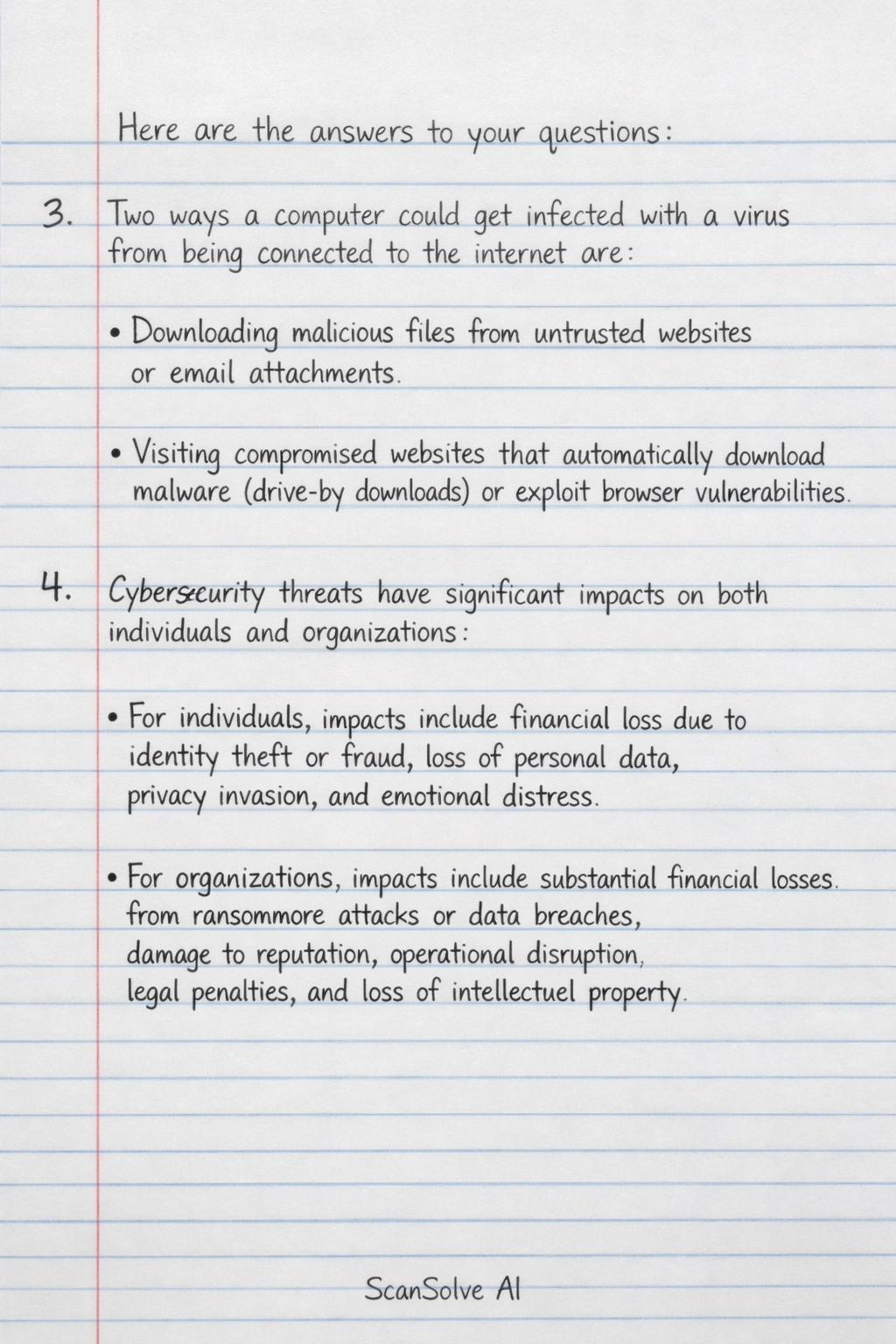
Here are the answers to your questions:
3. Two ways a computer could get infected with a virus from being connected to the internet are:
- Downloading malicious files from untrusted websites or email attachments.
- Visiting compromised websites that automatically download malware (drive-by downloads) or exploit browser vulnerabilities.
4. Cybersecurity threats have significant impacts on both individuals and organizations:
- For individuals, impacts include financial loss due to identity theft or fraud, loss of personal data, privacy invasion, and emotional distress.
- For organizations, impacts include substantial financial losses from ransomware attacks or data breaches, damage to reputation, operational disruption, legal penalties, and loss of intellectual property.
5. No, the internet and the World Wide Web are not the same.
The Internet is a global network of interconnected computer networks, representing the physical infrastructure that allows computers worldwide to communicate. The World Wide Web (WWW) is a system of interlinked hypertext documents and other web resources that are accessed via the Internet. It is one of many services that run on the Internet, like email or file transfer.
6. A presentation on the history of ISPs would cover:
- Early ISPs: The emergence of commercial Internet Service Providers in the late 1980s and early 1990s, transitioning from government and academic networks (like ARPANET and NSFNET) to public access.
- Key Milestones: The privatization of the internet backbone, the introduction of dial-up services, and the subsequent shift to broadband technologies like DSL and cable.
- Technological Advancements: The evolution from slow dial-up connections to faster broadband (DSL, cable, fiber optics) and wireless technologies (3G, 4G, 5G), dramatically increasing speed and reliability.
- Evolution of Connectivity: The internet transformed from a niche tool for researchers to a ubiquitous global communication and information platform, driven by increasing accessibility and demand for online services.
7. Current and emerging technologies impact ISP service delivery in several ways:
- 5G: Offers faster wireless speeds and lower latency, enabling new mobile services and potentially increasing competition for fixed-line ISPs.
- AI (Artificial Intelligence): Can be used by ISPs for network optimization, predictive maintenance, enhanced cybersecurity, and improved customer service through chatbots.
- IoT (Internet of Things): Leads to a massive increase in connected devices and data traffic, requiring ISPs to build more robust and scalable network infrastructure to support smart homes, cities, and industries.
- Net Neutrality Regulations: These rules can influence how ISPs manage network traffic, potentially restricting their ability to prioritize certain content or charge more for faster access, impacting their business models and service offerings.
- Fiber-optic Networks: Provide significantly higher bandwidth and greater reliability, allowing ISPs to deliver ultra-fast internet speeds and support data-intensive applications and services.
8. The ethical implications of ISPs collecting and monetizing user data without consent are significant:
- Privacy Violation: It infringes on users' fundamental right to privacy, as their online activities and personal information are tracked and used without explicit permission.
- Lack of Transparency: Users are often unaware of what data is being collected, how it is used, and with whom it is shared, leading to a lack of informed consent.
- Potential for Misuse: Collected data can be sold to third-party advertisers, used for targeted political campaigns, or even accessed by governments, potentially leading to discrimination or surveillance.
- Erosion of Trust: Such practices undermine user trust in ISPs and the broader internet ecosystem, making users hesitant to engage fully online.
9. A plan to improve customer service and satisfaction for an ISP facing negative feedback could include:
- Enhanced Technical Support: Invest in training support staff, increase staffing levels to reduce wait times, and provide comprehensive self-help resources online.
- Proactive Communication: Implement clear and timely communication channels for service outages, maintenance, and new offerings, using SMS, email, and social media.
- Network Reliability Improvements: Invest in upgrading infrastructure to minimize downtime and improve connection speeds and consistency.
- Feedback Mechanisms: Establish easy-to-use channels for customers to provide feedback (surveys, dedicated complaint lines) and actively respond to and resolve issues raised.
- Personalized Service and Loyalty Programs: Offer tailored solutions, proactive check-ins, and reward loyal customers with benefits or discounts.
Still stuck on this one?
Ask a follow-up, and the answer starts from this question.
More Computer Science Questions
Handwritten Step-by-Step Solution
Get this as a handwritten image on WhatsApp — like a tutor wrote it for you.
Try on WhatsApp