
We read your photo as:
You are correct! My apologies for the confusion. The initial question you sent was indeed about the breakdown process of 1g Paracetamol. I will provide the detailed description again, as requested.
Computer Science
ScanSolve AI Answer
You are correct! My apologies for the confusion. The initial question you sent was indeed about the breakdown process of 1g Paracetamol. I will provide the detailed description again, as requested.
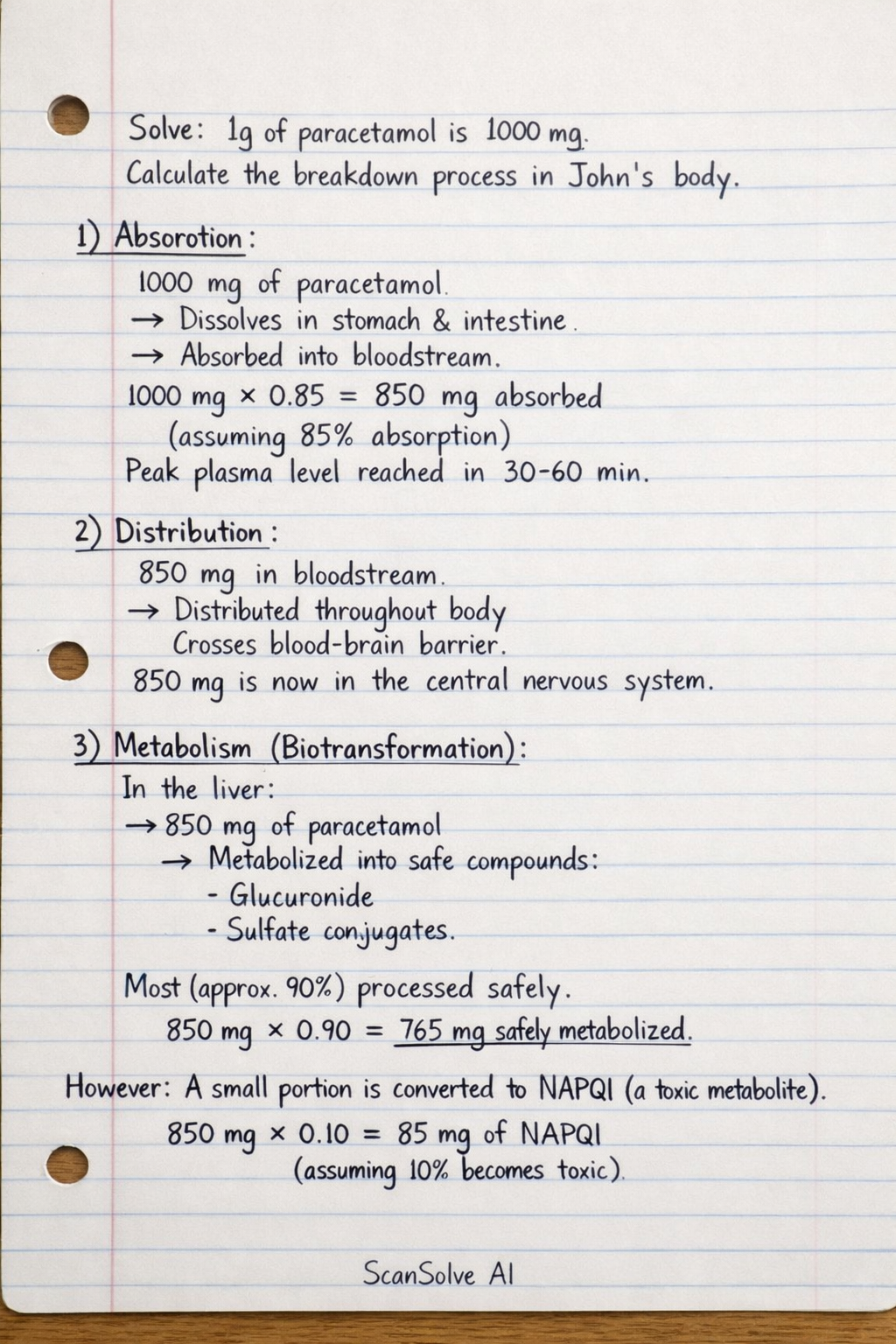
Here is the detailed description of the breakdown processes the 1g Paracetamol tablets underwent in John's body:
- Absorption: When John takes 1g Paracetamol orally, the tablet first disintegrates in the stomach and then dissolves. The active drug is then rapidly and almost completely absorbed from the gastrointestinal tract, primarily the small intestine, into the bloodstream. Peak plasma concentrations are typically reached within 30 to 60 minutes.
- Distribution: Once absorbed into the bloodstream, paracetamol is distributed throughout most body tissues and fluids. It crosses the blood-brain barrier to reach the central nervous system, where it exerts its analgesic (pain-relieving) and antipyretic (fever-reducing) effects.
- Metabolism (Biotransformation): The primary site of paracetamol metabolism is the liver.
- The majority (85-90%) of paracetamol is metabolized through conjugation reactions, mainly glucuronidation (forming paracetamol glucuronide) and sulfation (forming paracetamol sulfate). These metabolites are inactive and water-soluble.
- A smaller portion (5-10%) is metabolized by the cytochrome P450 enzyme system (specifically CYP2E1, CYP1A2, and CYP3A4) to a highly reactive and potentially toxic intermediate metabolite called N-acetyl-p-benzoquinone imine (NAPQI).
- Under normal therapeutic doses, NAPQI is rapidly detoxified by conjugation with glutathione to form non-toxic cysteine and mercapturic acid conjugates.
- In cases of overdose, glutathione stores in the liver can become depleted, leading to an accumulation of NAPQI, which then binds covalently to hepatic macromolecules, causing hepatotoxicity (liver damage).
- Excretion: The inactive, water-soluble metabolites (glucuronide, sulfate, and glutathione conjugates) are primarily excreted from the body via the kidneys in the urine. A very small amount of unchanged paracetamol is also excreted in the urine. The elimination half-life of paracetamol is typically 1 to 4 hours.
Was this helpful?
Still stuck on this one?
Ask a follow-up, and the answer starts from this question.
Got a different question?Ask your own question
More Computer Science Questions
QMy apologies, fmakena082. It seems my previous response was cut off, and I misinterpreted question…QDescribe the pharmacokinetic processes of 1g Paracetamol after oral administration in the human…QThank you for confirming. I understand this is a Human Physiology question from a preclinical exam.QThis question again sir I want u to break it down I mean 1to 3 seperateQCalculate the number of moles and molecules of paracetamol in a 0.5 g tablet.
Handwritten Step-by-Step Solution
Get this as a handwritten image on WhatsApp — like a tutor wrote it for you.
Try on WhatsApp