
We read your photo as:
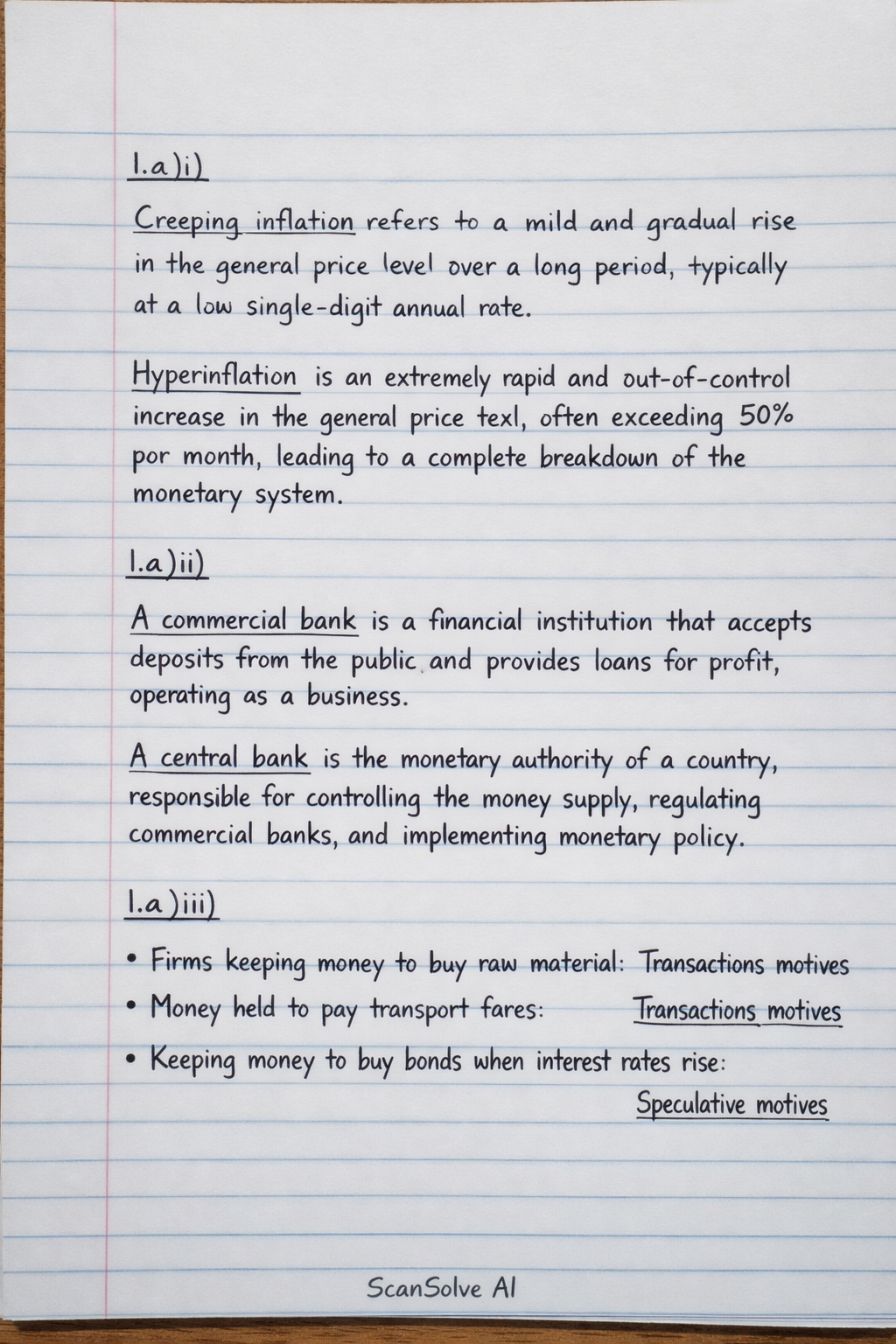
1.a)i) Creeping inflation refers to a mild and gradual rise in the general price level over a long period, typically at a low single-digit annual rate. Hyperinflation is an extremely rapid a
ScanSolve AI Answer
Step-by-step solution
8 steps1.a)i) Creeping inflation refers to a mild and gradual rise in the general price level over a long period, typically at a low single-digit annual rate. Hyperinflation is an extremely rapid and out-of-control increase in the general price level, often exceeding 50% per month, leading to a complete breakdown of the monetary system.
1.a)ii) A commercial bank is a financial institution that accepts deposits from the public and provides loans for profit, operating as a business. A central bank is the monetary authority of a country, responsible for controlling the money supply, regulating commercial banks, and implementing monetary policy.
1.a)iii)
- Firms keeping money to buy raw material: Transactions motives
- Money held to pay transport fares: Transactions motives
- Keeping money to buy bonds when interest rates rise: Speculative motives
1.a)iv)
- Open market operations: The central bank buys government securities from commercial banks, increasing their reserves and enabling them to lend more.
- Lowering the bank rate (discount rate): The central bank reduces the interest rate at which it lends to commercial banks, making it cheaper for them to borrow and encouraging more lending to the public.
- Reducing the cash reserve ratio (CRR): The central bank lowers the percentage of deposits that commercial banks must hold as reserves, freeing up more funds for lending.
1.b)
- Provides a market for buying and selling existing shares and debentures, offering liquidity to investors.
- Facilitates capital formation by enabling companies to raise long-term capital from the public.
- Helps in the valuation of securities, providing a benchmark for their worth based on market forces.
- Encourages savings and investment by providing an avenue for individuals and institutions to invest their funds.
2.a)i) Horizontal integration is the merger or acquisition of two or more companies that produce the same type of good or service at the same stage of production.
Example: Two competing car manufacturers merging.
2.a)ii) Internal economies of scale are cost advantages that a firm gains due to its own growth and expansion, leading to a decrease in average cost per unit.
Example: A large firm buying raw materials in bulk at a discounted price.
2.a)iii) Mobility of labour refers to the ease with which workers can move between different jobs, occupations, or geographical locations.
Example: A construction worker moving from one city to another for a new project.
2.b)
- Wage rate: Higher wages attract more workers, increasing the supply of labor.
- Non-monetary benefits: Attractive benefits like health insurance, flexible hours, or good working conditions can increase labor supply.
- Education and training: The availability and quality of education and training influence the supply of skilled labor in specific occupations.
- Population size and structure: A larger working-age population generally leads to a higher labor supply, influenced by birth rates, death rates, and migration.
3.a)
- Lack of adequate infrastructure: Poor transport networks, unreliable power supply, and limited access to clean water hinder industrial development.
- Limited access to finance: Small and medium-sized enterprises (SMEs) struggle to secure loans and investment for expansion due to high interest rates and strict collateral requirements.
- Corruption and poor governance: Corruption increases the cost of doing business and discourages both domestic and foreign investment in industrial sectors.
3.b)i) Privatization is the transfer of ownership of a business, enterprise, agency, public service, or public property from the public sector (government) to the private sector. Nationalization is the process by which a government or state takes control of a company or industry, previously owned by private entities.
3.b)ii) A Memorandum of Association is a legal document that defines the objectives, powers, and scope of a company, outlining its relationship with the outside world. Articles of Association are internal rules and regulations governing the management of a company's internal affairs and the conduct of its business.
3.b)iii) A public corporation is a state-owned enterprise established by a special act of parliament to provide public services, often operating without the primary goal of profit. A public company is a company whose shares are traded on a stock exchange and can be bought and sold by the general public.
3.b)iv) Scarcity is the fundamental economic problem of having seemingly unlimited human wants and needs in a world of limited resources. Opportunity cost is the value of the next best alternative that must be forgone when making a choice.
3.c)
- Internal sources of finance: Past savings, retained profits, depreciation funds.
- External sources of finance: Sale of shares and debentures, bank credits, subsidies, hire purchase, sale of assets.
4.a)
- Co-existence of public and private sectors: Both government-owned and privately-owned enterprises operate side-by-side in the economy.
- Economic planning: The government plays a role in economic planning and resource allocation, often through development plans.
- Social welfare: The government intervenes to provide social welfare services and reduce income inequality.
- Government regulation: The government regulates economic activities to ensure fair competition, protect consumers, and achieve social objectives.
4.b)i) National income is the total value of all final goods and services produced within a country's borders in a specific period, usually a year, plus net income from abroad.
4.b)ii) Unemployment refers to the situation where individuals who are actively seeking employment are unable to find work.
4.c)
- To assess economic performance: National income figures indicate the overall health and growth of an economy over time.
- To formulate economic policies: Governments use national income data to design and implement policies related to taxation, spending, and trade.
- To compare living standards: Per capita national income allows for comparisons of living standards between different countries or over different periods.
4.d)
- Investment in infrastructure projects: Government spending on roads, bridges, and public buildings creates jobs in the construction sector.
- Vocational training and education programs: Equipping the workforce with relevant skills improves their employability in various industries.
- Support for small and medium-sized enterprises (SMEs): Providing financial assistance and incentives to SMEs encourages their growth and job creation.
4.e) Fiscal policy refers to the government's use of spending and taxation to influence the economy. Monetary policy refers to actions undertaken by a central bank to influence the availability and cost of money and credit to help promote national economic goals.
5.a) A market in economics is any place or system where buyers and sellers interact to exchange goods, services, or resources. This interaction determines prices and quantities traded.
5.b)i) A guarantee price of 150 FCFA per packet of bread is a price floor.
5.b)ii)
Identify the quantity supplied and demanded at the imposed price.
At a price of 300 FCFA, quantity supplied is 800 packets and quantity demanded is 150 packets.
Calculate the excess supply.
Excess supply = Quantity supplied - Quantity demanded
Excess supply = packetsCalculate the cost to the government.
Cost to government = Excess supply Price
Cost to government =
Cost to government =The cost to the government is .
5.b)iii)
Identify initial and final prices and quantities.
Initial Price () = 250 FCFA, Initial Quantity Demanded () = 250 packets
Final Price () = 200 FCFA, Final Quantity Demanded () = 300 packetsCalculate the percentage change in quantity demanded.
Percentage change in
Percentage change in
Percentage change inCalculate the percentage change in price.
Percentage change in
Percentage change in
Percentage change inCalculate the price elasticity of demand (using the midpoint formula).
Interpret the elasticity.
The absolute value of is .
Since , the demand is inelastic.The price elasticity of demand is , and the demand is .
6.a)
- Availability of inputs: The ease and speed with which producers can acquire raw materials, labor, and capital affect how quickly they can increase output in response to price changes.
- Time period: In the short run, supply is often inelastic because firms cannot easily change their production capacity. In the long run, firms have more time to adjust, making supply more elastic.
- Nature of the good: Perishable goods or goods with limited production capacity tend to have inelastic supply, while manufactured goods with readily available inputs often have more elastic supply.
6.b)
- Breaking bulk: Retailers buy goods in large quantities from wholesalers and sell them in smaller, more convenient units to consumers.
- Providing information: Retailers inform customers about products through displays, advertising, and personal selling, and provide feedback to manufacturers.
- Offering credit facilities: Some retailers provide credit
Still stuck on this one?
Ask a follow-up, and the answer starts from this question.
More Economics Questions
Handwritten Step-by-Step Solution
Get this as a handwritten image on WhatsApp — like a tutor wrote it for you.
Try on WhatsApp