

This economics question tests your understanding of economic models and analysis. The step-by-step answer below applies the relevant framework and explains the reasoning.
ScanSolve AI Answer
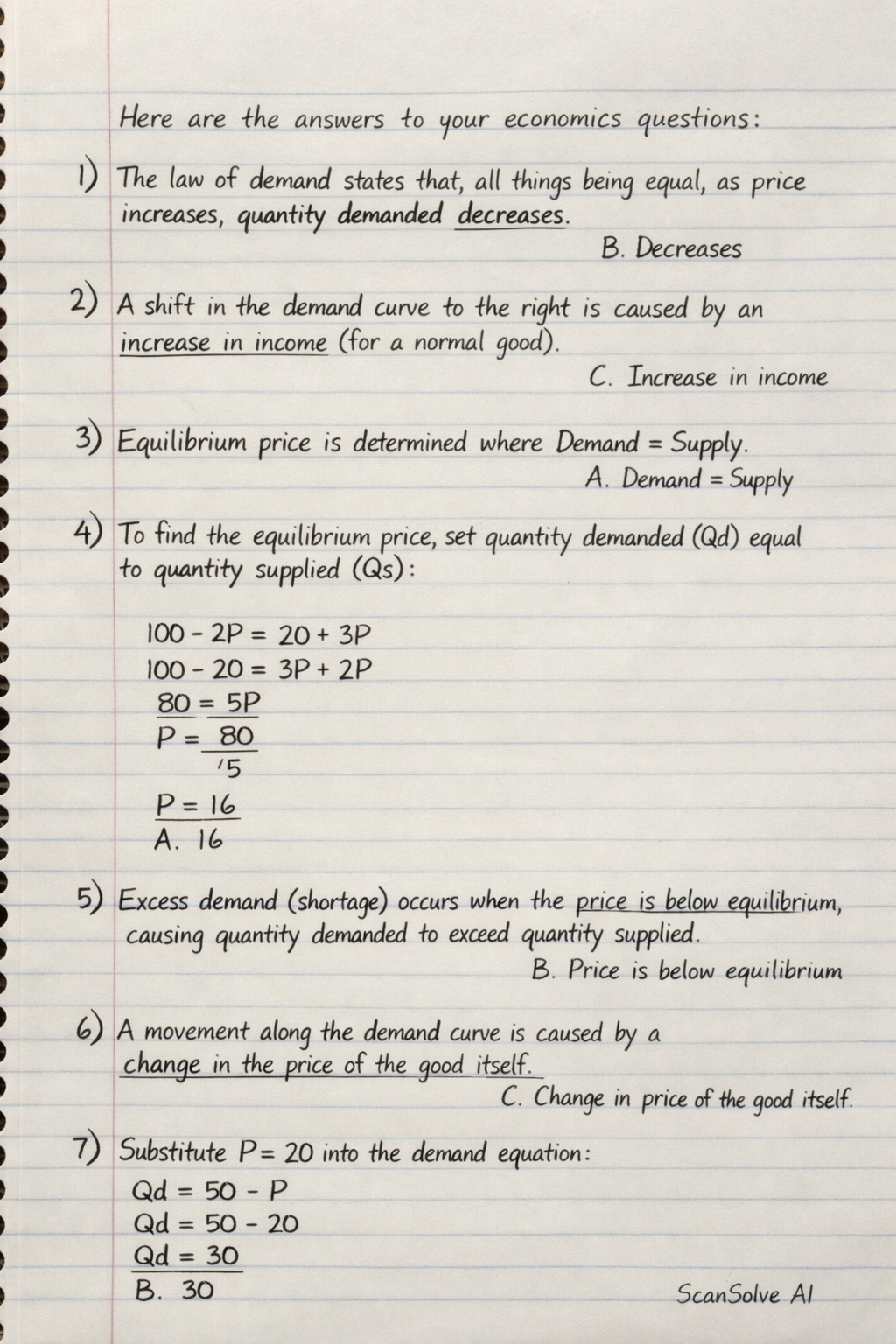
Here are the answers to your economics questions: 1) The law of demand states that, all things being equal, as price increases, quantity demanded decreases. B. Decreases 2) A shift in the demand curve to the right is caused by an increase in income (for a normal good). C. Increase in income 3) Equilibrium price is determined where Demand = Supply. A. Demand = Supply 4) To find the equilibrium price, set quantity demanded (Qd) equal to quantity supplied (Qs): 100 - 2P = 20 + 3P 100 - 20 = 3P + 2P 80 = 5P P = (80)/(5) P = 16 A. 16 5) Excess demand (shortage) occurs when the price is below equilibrium, causing quantity demanded to exceed quantity supplied. B. Price is below equilibrium 6) A movement along the demand curve is caused by a change in the price of the good itself. C. Change in price of the good itself 7) Substitute P = 20 into the demand equation: Qd = 50 - P Qd = 50 - 20 Qd = 30 B. 30 8) An increase in supply with demand constant will lead to a lower price and a higher quantity. B. Lower price, higher quantity 9) Complementary goods have demand curves that shift in the same direction. For example, if the demand for coffee increases, the demand for sugar (a complement) also increases. B. Same direction 10) In a linear supply function Qs = a + bP, the coefficient 'b' represents the slope of the supply curve (change in quantity supplied per unit change in price). B. b 11) Price elasticity of demand measures the responsiveness of quantity demanded (Qd) to a price change. B. Responsiveness of Qd to price change 12) If the price elasticity of demand (Ed) is 0, demand is perfectly inelastic, meaning quantity demanded does not change regardless of price. B. Perfectly inelastic 13) Luxury goods usually have demand that is elastic, as consumers can easily reduce their consumption if prices rise. B. Elastic 14) The formula for price elasticity of demand (Ed) is the percentage change in quantity demanded divided by the percentage change in price. B. Price 15) Calculate the price elasticity of demand (Ed): Ed = \% change in Qd\% change in P Ed = (-5\%)/(10\%) Ed = -0.5 C. -0.5 16) Total revenue increases when price falls if demand is elastic. In this case, the percentage increase in quantity demanded is greater than the percentage decrease in price. B. Elastic 17) Necessities like salt have demand that is inelastic, as consumers will continue to purchase them even if prices change. B. Inelastic 18) Elasticity of supply is high when producers can easily increase output in response to a price change. A. Producers can easily increase output 19) Calculate the percentage increase in supply: Es = \% change in Qs\% change in P 1.5 = \% change in Qs10\% \% change in Qs = 1.5 × 10\% \% change in Qs = 15\% C. 15% Send me the next one 📸