
We read your photo as:
7(a) Explain the following terms i tax incidence ii tax burden iii impact of tax (b) What are the advantages of Direct Tax over Indirect Tax?
ScanSolve AI Answer
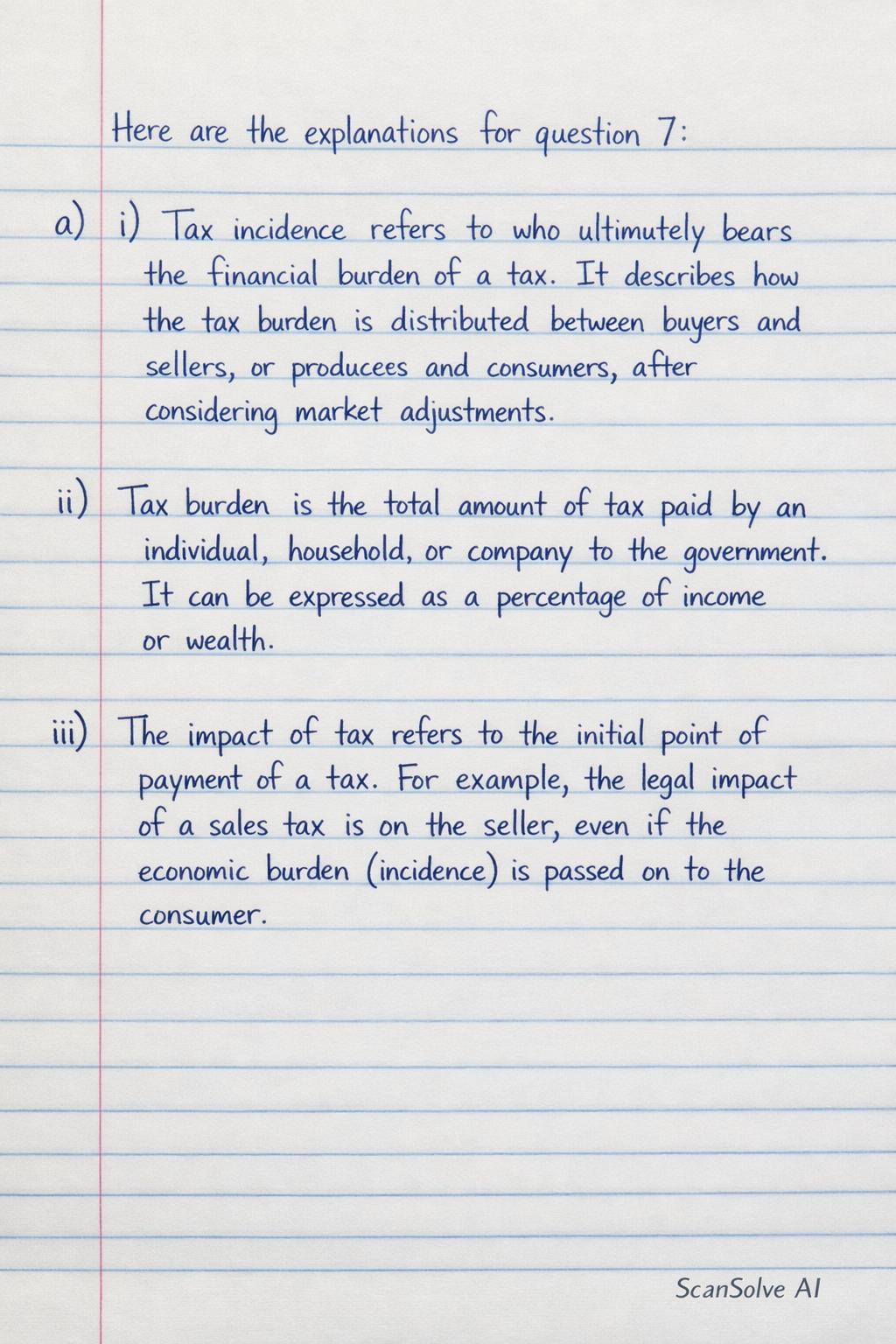
Here are the explanations for question 7:
a)
i) Tax incidence refers to who ultimately bears the financial burden of a tax. It describes how the tax burden is distributed between buyers and sellers, or producers and consumers, after considering market adjustments.
ii) Tax burden is the total amount of tax paid by an individual, household, or company to the government. It can be expressed as a percentage of income or wealth.
iii) The impact of tax refers to the initial point of payment of a tax. For example, the legal impact of a sales tax is on the seller, even if the economic burden (incidence) is passed on to the consumer.
b)
Advantages of Direct Tax over Indirect Tax:
- Equity: Direct taxes, like income tax, can be progressive, meaning those with higher incomes pay a larger percentage of their income in tax. This promotes a fairer distribution of wealth.
- Certainty: Taxpayers know exactly how much tax they need to pay, and the government knows how much revenue it will collect.
- Elasticity: Direct taxes can be easily adjusted by the government to meet changing revenue needs or economic conditions.
- Economic Stability: Direct taxes can be used as a tool for fiscal policy to control inflation or deflation by adjusting tax rates.
Still stuck on this one?
Ask a follow-up, and the answer starts from this question.
More Economics Questions
Handwritten Step-by-Step Solution
Get this as a handwritten image on WhatsApp — like a tutor wrote it for you.
Try on WhatsApp