
![Analyse the effect of decrease in price of cement using the indifference curve approach in essay format [25 marks]](/_next/image?url=https%3A%2F%2Fohijasnjvprzodcmxltt.supabase.co%2Fstorage%2Fv1%2Fobject%2Fpublic%2Fwhatsapp-images%2F1790325987883-6b67eb79891b04f5.png&w=3840&q=75)
This economics question tests your understanding of economic models and analysis. The step-by-step answer below applies the relevant framework and explains the reasoning.
ScanSolve AI Answer
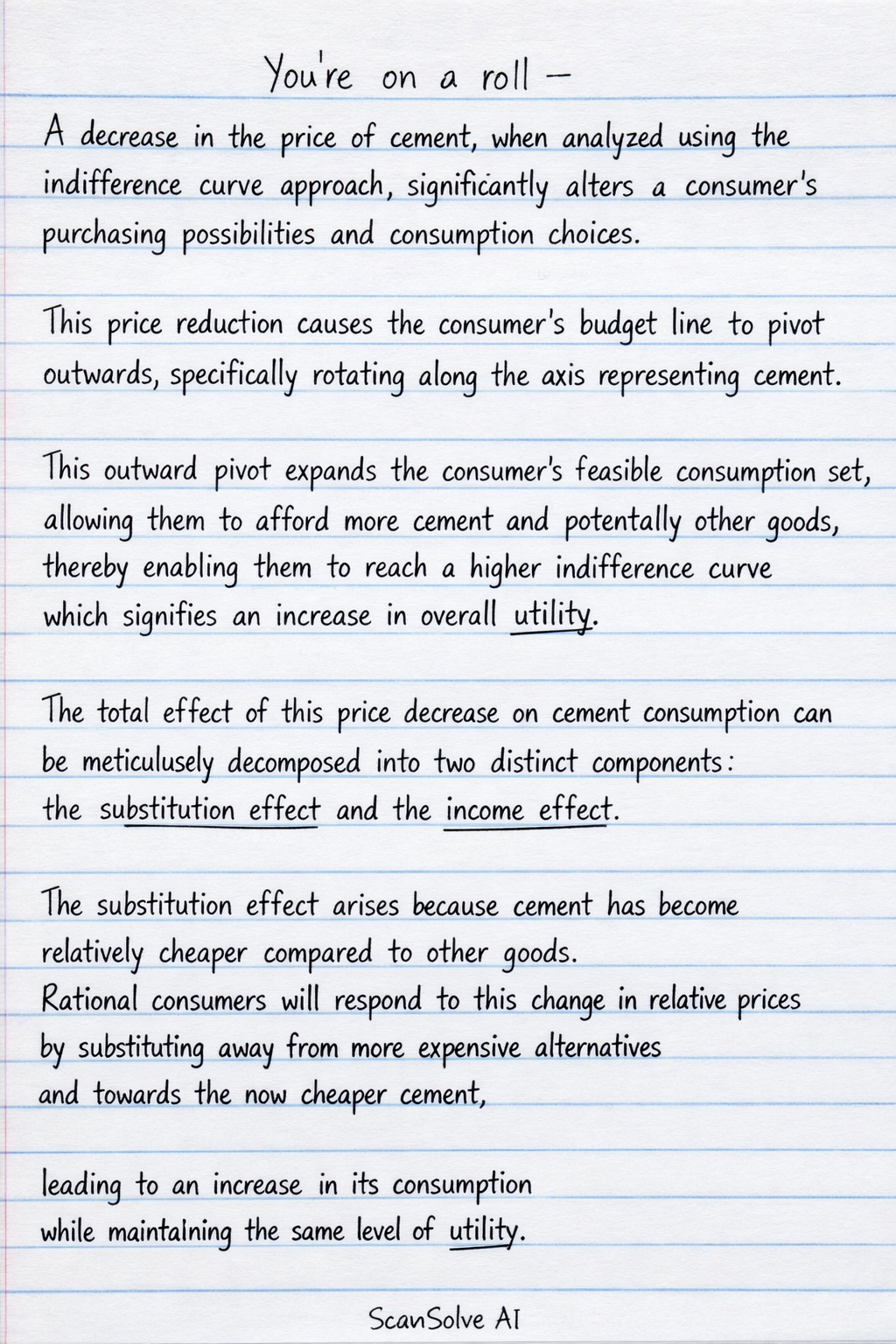
A decrease in the price of cement, when analyzed using the indifference curve approach, significantly alters a consumer's purchasing possibilities and consumption choices. This price reduction causes the consumer's budget line to pivot outwards, specifically rotating along the axis representing cement. This outward pivot expands the consumer's feasible consumption set, allowing them to afford more cement and potentially other goods, thereby enabling them to reach a higher indifference curve which signifies an increase in overall utility. The total effect of this price decrease on cement consumption can be meticulously decomposed into two distinct components: the substitution effect and the income effect. The substitution effect arises because cement has become relatively cheaper compared to other goods. Rational consumers will respond to this change in relative prices by substituting away from more expensive alternatives and towards the now cheaper cement, leading to an increase in its consumption while maintaining the same level of utility. Concurrently, the decrease in the price of cement enhances the consumer's real income or purchasing power. With the same nominal income, the consumer can now buy more goods and services. For cement, which is typically considered a normal good, this increase in real income further stimulates demand, leading to an additional increase in its consumption. Therefore, both the substitution effect and the income effect work in the same direction for a normal good like cement. They both contribute to an increase in the quantity of cement demanded. The new equilibrium will be established at a point where the new, flatter budget line is tangent to a higher indifference curve, reflecting a greater consumption of cement and an overall improvement in the consumer's welfare.