
We read your photo as:
Analyze the market for a good using the provided data. Determine the equilibrium price and quantity. Then, assess the impact of a government-imposed minimum price of N300, including the resulting surp
ScanSolve AI Answer
Here are the solutions for Question 1 and Question 2.
Question 1:
-
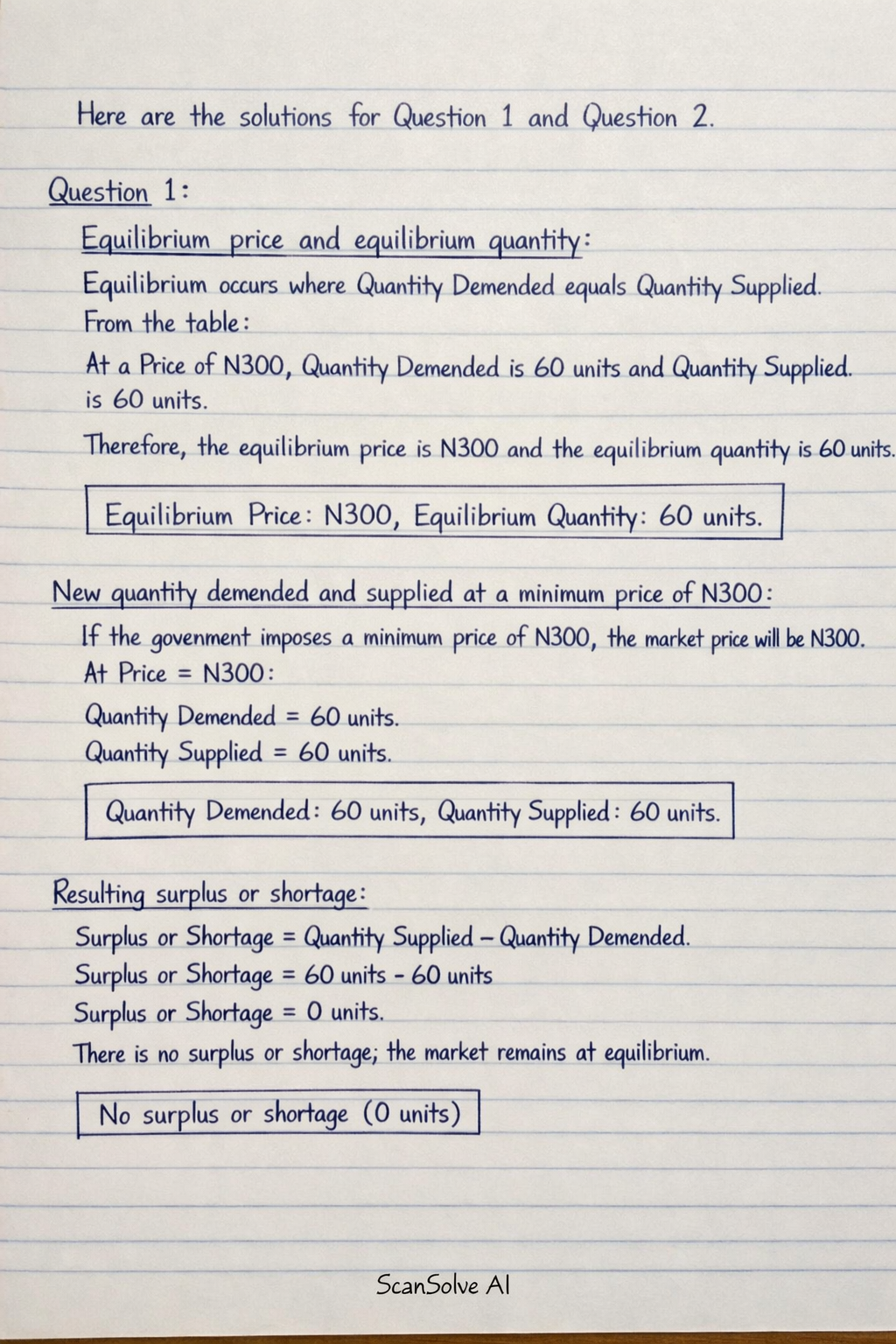
Equilibrium price and equilibrium quantity: Equilibrium occurs where Quantity Demanded equals Quantity Supplied. From the table: At a Price of N300, Quantity Demanded is 60 units and Quantity Supplied is 60 units. Therefore, the equilibrium price is N300 and the equilibrium quantity is 60 units.
-
New quantity demanded and supplied at a minimum price of N300: If the government imposes a minimum price of N300, the market price will be N300. At Price = N300: Quantity Demanded = 60 units Quantity Supplied = 60 units
-
Resulting surplus or shortage: Surplus or Shortage = Quantity Supplied - Quantity Demanded Surplus or Shortage = 60 units - 60 units = 0 units There is no surplus or shortage; the market remains at equilibrium.
-
Two consequences of fixing a price above the equilibrium:
- Surplus: When a price is fixed above the equilibrium (a price floor), the quantity supplied will exceed the quantity demanded, leading to an unsold surplus of the product in the market.
- Inefficiency and Resource Misallocation: Producers are encouraged to produce more at the higher price, but consumers are unwilling to buy that much. This leads to an inefficient allocation of resources, as resources are used to produce goods that are not sold, and it can also lead to reduced consumer welfare due to higher prices.
Question 2:
-
Average Variable Cost (AVC) for all levels of output: The formula for Average Variable Cost (AVC) is .
Output (Q) Total Variable Cost (TVC) AVC (N) 0 0 - 1 30 30 2 50 25 3 80 26.67 4 100 25 -
Marginal Cost (MC) of producing the 4th unit: The formula for Marginal Cost (MC) is . MC of 4th unit = Total Cost at Q=4 - Total Cost at Q=3 MC of 4th unit = N220 - N180 = N40
-
Profit or loss at 4 units if the price per unit is N60: Total Revenue (TR) = Price Quantity TR at 4 units = N60 4 = N240
Total Cost (TC) at 4 units = N220 (from the table)
Profit/Loss = Total Revenue - Total Cost
Profit/Loss = N240 - N220 = N20 -
Definition of "Sunk Cost": A sunk cost is a cost that has already been incurred and cannot be recovered. It is irrelevant to future business decisions because it will not change regardless of the choice made.
Still stuck on this one?
Ask a follow-up, and the answer starts from this question.
More Economics Questions
Handwritten Step-by-Step Solution
Get this as a handwritten image on WhatsApp — like a tutor wrote it for you.
Try on WhatsApp