

This economics question tests your understanding of economic models and analysis. The step-by-step answer below applies the relevant framework and explains the reasoning.
ScanSolve AI Answer
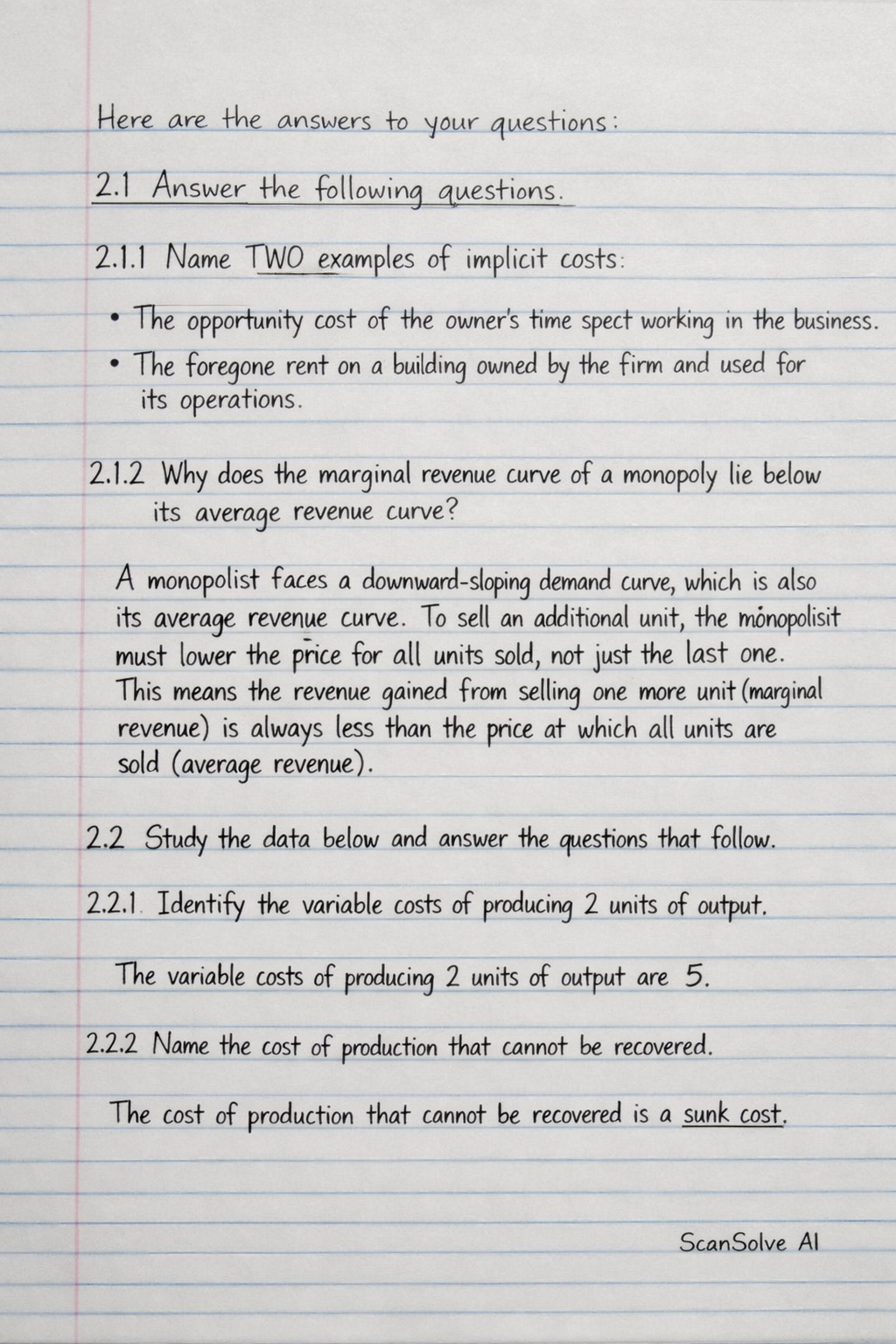
Here are the answers to your questions: 2.1 Answer the following questions. 2.1.1 Name TWO examples of implicit costs. The opportunity cost* of the owner's time spent working in the business. The foregone rent* on a building owned by the firm and used for its operations. 2.1.2 Why does the marginal revenue curve of a monopoly lie below its average revenue curve? A monopolist faces a downward-sloping demand curve, which is also its average revenue curve. To sell an additional unit, the monopolist must lower the price for all units sold, not just the last one. This means the revenue gained from selling one more unit (marginal revenue) is always less than the price at which all units are sold (average revenue). 2.2 Study the data below and answer the questions that follow. 2.2.1 Identify the variable costs of producing 2 units of output. The variable costs of producing 2 units of output are 5. 2.2.2 Name the cost of production that cannot be recovered. The cost of production that cannot be recovered is a sunk cost. 2.2.3 Briefly describe the term production costs. Production costs are the total expenses incurred by a firm to produce goods or services. These costs include both fixed costs (which do not change with output) and variable costs (which change with output). 2.2.4 Explain the impact of producing the fifth unit of output on the average variable costs curve. Step 1: Identify average variable costs for 4 and 5 units. From the table, the average variable cost for 4 units is 3.3, and for 5 units, it is 4. Step 2: Explain the impact. Producing the fifth unit causes the average variable costs to increase from 3.3 to 4. This indicates that the average variable cost curve is rising at this point, typically due to the onset of diminishing returns. 2.2.5 Calculate the total cost of producing 4 units. Show ALL calculations. Step 1: Identify Fixed Costs (FC) and Variable Costs (VC) for 4 units of output from the table. Fixed Costs (FC) = 30 Variable Costs (VC) = 10 Step 2: Use the formula for Total Cost (TC). Total Cost (TC) = Fixed Costs (FC) + Variable Costs (VC) Step 3: Substitute the values and calculate. TC = 30 + 10 TC = 40 The total cost of producing 4 units is 40. That's 2 down. 3 left today — send the next one.