
We read your photo as:
As the level of output increases, what happens to the average fixed cost of a firm?
ScanSolve AI Answer
Answer
Step-by-step solution
4 stepsDefine Average Fixed Cost (AFC).
Average Fixed Cost (AFC) is calculated by dividing the total fixed cost (FC) by the quantity of output (Q).
Understand the nature of Fixed Cost.
Fixed costs are expenses that do not change regardless of the level of production. For example, rent for a factory building remains the same whether the factory produces 1 unit or 1000 units.
Analyze the effect of increasing output on AFC.
If the total fixed cost (FC) remains constant, and the quantity of output (Q) increases, the denominator in the AFC formula gets larger. When a constant number (FC) is divided by an increasingly larger number (Q), the result (AFC) will decrease.
For example, if Fixed Cost = N100:
- If Output = 1 unit, AFC = N100/1 = N100
- If Output = 10 units, AFC = N100/10 = N10
- If Output = 100 units, AFC = N100/100 = N1
As output increases, the average fixed cost continues to decrease.
Select the correct option.
Based on the analysis, as the level of output increases, the average fixed cost of a firm will continue to decrease.
The final answer is .
Try one yourself
A new problem that tests the same skill.
Still stuck on this one?
Ask a follow-up, and the answer starts from this question.
More Economics Questions
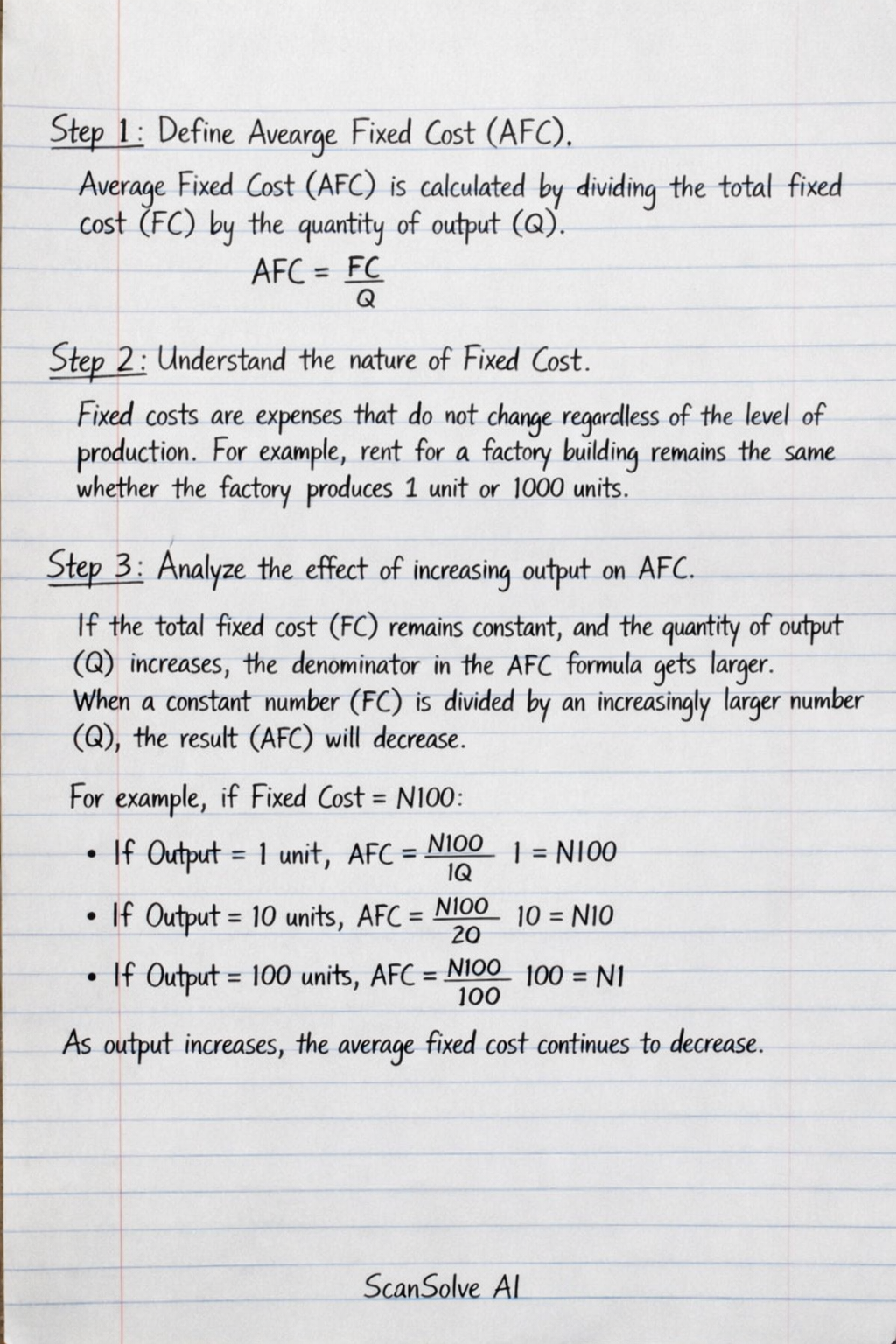
Handwritten Step-by-Step Solution
Get this as a handwritten image on WhatsApp — like a tutor wrote it for you.
Try on WhatsApp