

This economics question tests your understanding of economic models and analysis. The step-by-step answer below applies the relevant framework and explains the reasoning.
ScanSolve AI Answer
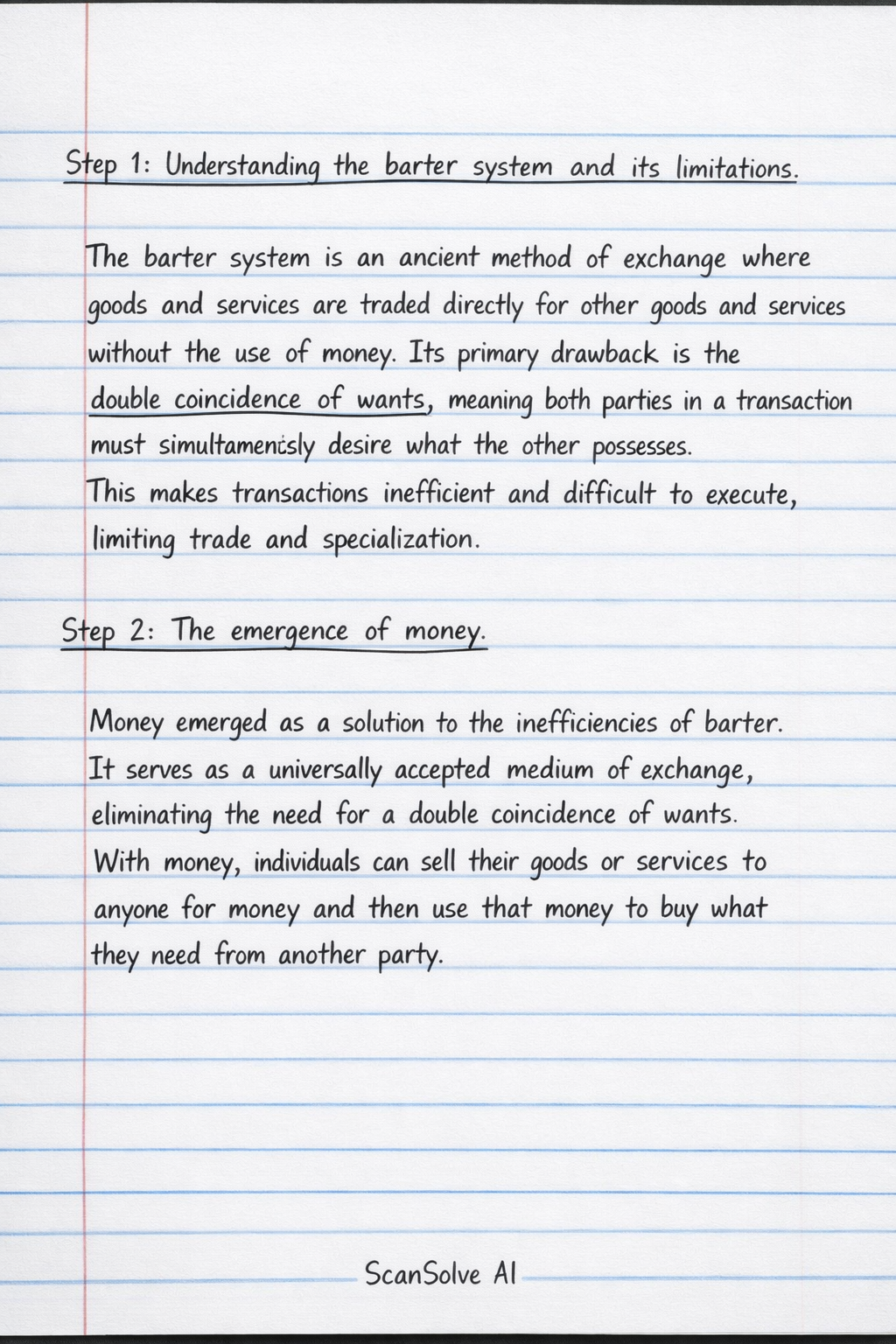
Step 1: Understanding the barter system and its limitations. The barter system is an ancient method of exchange where goods and services are traded directly for other goods and services without the use of money. Its primary drawback is the double coincidence of wants, meaning both parties in a transaction must simultaneously desire what the other possesses. This makes transactions inefficient and difficult to execute, limiting trade and specialization. Step 2: The emergence of money. Money emerged as a solution to the inefficiencies of barter. It serves as a universally accepted medium of exchange, eliminating the need for a double coincidence of wants. With money, individuals can sell their goods or services to anyone for money and then use that money to buy what they need from another party. Step 3: How money led to the "death" of barter. Beyond being a medium of exchange, money also functions as a unit of account, providing a common measure of value for all goods and services, and a store of value, allowing wealth to be saved and used in the future. These functions made transactions significantly more efficient, facilitated specialization, and expanded trade, rendering the cumbersome barter system largely obsolete. The birth of money thus provided a superior, more flexible, and efficient system for economic transactions, leading to the decline and eventual "death" of the barter system in most economies. That's 2 down. 3 left today — send the next one.