
We read your photo as:
Explain capitalism and socialism, stating four characteristics of each.
ScanSolve AI Answer
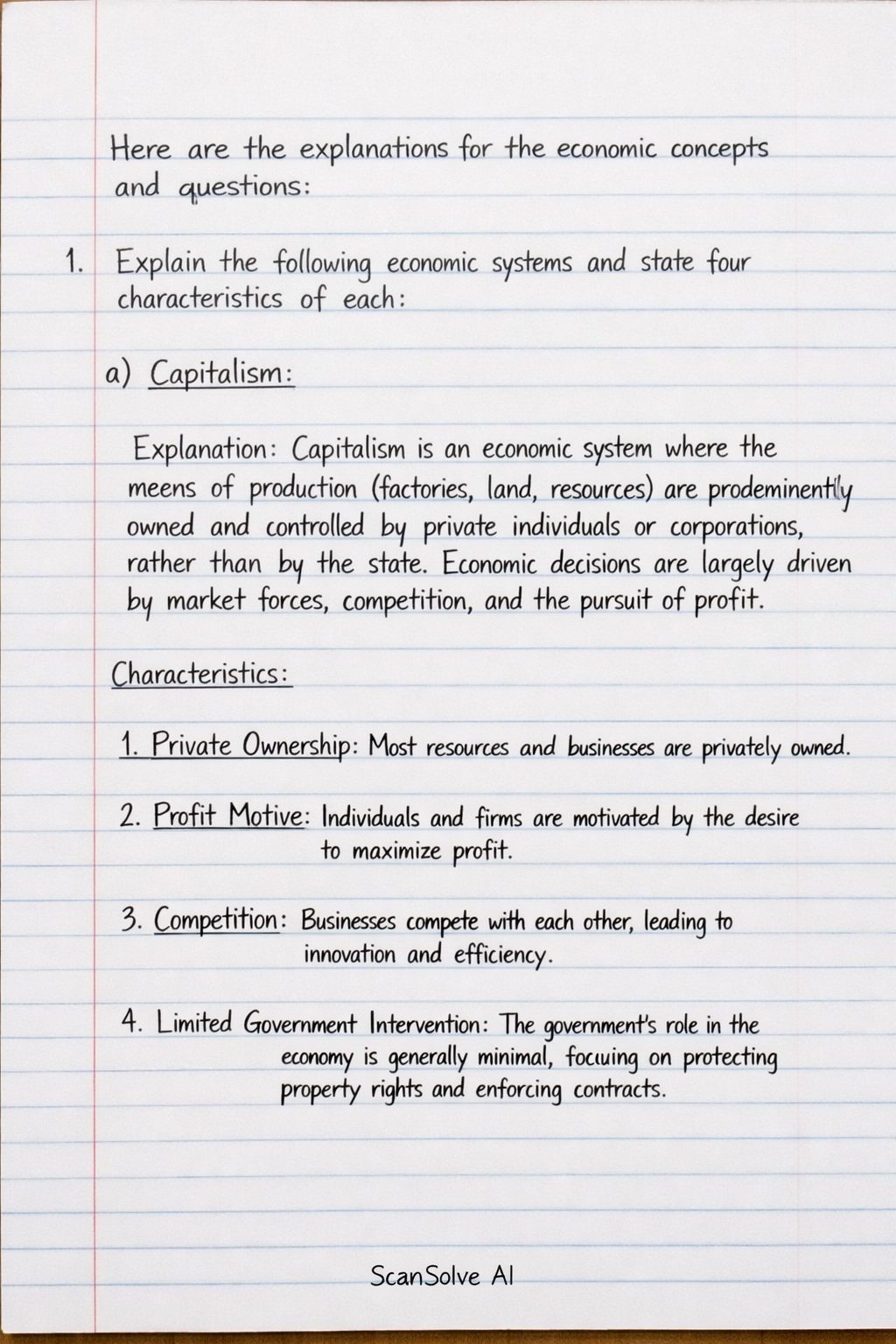
Here are the explanations for the economic concepts and questions:
1. Explain the following economic systems and state four characteristics of each:
-
a) Capitalism
- Explanation: Capitalism is an economic system where the means of production (factories, land, resources) are predominantly owned and controlled by private individuals or corporations, rather than by the state. Economic decisions are largely driven by market forces, competition, and the pursuit of profit.
- Characteristics:
- Private Ownership: Most resources and businesses are privately owned.
- Profit Motive: Individuals and firms are motivated by the desire to maximize profit.
- Competition: Businesses compete with each other, leading to innovation and efficiency.
- Limited Government Intervention: The government's role in the economy is generally minimal, focusing on protecting property rights and enforcing contracts.
-
b) Socialism
- Explanation: Socialism is an economic system where the means of production are largely owned and controlled by the state or the community as a whole. The primary goal is to achieve social equality and collective welfare, with economic decisions often made through central planning.
- Characteristics:
- Public Ownership: Key industries and resources are owned and controlled by the government or public entities.
- Central Planning: Economic decisions regarding production and distribution are often made by a central authority.
- Social Welfare: Emphasis is placed on providing social services and reducing income inequality.
- Cooperation: Promotes collective goals and cooperation over individual competition.
-
c) The Mixed Economy
- Explanation: A mixed economy combines elements of both capitalism and socialism. It features both private and public ownership of resources, with market mechanisms operating alongside significant government intervention and regulation to achieve social and economic goals.
- Characteristics:
- Dual Ownership: Both private and public sectors play significant roles in the economy.
- Market and Planning: Economic decisions are influenced by both market forces and government planning/regulation.
- Social Safety Nets: The government provides social services and welfare programs to protect citizens.
- Regulation: The government regulates private businesses to correct market failures, ensure fair competition, and protect consumers/workers.
2. What is meant by localization of industry? What are its economic and social effects?
-
Localization of Industry: This refers to the tendency for industries or specific types of businesses to concentrate in particular geographical areas. This concentration often occurs due to factors like access to raw materials, skilled labor, markets, specialized infrastructure, or historical advantages.
-
Economic Effects:
- Advantages:
- External Economies of Scale: Industries benefit from shared infrastructure (e.g., transport, power), a specialized labor pool, and the presence of ancillary industries, leading to lower production costs and increased efficiency.
- Innovation and Specialization: The concentration fosters knowledge sharing, innovation, and the development of highly specialized skills and technologies.
- Job Creation: Creates numerous employment opportunities within the localized region.
- Disadvantages:
- Over-reliance: The region becomes highly dependent on a single industry, making it vulnerable to economic downturns in that sector.
- Increased Competition for Resources: Can lead to higher costs for land, labor, and other inputs within the concentrated area.
- Environmental Strain: High industrial concentration can lead to increased pollution and congestion.
- Advantages:
-
Social Effects:
- Advantages:
- Community Development: The growth of industry often leads to the development of social amenities like schools, hospitals, and housing.
- Cultural Identity: The industry can become a central part of the region's identity and culture.
- Disadvantages:
- Social Inequality: Benefits of industrial growth may not be evenly distributed, leading to disparities in wealth and living standards.
- Housing Shortages and High Cost of Living: Influx of workers can drive up housing costs and strain social services.
- Brain Drain (if industry declines): If the industry faces decline, skilled workers may migrate, leading to social and economic decay in the area.
- Advantages:
3. Explain the role of the government in determining wages in your country.
The government plays a significant role in determining wages through various mechanisms, especially in mixed economies.
- Minimum Wage Legislation: The government sets a legal minimum wage that employers must pay their workers. This acts as a floor for wages, particularly for low-skilled labor, aiming to ensure a basic standard of living and reduce poverty.
- Public Sector Employer: As a major employer (e.g., civil servants, teachers, healthcare workers), the government directly sets the wages and salaries for its employees. These public sector wage policies can influence wage expectations and levels in the private sector.
- Labor Laws and Regulations: Governments enact laws concerning working conditions, collective bargaining rights, and dispute resolution mechanisms. These regulations empower trade unions and workers to negotiate for better wages and terms, indirectly influencing wage levels.
- Incomes Policy: In certain economic situations (e.g., high inflation), governments may implement incomes policies, such as wage freezes or guidelines, to control wage growth and stabilize the economy.
- Taxation and Subsidies: Government tax policies (e.g., income tax rates) affect the net wages received by workers. Subsidies to certain industries or training programs can also indirectly influence wage levels by affecting labor demand or supply.
4. What are the consequences of rural-urban migration in West African countries?
Rural-urban migration, the movement of people from rural areas to cities, has profound consequences for both the sending rural areas and the receiving urban centers in West African countries.
-
Consequences for Urban Areas (Receiving Areas):
- Overpopulation and Strain on Infrastructure: Rapid influx of migrants leads to overcrowded cities, inadequate housing (proliferation of slums), and severe pressure on existing infrastructure such as water supply, sanitation, electricity, transport, and healthcare facilities.
- Unemployment and Underemployment: Many migrants lack the skills required for formal urban jobs, leading to high rates of unemployment or underemployment in the informal sector, which often offers low wages and poor working conditions.
- Increased Crime and Social Problems: Poverty, lack of opportunities, and social dislocation can contribute to increased crime rates, social unrest, and the breakdown of traditional social structures.
- Environmental Degradation: Increased population density and industrial activity lead to higher levels of pollution (air, water, noise) and waste generation, straining urban environmental management.
-
Consequences for Rural Areas (Sending Areas):
- Labor Shortages: The departure of young, able-bodied individuals, particularly men, leads to a shortage of labor in agriculture and other rural economic activities, potentially reducing agricultural output and productivity.
- Aging Population and Dependency Ratio: Rural areas are left with a higher proportion of elderly people and children, increasing the dependency ratio and placing a burden on the remaining productive population.
- Remittances: Migrants often send money back to their families in rural areas. These remittances can significantly improve the living standards of recipient households, fund education, healthcare, and small businesses, and stimulate local economies.
- Decline in Social Services: With a shrinking and aging population, demand for and provision of social services like schools and health clinics may decline, further exacerbating rural disadvantage.
- Loss of Traditional Knowledge and Skills: The migration of younger generations can lead to the loss of traditional farming methods, cultural practices, and indigenous knowledge.
Still stuck on this one?
Ask a follow-up, and the answer starts from this question.
More Economics Questions
Handwritten Step-by-Step Solution
Get this as a handwritten image on WhatsApp — like a tutor wrote it for you.
Try on WhatsApp