
We read your photo as:
Explain the characteristics of a perfect market and analyze a firm's profit maximization and shutdown point using the provided graph.
ScanSolve AI Answer
Answer
Step-by-step solution
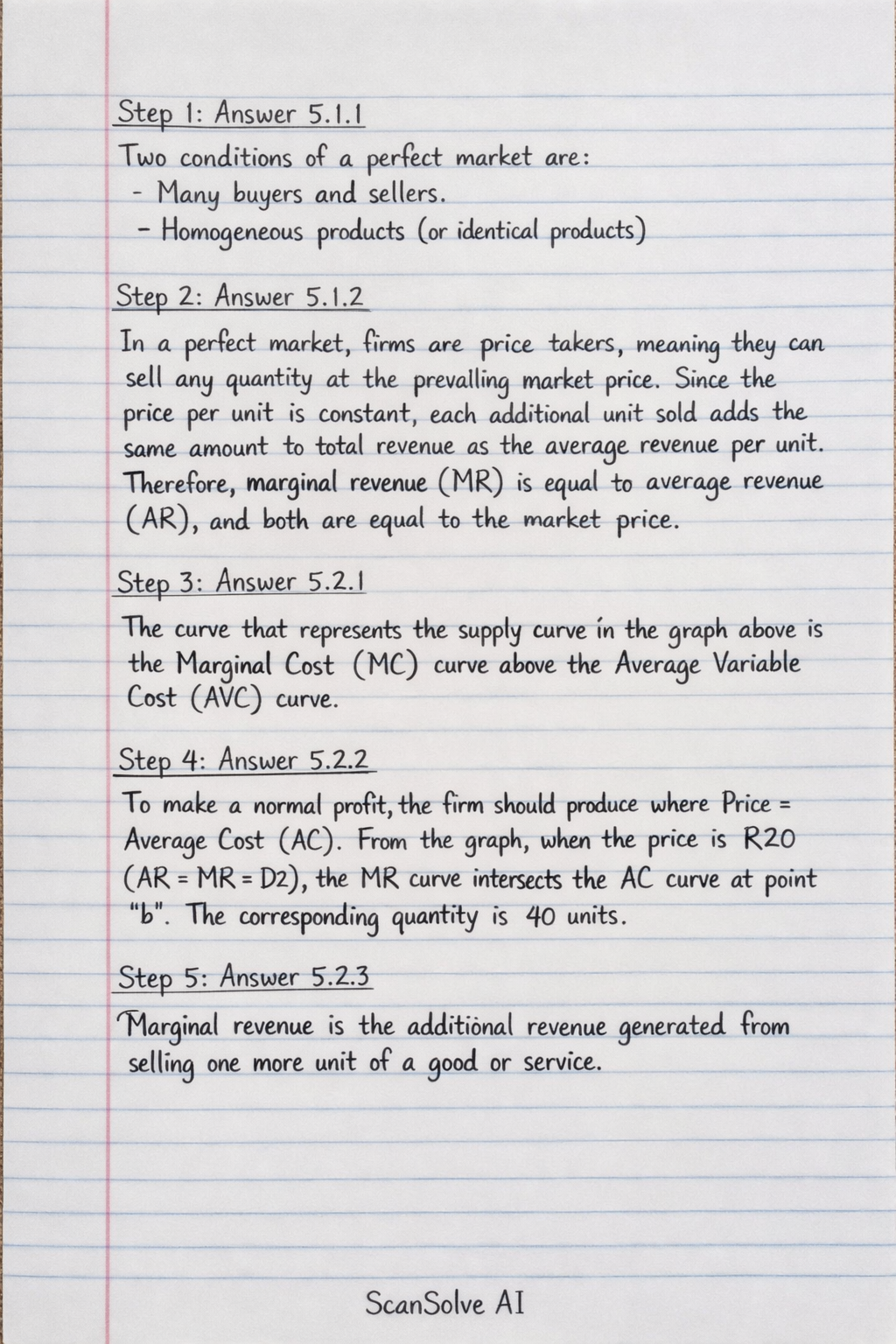
7 stepsAnswer 5.1.1
Two conditions of a perfect market are:
- Many buyers and sellers
- Homogeneous products (or identical products)
Answer 5.1.2
In a perfect market, firms are price takers, meaning they can sell any quantity at the prevailing market price. Since the price per unit is constant, each additional unit sold adds the same amount to total revenue as the average revenue per unit. Therefore, marginal revenue (MR) is equal to average revenue (AR), and both are equal to the market price.
Answer 5.2.1
The curve that represents the supply curve in the graph above is the Marginal Cost (MC) curve above the Average Variable Cost (AVC) curve.
Answer 5.2.2
To make a normal profit, the firm should produce where Price = Average Cost (AC). From the graph, when the price is R20 (AR=MR=D2), the MR curve intersects the AC curve at point 'b'. The corresponding quantity is 40 units.
Answer 5.2.3
Marginal revenue is the additional revenue generated from selling one more unit of a good or service.
Answer 5.2.4
The producer would be unwilling to produce 30 units or less because at 30 units, the price (R15) is equal to the Average Variable Cost (AVC) at point 'a'. This is the shutdown point, where the firm only covers its variable costs. Producing less than 30 units would mean the price is below AVC, resulting in losses greater than its fixed costs, making it more rational to shut down production.
Answer 5.2.5
To calculate the total revenue when the price is R25:
From the graph, when the price is R25 (AR=MR=D3), the profit-maximizing quantity (where MC = MR) is 50 units (point 'c').The formula for Total Revenue (TR) is:
Where:
Substitute the values into the formula:
The total revenue when the price is R25 is .
Try one yourself
A new problem that tests the same skill.
Still stuck on this one?
Ask a follow-up, and the answer starts from this question.
More Economics Questions
Handwritten Step-by-Step Solution
Get this as a handwritten image on WhatsApp — like a tutor wrote it for you.
Try on WhatsApp