
We read your photo as:
Choose a description from the column B that matches the item in column A. Write only the letter to the question number (1.2.1- 1.2.8.) in the answer book.
ScanSolve AI Answer
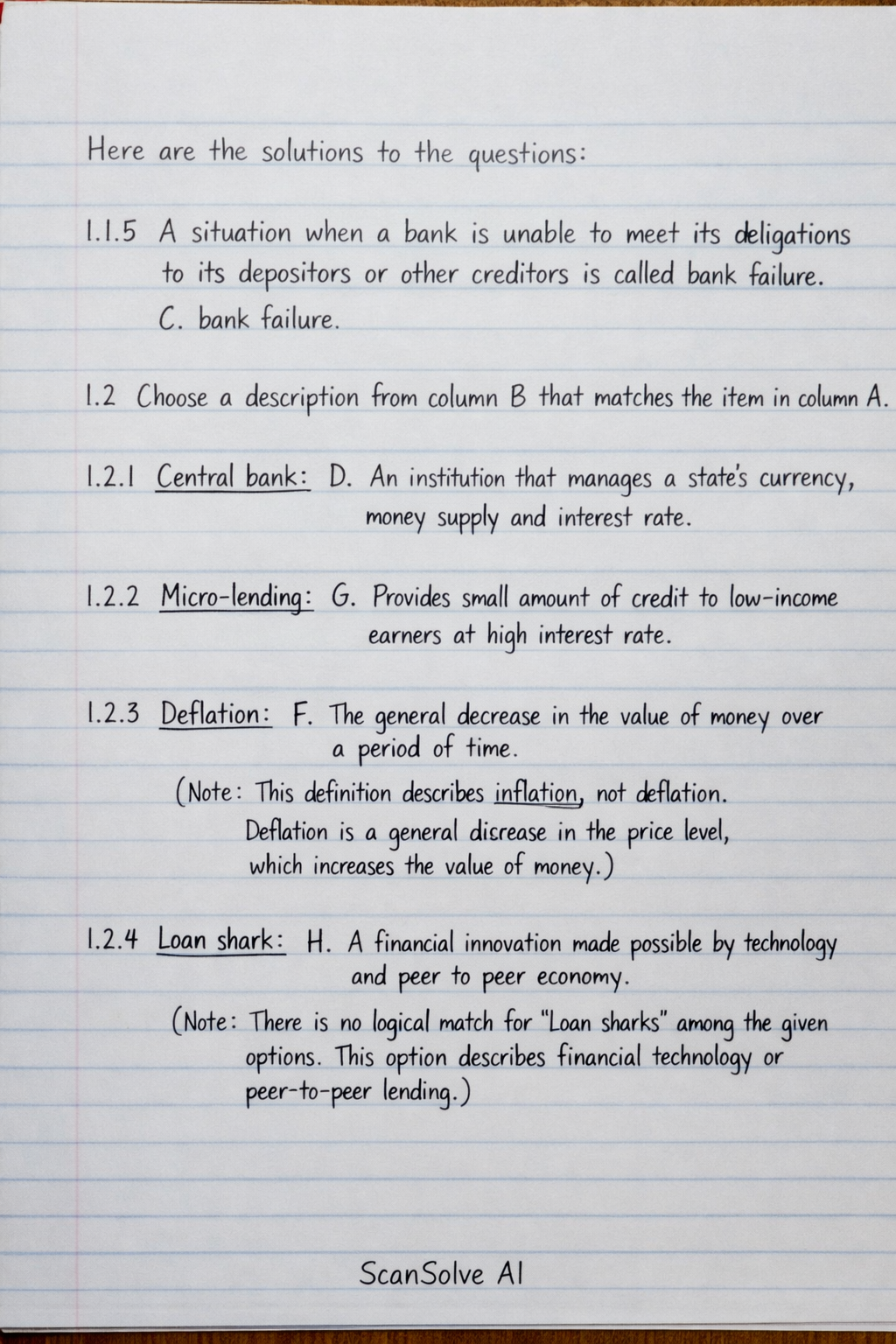
Here are the solutions to the questions:
1.1.5 A situation when a bank is unable to meet its obligations to its depositors or other creditors is called bank failure.
- C. bank failure
1.2 Choose a description from column B that matches the item in column A.
- 1.2.1 Central bank: D. An institution that manages a state currency, money supply and interest rate.
- 1.2.2 Micro-lending: G. Provides small amount of credit to low-income earners at high interest rate.
- 1.2.3 Deflation: F. The general decrease in the value of money over a period of time. (Note: This definition describes inflation, not deflation. Deflation is a general decrease in the price level, which increases the value of money.)
- 1.2.4 Loan sharks: H. A financial innovation made possible by technology and peer to peer economy. (Note: There is no logical match for "Loan sharks" among the given options. This option describes financial technology or peer-to-peer lending.)
- 1.2.5 Moral persuasion: A. Used by the SARB to convince banks to act in a way that is desirable in the current economic conditions.
- 1.2.6 Prime rate: C. The rate at which the commercial banks charge creditworthy customers.
- 1.2.7 Money: E. Generally accepted by law as a means of payments.
- 1.2.8 Monetary policy: B. The central banks use of changes in the quantity of money or the interest rates to stabilize the economy.
4.1.1 The central bank in South Africa is the South African Reserve Bank.
4.1.2 Two instruments used in monetary policy are the repo rate and open market operations.
4.1.3 The repo rate is the interest rate at which the South African Reserve Bank lends money to other commercial banks.
4.1.4 As the government's banker, the central bank manages the government's accounts, handles its receipts and payments, and advises the government on financial matters.
4.1.5 A cut in interest rates makes borrowing cheaper for consumers. This encourages them to take out more loans for purchases like houses or cars, leading to an increase in consumer spending.
Still stuck on this one?
Ask a follow-up, and the answer starts from this question.
More Economics Questions
Handwritten Step-by-Step Solution
Get this as a handwritten image on WhatsApp — like a tutor wrote it for you.
Try on WhatsApp