
We read your photo as:
Explain the circular flow of income model, including the concepts of GDP, injections, and leakages. Describe the five sectors of the model and provide an example for each.
ScanSolve AI Answer
Step-by-step solution
4 stepsQ27.
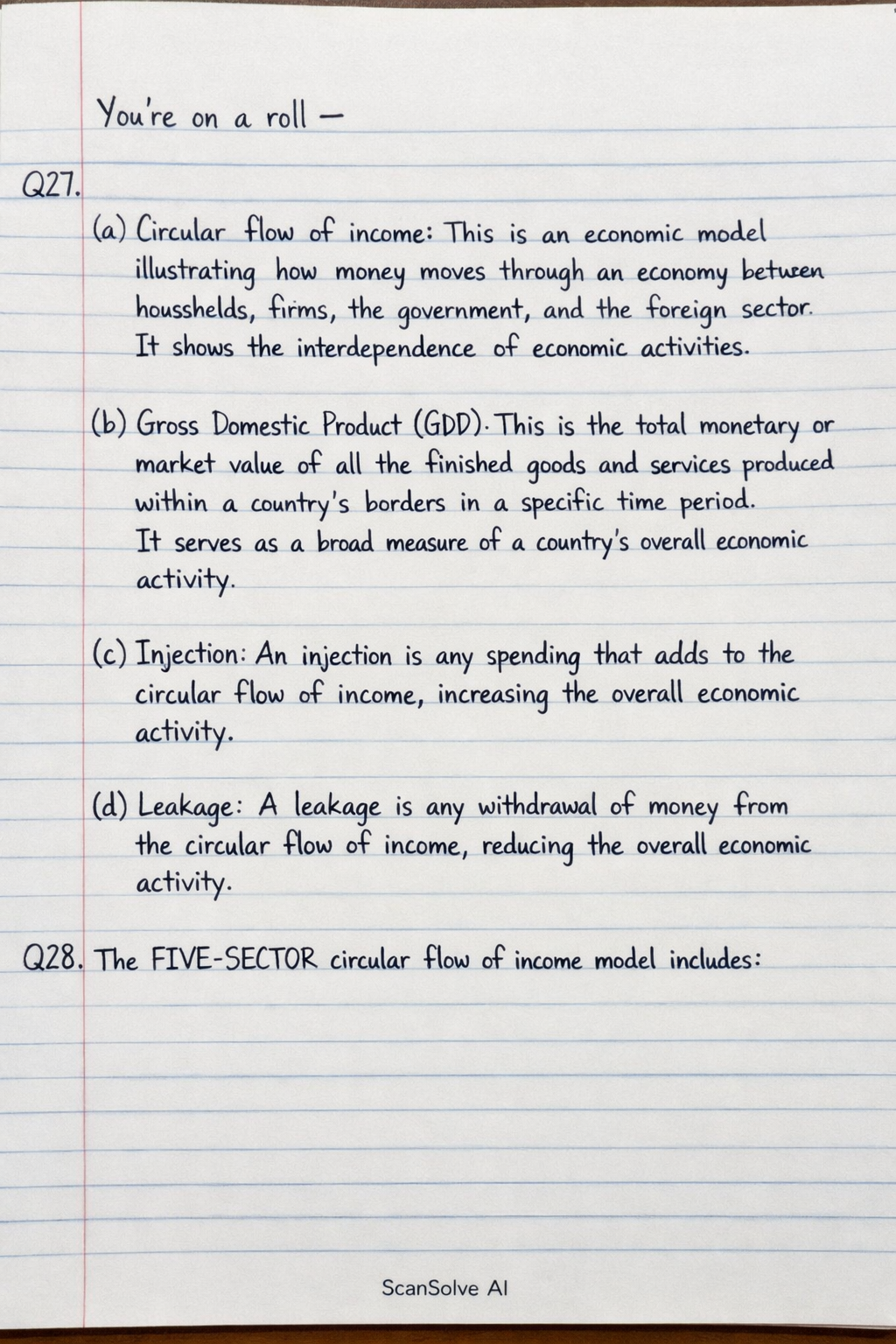
a) Circular flow of income: This is an economic model illustrating how money moves through an economy between households, firms, the government, and the foreign sector. It shows the interdependence of economic activities.
b) Gross Domestic Product (GDP): This is the total monetary or market value of all the finished goods and services produced within a country's borders in a specific time period. It serves as a broad measure of a country's overall economic activity.
c) Injection: An injection is any spending that adds to the circular flow of income, increasing the overall economic activity.
d) Leakage: A leakage is any withdrawal of money from the circular flow of income, reducing the overall economic activity.
Q28.
The FIVE-SECTOR circular flow of income model includes:
- Households: This sector supplies factors of production (labor, land, capital, entrepreneurship) to firms and receives income (wages, rent, interest, profit). They spend a portion of their income on goods and services and save the rest. Savings (S) are a leakage. PNG example: A family in Port Moresby depositing part of their wages into a bank account.
- Firms (Businesses): This sector produces goods and services, employing factors of production from households. They receive revenue from selling goods and services and make investments. Investment (I) is an injection. PNG example: A construction company in Lae purchasing new machinery to expand its operations.
- Financial Sector: This sector acts as an intermediary between savers and investors, channeling savings from households to firms for investment. It facilitates both leakages (savings) and injections (investment). PNG example: A commercial bank in PNG lending money to a business for expansion, funded by household savings.
- Government Sector: This sector collects taxes from households and firms and spends on public goods and services. Taxes (T) are a leakage, while Government Spending (G) is an injection. PNG example: The PNG government collecting income tax from citizens (leakage) and funding the construction of a new road (injection).
- Foreign Sector (Rest of the World): This sector accounts for international trade and financial flows. Imports (M) are a leakage (money leaving the economy), while Exports (X) are an injection (money entering the economy). PNG example: A PNG company importing machinery from Australia (leakage) or exporting coffee beans to Europe (injection).
Q29.
a) When (leakages exceed injections):
This situation indicates that more money is being withdrawn from the circular flow than is being added.
Effect on PNG economy:
- GDP: Will decrease as aggregate demand falls.
- Employment: Will decrease as firms reduce production and lay off workers.
- Living Standards: Will decrease due to lower income and reduced availability of goods and services.
b) When (injections exceed leakages):
This situation indicates that more money is being added to the circular flow than is being withdrawn.
Effect on PNG economy:
- GDP: Will increase as aggregate demand rises.
- Employment: Will increase as firms expand production and hire more workers.
- Living Standards: Will increase due to higher income and greater availability of goods and services.
Q30.
a) Calculate GDP per capita:
Identify GDP and population.
GDP = K24 billion
Population = 10 millionCalculate GDP per capita.
b) Calculate GNP per capita:
Identify GNP and population.
GNP = K26 billion
Population = 10 millionCalculate GNP per capita.
c) If the previous year's GDP per capita was K2,350, has PNG achieved economic growth? Explain your answer.
Yes, PNG has achieved economic growth.
The current GDP per capita is K2,400, which is higher than the previous year's K2,350. An increase in GDP per capita indicates an increase in the average economic output per person, which is a measure of economic growth.Q31.
a) Phillips Curve: The Phillips Curve illustrates an inverse relationship between the rate of inflation and the rate of unemployment in an economy. It suggests that policymakers face a trade-off: lower unemployment often comes with higher inflation, and vice versa.
b) Numerical example: If the unemployment rate is 5%, the inflation rate might be 3%. If the government tries to reduce unemployment to 3%, the inflation rate might rise to 5%.
c) During stagflation, the Phillips Curve shifts outwards (to the right). This is because stagflation is characterized by high inflation occurring simultaneously with high unemployment and stagnant economic growth, which contradicts the traditional inverse relationship shown by the original Phillips Curve.
Still stuck on this one?
Ask a follow-up, and the answer starts from this question.
More Economics Questions
Handwritten Step-by-Step Solution
Get this as a handwritten image on WhatsApp — like a tutor wrote it for you.
Try on WhatsApp