
We read your photo as:
Define circular flow of income terms (circular flow, GDP, injection, leakage) and explain the five-sector model with PNG examples.
ScanSolve AI Answer
Step-by-step solution
6 stepsHere are the answers to your questions:
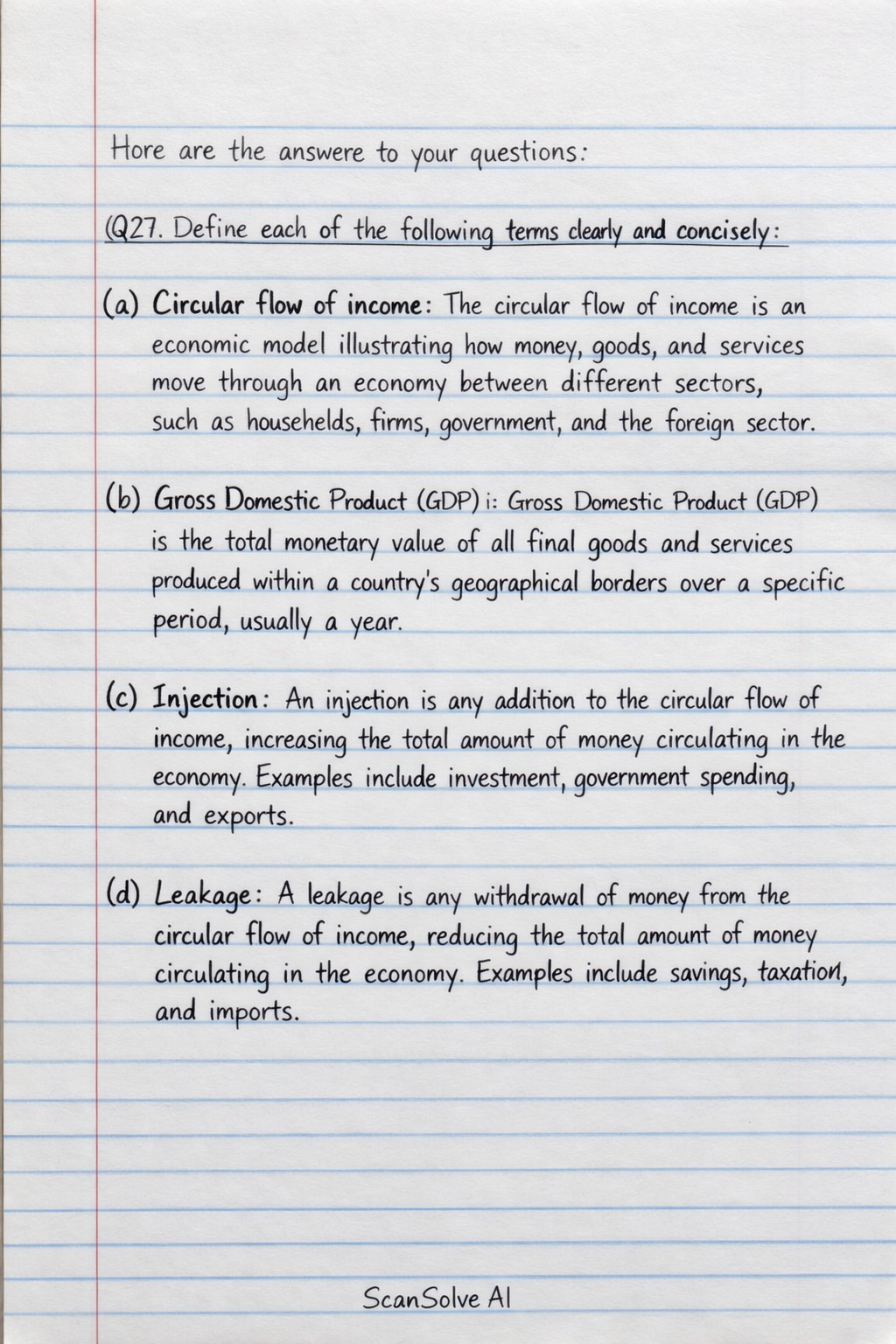
Q27. Define each of the following terms clearly and concisely:
- (a) Circular flow of income: This is an economic model illustrating how money, goods, and services move through an economy between different sectors, such as households, firms, government, and the foreign sector.
- (b) Gross Domestic Product (GDP): This is the total monetary value of all final goods and services produced within a country's geographical borders over a specific period, usually a year.
- (c) Injection: An injection is any addition to the circular flow of income, increasing the total amount of money circulating in the economy. Examples include investment, government spending, and exports.
- (d) Leakage: A leakage is any withdrawal of money from the circular flow of income, reducing the total amount of money circulating in the economy. Examples include savings, taxation, and imports.
Q28. Explain the FIVE-SECTOR circular flow of income model. For each sector, identify whether it creates an injection, a leakage, or both, and give a specific PNG example for each sector.
The five-sector circular flow of income model includes:
- Households: Provide factors of production (labor, land, capital) to firms and receive income. They create a leakage through savings (e.g., depositing money in a PNG bank) and taxation (e.g., paying income tax to the PNG government).
- Firms: Produce goods and services and pay for factors of production. They create an injection through investment (e.g., a PNG mining company buying new machinery).
- Financial Sector: Facilitates the flow of funds between savers and borrowers. It channels leakages (savings from households) into injections (investment for firms). Example: Bank South Pacific (BSP) lending money to a business.
- Government Sector: Collects taxes and provides public goods and services. It creates a leakage through taxation (e.g., GST collected by IRC) and an injection through government spending (e.g., PNG government funding infrastructure projects).
- Foreign Sector: Represents international trade and financial flows. It creates a leakage through imports (e.g., PNG importing goods from Australia) and an injection through exports (e.g., PNG exporting coffee to overseas markets).
Q29. Using the four-sector circular flow of income model, explain what happens to the PNG economy in each of the following situations. Identify the effect on GDP, employment, and living standards in each case:
-
(a) When S + T > I + G (leakages exceed injections): When leakages (savings and taxation) are greater than injections (investment and government spending), there is a net withdrawal of money from the circular flow. This leads to a decrease in aggregate demand. Consequently, firms reduce production, leading to a fall in GDP, an increase in unemployment, and a decline in living standards in PNG.
-
(b) When I + G > S + T (injections exceed leakages): When injections (investment and government spending) are greater than leakages (savings and taxation), there is a net addition of money into the circular flow. This leads to an increase in aggregate demand. Consequently, firms increase production, leading to a rise in GDP, a decrease in unemployment, and an improvement in living standards in PNG.
Q30. Papua New Guinea's GDP is K24 billion and GNP is K26 billion. The population of PNG is 10 million.
- (a) Calculate GDP per capita:
Use the formula for GDP per capita.
$$ \text{GDP per capita} = \frac{\text{GDP}}{\text{Population}} $$Substitute the given values.
$$ \text{GDP per capita} = \frac{\text{K24,000,000,000}}{\text{10,000,000}} $$Calculate the result.
$$ \text{GDP per capita} = \text{K2,400} $$ * **Answer: K2,400**- (b) Calculate GNP per capita:
Use the formula for GNP per capita.
$$ \text{GNP per capita} = \frac{\text{GNP}}{\text{Population}} $$Substitute the given values.
$$ \text{GNP per capita} = \frac{\text{K26,000,000,000}}{\text{10,000,000}} $$Calculate the result.
$$ \text{GNP per capita} = \text{K2,600} $$ * **Answer: K2,600**- (c) If the previous year's GDP per capita was K2,350, has PNG achieved economic growth? Explain your answer.
- Yes, PNG has achieved economic growth.
- Explanation: Economic growth is typically measured by an increase in real GDP per capita. Since the current GDP per capita (K2,400) is higher than the previous year's GDP per capita (K2,350), it indicates that the average economic output per person has increased, signifying economic growth.
Q31. Explain Philip's Curve. In your answer: (a) describe the relationship it shows, (b) give a numerical example using inflation and unemployment rates, and (c) explain what happens to the Philip's Curve during stagflation.
- (a) Relationship: The Phillips Curve illustrates an inverse relationship between the rate of inflation and the rate of unemployment in an economy. It suggests that policymakers face a trade-off: to reduce unemployment, they might have to accept higher inflation, and vice versa.
- (b) Numerical example: If the unemployment rate is 6%, the inflation rate might be 3%. If the government implements policies to reduce unemployment to 4%, the inflation rate might then rise to 5%.
- (c) Stagflation: During stagflation, an economy experiences both high inflation and high unemployment simultaneously. This phenomenon causes the short-run Phillips Curve to shift to the right (or upwards), indicating that a higher inflation rate is now associated with any given unemployment rate, or a higher unemployment rate is associated with any given inflation rate.
- (c) If the previous year's GDP per capita was K2,350, has PNG achieved economic growth? Explain your answer.
Still stuck on this one?
Ask a follow-up, and the answer starts from this question.
More Economics Questions
Handwritten Step-by-Step Solution
Get this as a handwritten image on WhatsApp — like a tutor wrote it for you.
Try on WhatsApp