
Describe the components of total final expenditure
ScanSolve AI Answer
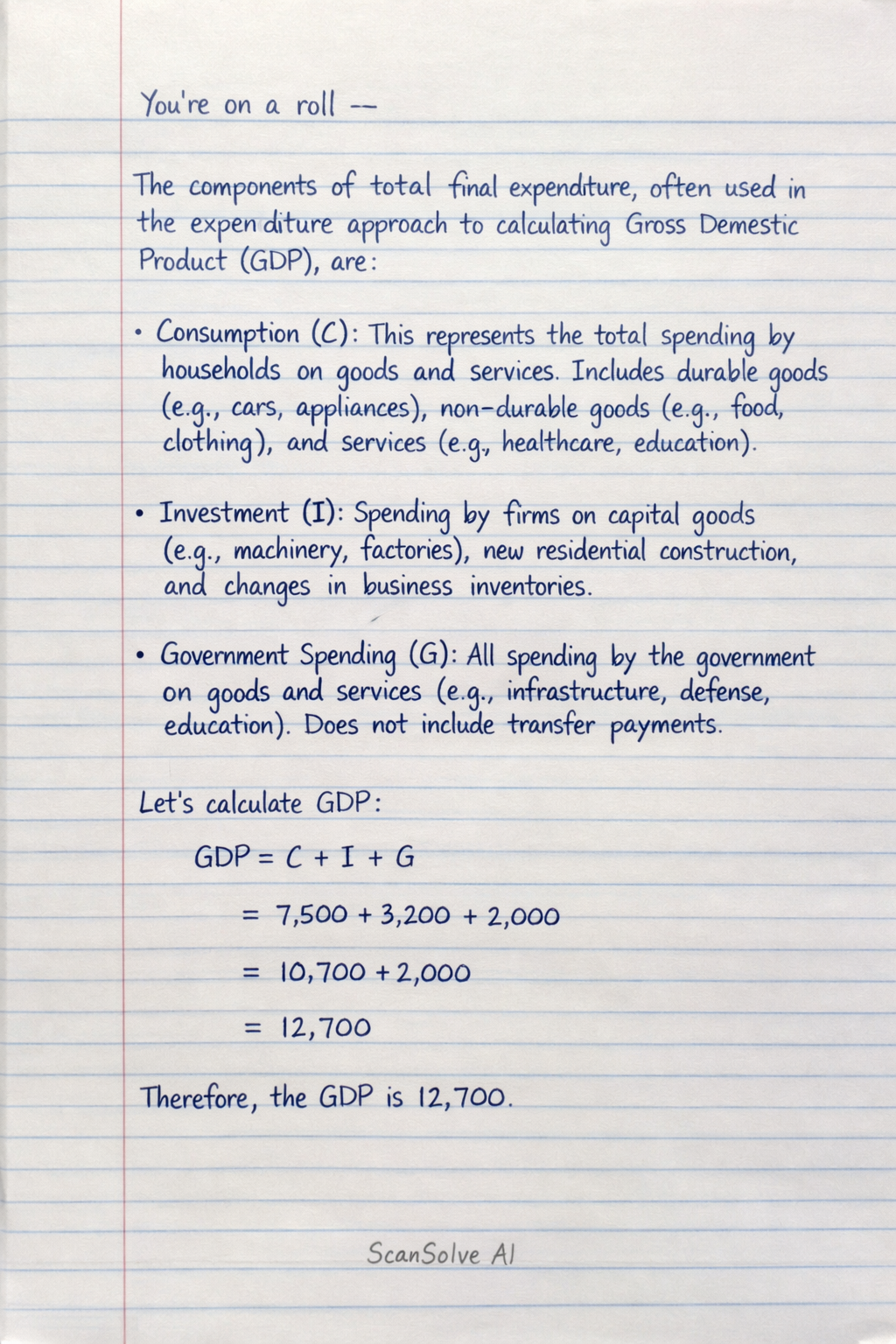
The components of total final expenditure, often used in the expenditure approach to calculating Gross Domestic Product (GDP), are:
-
Consumption (C): This represents the total spending by households on goods and services. It includes durable goods (e.g., cars, appliances), non-durable goods (e.g., food, clothing), and services (e.g., healthcare, education).
-
Investment (I): This refers to spending by firms on capital goods (e.g., machinery, factories), new residential construction by households, and changes in business inventories. It represents spending that adds to the economy's future productive capacity.
-
Government Spending (G): This includes all spending by the government on goods and services, such as infrastructure projects, defense, education, and salaries of public sector employees. It does not include transfer payments (like unemployment benefits) as these do not represent spending on newly produced goods or services.
-
Net Exports (X - M): This is the difference between the value of a country's exports (X) and its imports (M). Exports are goods and services produced domestically and sold to foreigners, while imports are goods and services produced abroad and purchased by domestic residents.
The formula for total final expenditure (GDP) is:
Still stuck on this one?
Ask a follow-up, and the answer starts from this question.
More Economics Questions
Handwritten Step-by-Step Solution
Get this as a handwritten image on WhatsApp — like a tutor wrote it for you.
Try on WhatsApp