
We read your photo as:
Explain the concept of minimum prices (price floors) in economics, including their definition, typical application, purpose, and market effects.
ScanSolve AI Answer
Step-by-step solution
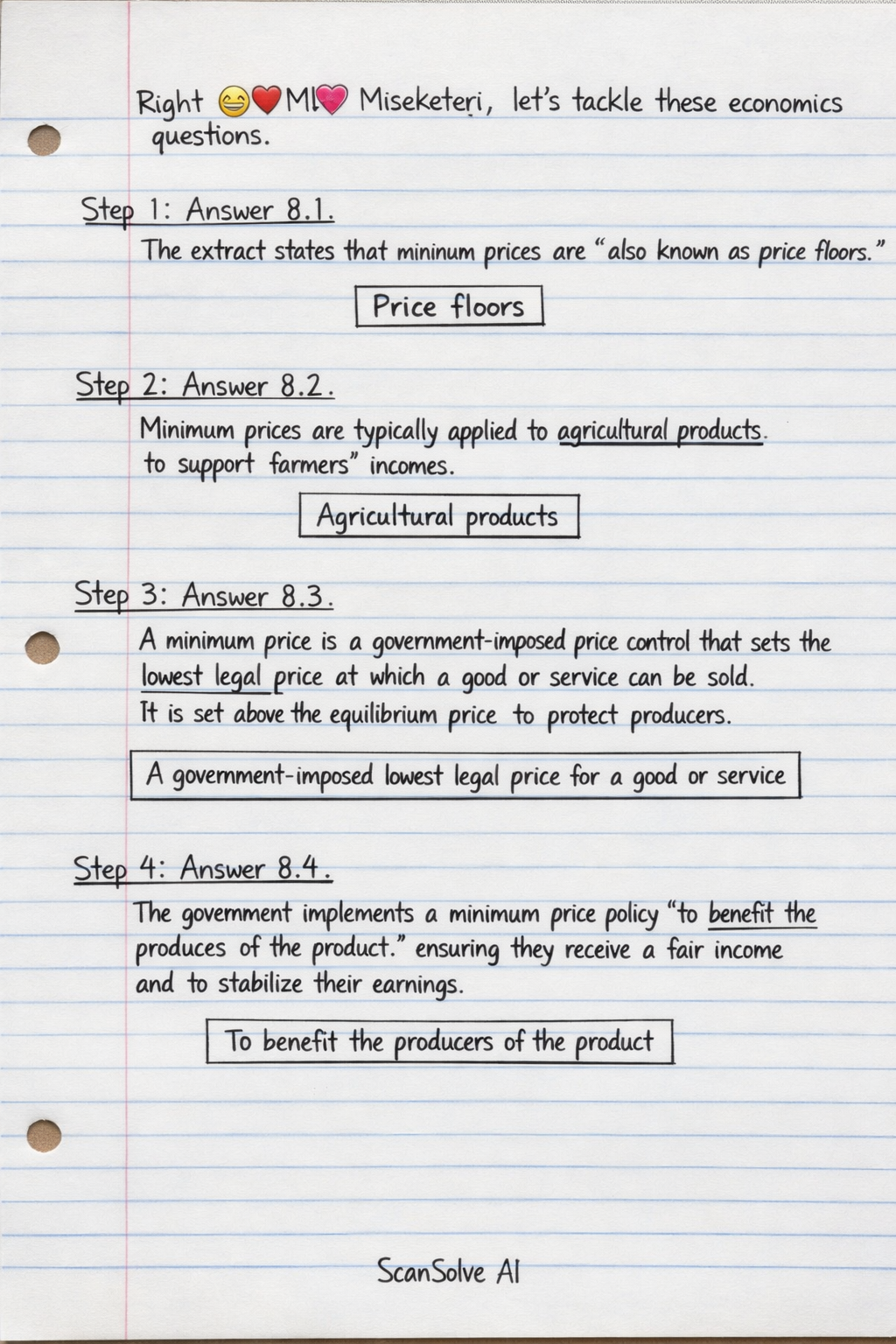
10 stepsRight 🥹❤️🔥M💞🥹Miseketeri, let's tackle these economics questions.
Answer 8.1
The extract states that minimum prices are "also known as price floors".
Answer 8.2
Minimum prices are typically applied to agricultural products to support farmers' incomes.
Answer 8.3
A minimum price is a government-imposed price control that sets the lowest legal price at which a good or service can be sold. It is set above the equilibrium price to protect producers.
Answer 8.4
The government implements a minimum price policy "to benefit the producers of the product", ensuring they receive a fair income and to stabilize their earnings.
Answer 8.5
A minimum price, set above the equilibrium price, affects the market as follows:
- Demand: At the higher minimum price, the quantity demanded decreases as consumers are less willing to buy at a higher cost.
- Supply: At the higher minimum price, the quantity supplied increases as producers are encouraged to supply more due to the higher guaranteed price. This typically leads to a surplus of the product in the market.
Answer 12.1
In economics, the supply curve represents the sellers. The curve labeled 'S' represents the sellers.
Answer 12.2
The alternative term for maximum price is a price ceiling.
Answer 12.3
A maximum price is a government-imposed price control that sets the highest legal price at which a good or service can be sold. It is set below the equilibrium price to make essential goods more affordable for consumers.
Answer 12.4
The maximum price (P1) is set below the equilibrium price (P). According to the law of demand, when the price of a good decreases, the quantity demanded increases. Consumers are willing and able to buy more at the lower price.
Answer 12.5
The effect of a maximum price on supply is that at the lower price (P1), which is below the equilibrium, producers are less willing to supply the product. This is because the lower price reduces their profitability, leading to a decrease in the quantity supplied (from Q to Q1).
Still stuck on this one?
Ask a follow-up, and the answer starts from this question.
More Economics Questions
Handwritten Step-by-Step Solution
Get this as a handwritten image on WhatsApp — like a tutor wrote it for you.
Try on WhatsApp