
We read your photo as:
Explain the concepts of elasticity and market equilibrium, and describe their importance to producers.
ScanSolve AI Answer
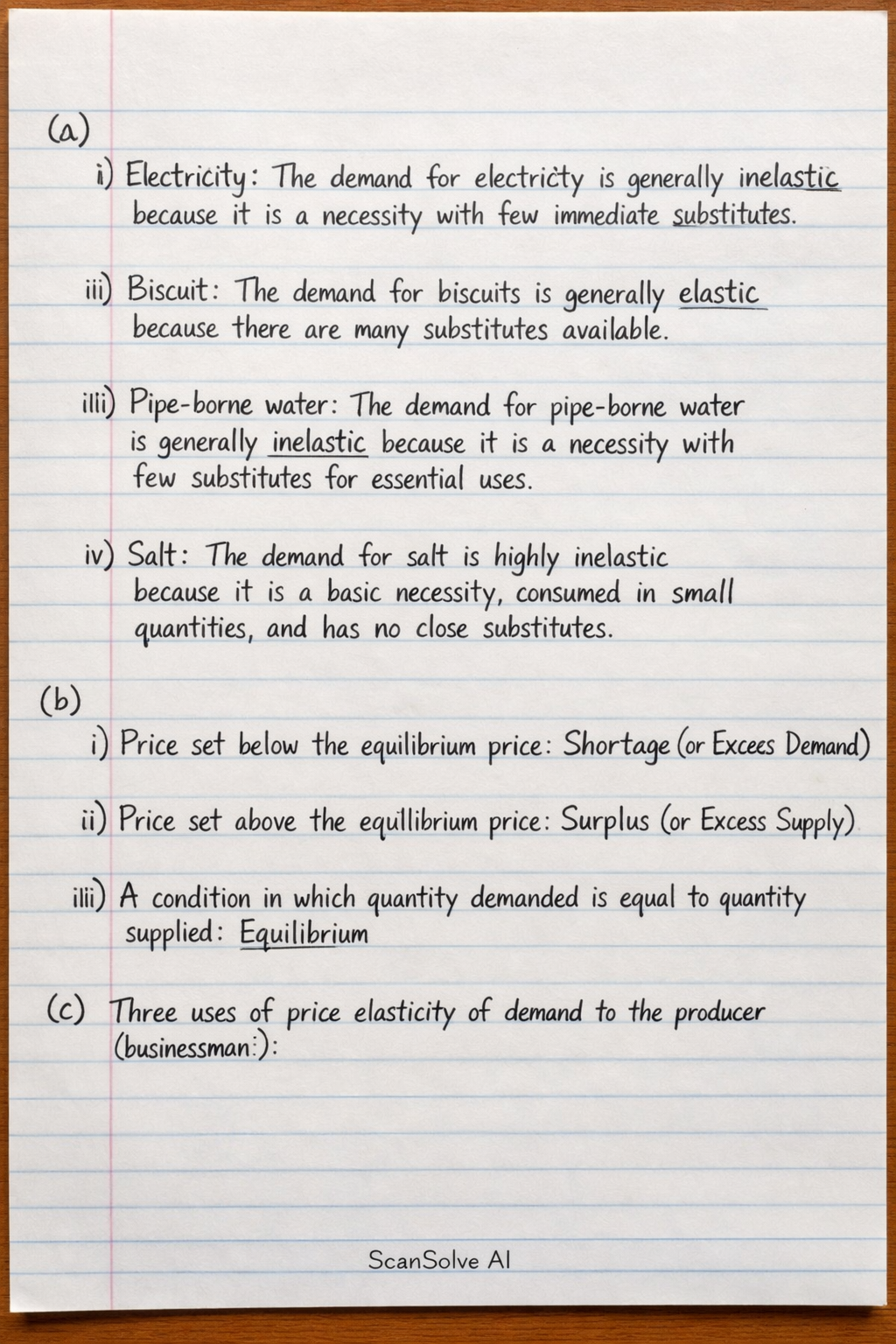
a)
i) Electricity: The demand for electricity is generally inelastic because it is a necessity with few immediate substitutes.
ii) Biscuit: The demand for biscuits is generally elastic because there are many substitutes available.
iii) Pipe-borne water: The demand for pipe-borne water is generally inelastic because it is a necessity with few substitutes for essential uses.
iv) Salt: The demand for salt is highly inelastic because it is a basic necessity, consumed in small quantities, and has no close substitutes.
b)
i) Price set below the equilibrium price: Shortage (or Excess Demand)
ii) Price set above the equilibrium price: Surplus (or Excess Supply)
iii) A condition in which quantity demanded is equal to quantity supplied: Equilibrium
c)
Three uses of price elasticity of demand to the producer (businessman):
- Pricing Decisions: Producers use price elasticity of demand to determine optimal pricing strategies. If demand for their product is elastic, a price increase will lead to a significant drop in quantity demanded and total revenue. If demand is inelastic, a price increase will lead to a smaller drop in quantity demanded and an increase in total revenue.
- Production Planning: Understanding elasticity helps producers forecast how changes in price will affect the quantity of goods consumers will buy. This allows them to adjust production levels to avoid overproduction or underproduction, optimizing resource allocation.
- Revenue Maximization: Producers can use elasticity to predict the impact of price changes on their total revenue. For elastic goods, lowering prices can increase total revenue, while for inelastic goods, raising prices can increase total revenue, helping them maximize profits.
Still stuck on this one?
Ask a follow-up, and the answer starts from this question.
More Economics Questions
Handwritten Step-by-Step Solution
Get this as a handwritten image on WhatsApp — like a tutor wrote it for you.
Try on WhatsApp