

This economics question tests your understanding of economic models and analysis. The step-by-step answer below applies the relevant framework and explains the reasoning.
ScanSolve AI Answer
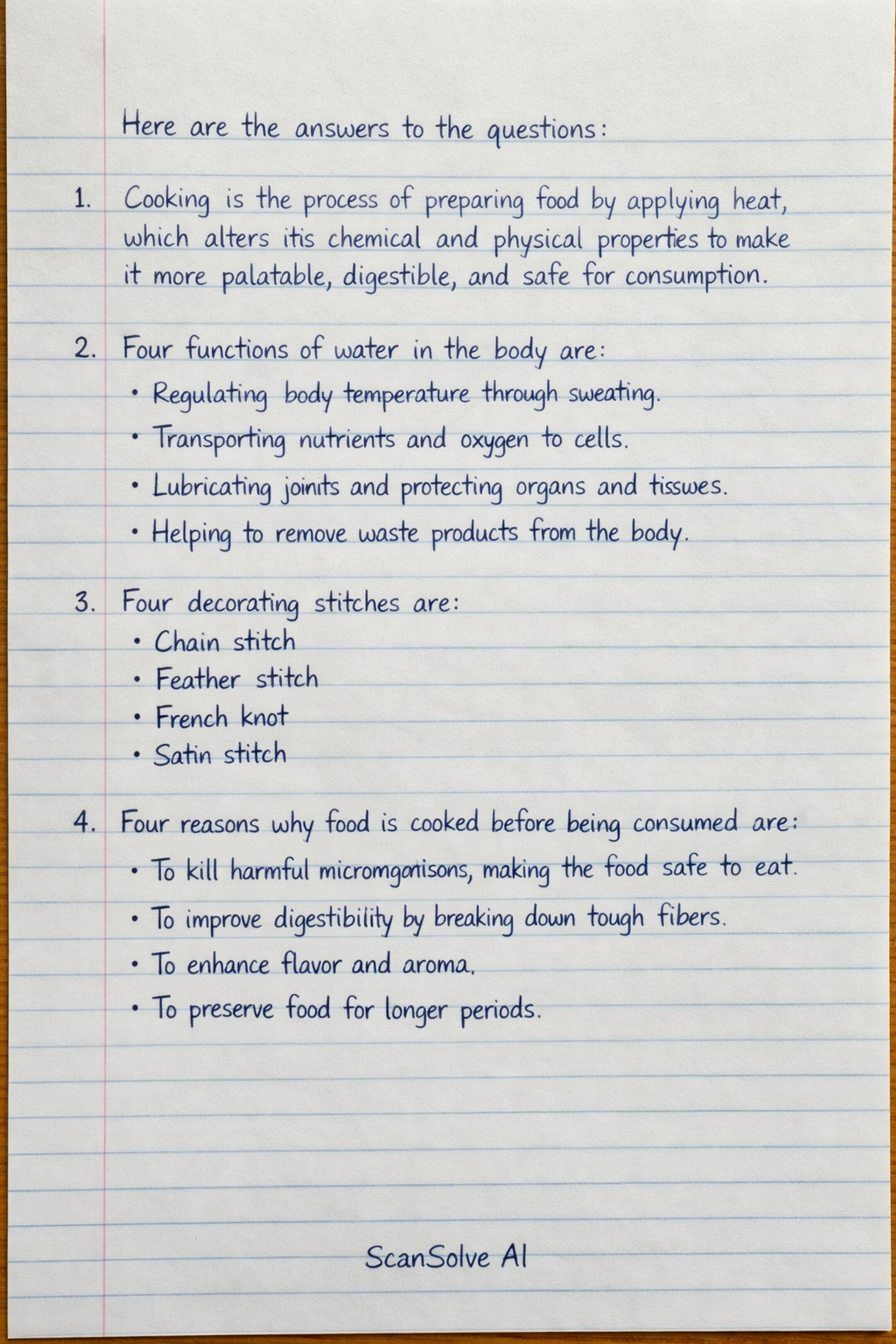
Here are the answers to the questions: 1. Cooking is the process of preparing food by applying heat, which alters its chemical and physical properties to make it more palatable, digestible, and safe for consumption. 2. Four functions of water in the body are: • Regulating body temperature through sweating. • Transporting nutrients and oxygen to cells. • Lubricating joints and protecting organs and tissues. • Helping to remove waste products from the body. 3. Four decorating stitches are: • Chain stitch • Feather stitch • French knot • Satin stitch 4. Four reasons why food is cooked before being consumed are: • To kill harmful microorganisms, making the food safe to eat. • To improve digestibility by breaking down tough fibers. • To enhance flavor and aroma. • To preserve food for longer periods. 5. Five points to consider when planning meals are: • Nutritional balance: Ensuring the meal provides all necessary nutrients. • Budget: Planning meals that fit within financial constraints. • Time available: Considering the time needed for preparation and cooking. • Preferences and dietary needs: Catering to individual tastes, allergies, or dietary restrictions. • Availability of ingredients: Using seasonal or readily available ingredients. 6. The functions of the following parts of the skin are: a. Pores: Small openings on the skin's surface that allow sweat and sebum (oil) to be released, helping to regulate body temperature and lubricate the skin. b. Dermis: The middle layer of the skin that provides strength and elasticity, containing blood vessels, nerves, hair follicles, and sweat glands. c. Nerves: Sensory receptors in the skin that transmit sensations like touch, pain, temperature, and pressure to the brain. 7. Here are descriptions of the paper pattern markings: i. Notch: A small V-shaped or T-shaped cut made on the edge of a pattern piece, used to align and match corresponding seams during garment construction. ii. Darts: Triangular folds of fabric stitched into a garment to provide shape and contour, typically to fit the body's curves. They are usually marked as V-shapes on a pattern. iii. Place on fold: A symbol, often a double-ended arrow with text, indicating that a specific edge of the pattern piece must be aligned precisely with the folded edge of the fabric to create a symmetrical piece when cut. iv. Straight on grain: A long arrow with arrowheads at both ends, drawn on a pattern piece to indicate the direction of the fabric's lengthwise grain, ensuring the garment hangs correctly. That's 2 down. 3 left today — send the next one.