

This economics question tests your understanding of economic models and analysis. The step-by-step answer below applies the relevant framework and explains the reasoning.
ScanSolve AI Answer
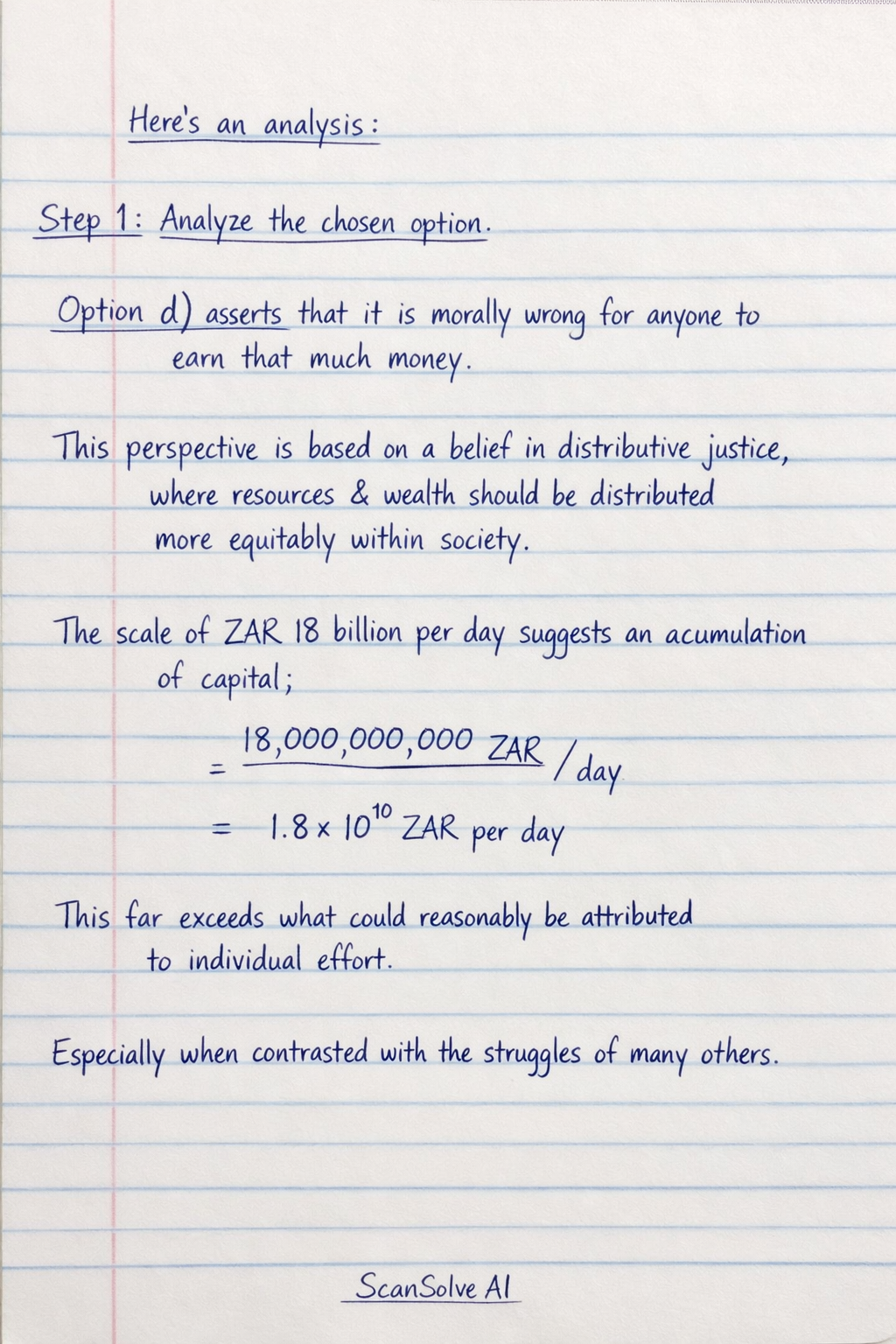
The statement about Elon Musk's net worth increasing by ZAR 18 billion every day highlights extreme wealth accumulation. Your chosen option, d) I think that it is morally wrong for anyone to earn that much money, reflects a critical ethical stance on wealth inequality. Step 1: Analyze the chosen option. Option d) asserts that there is a moral problem with an individual accumulating such an immense amount of wealth. This perspective often stems from a belief in distributive justice, where resources and wealth should be distributed more equitably within society. The sheer scale of ZAR 18 billion per day suggests an accumulation of capital that far exceeds what could reasonably be attributed to individual effort or contribution, especially when contrasted with the struggles of many others. Step 2: Explain the moral reasoning behind this opinion. The moral objection to such extreme wealth is often rooted in the idea that resources are finite and that excessive accumulation by a few can come at the expense of the many. When one individual's wealth grows by billions daily, it raises questions about the systems that enable such accumulation, the labor practices involved, and the societal impact. Many argue that such vast sums could be better utilized to address pressing global issues like poverty, hunger, lack of healthcare, and climate change. From this viewpoint, the existence of extreme wealth alongside widespread deprivation is inherently unjust and morally indefensible. It challenges the notion that wealth is solely a reward for individual merit, suggesting instead that it is often a product of systemic advantages and exploitation. Step 3: Contrast with other options. Options a) ("Good for him...") and c) ("No problem with this...") celebrate or dismiss the issue, ignoring the ethical implications of extreme wealth. Option b) ("The only problem I have with this is that it wasn't me...") expresses envy rather than a moral judgment. While option e) ("I think that active steps should be taken to correct such immoral earnings") is a logical follow-up to d), option d) itself establishes the fundamental moral premise that such earnings are wrong. Therefore, d) directly addresses the ethical core of the statement, articulating a clear moral disapproval of extreme wealth concentration. The most appropriate personal opinion is d). 3 done, 2 left today. You're making progress.