
We read your photo as:
Differentiate between creeping inflation and hyperinflation, and between a commercial bank and a central bank. Classify the motives for money demand.
Economics
ScanSolve AI Answer
Step-by-step solution
13 stepsDistinguish between the given pairs of concepts.
-
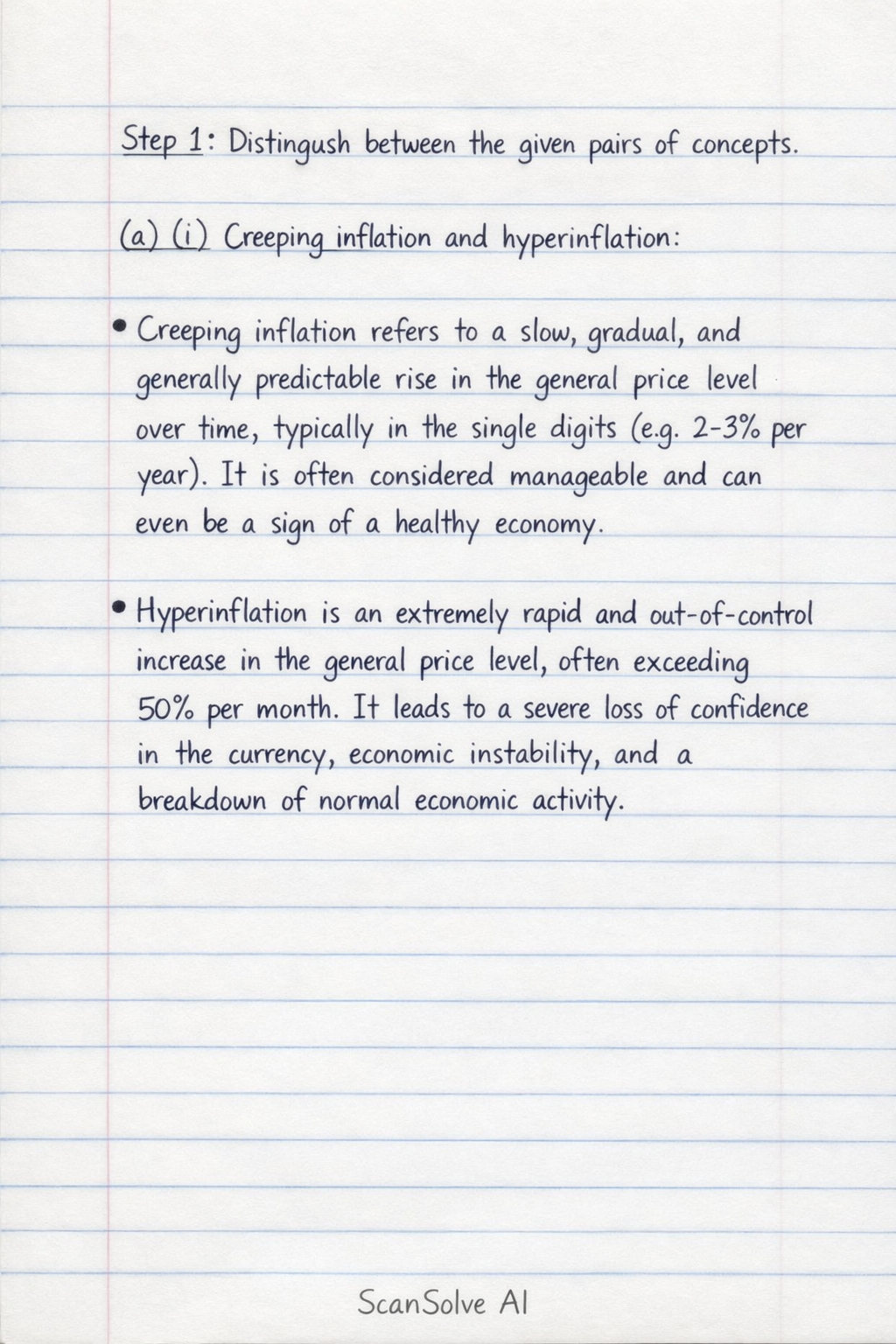
a) (i) Creeping inflation and hyperinflation:
- Creeping inflation refers to a slow, gradual, and generally predictable rise in the general price level over time, typically in the single digits (e.g., 2-3% per year). It is often considered manageable and can even be a sign of a healthy economy.
- Hyperinflation is an extremely rapid and out-of-control increase in the general price level, often exceeding 50% per month. It leads to a severe loss of confidence in the currency, economic instability, and a breakdown of normal economic activity.
-
a) (ii) Commercial bank and central bank:
- A commercial bank is a financial institution that accepts deposits from the public, offers various banking services like checking and savings accounts, and provides loans to individuals and businesses. Its primary goal is to make a profit.
- A central bank is the monetary authority of a country, responsible for managing the money supply, controlling interest rates, regulating commercial banks, and acting as a banker to the government. Its primary goal is to maintain economic stability, not profit.
-
Classify the motives for the demand for money.
- b) (i) Transactions motives: Money held for everyday spending and routine transactions.
- "Firms keeping money to buy raw material"
- "Money held to pay transport fares"
- b) (ii) Speculative motives: Money held to take advantage of future changes in asset prices, such as bonds or stocks.
- "Keeping money to buy bonds when interest rates rise" (implies waiting for interest rates to rise to buy bonds at a lower price, or holding money instead of bonds if rates are expected to rise, causing bond prices to fall).
- b) (iii) Precautionary motives: Money held for unforeseen future expenses or emergencies.
- "Keeping cash to meet medical emergencies"
- b) (i) Transactions motives: Money held for everyday spending and routine transactions.
State and explain three measures to increase the money supply.
- c) (i) Lowering the Cash Reserve Ratio (CRR): The central bank can reduce the percentage of deposits that commercial banks are required to hold as reserves. This frees up more funds for commercial banks to lend, increasing the money supply.
- c) (ii) Lowering the Bank Rate (Discount Rate): The central bank can decrease the interest rate at which it lends money to commercial banks. A lower bank rate encourages commercial banks to borrow more from the central bank, which they then lend out to the public, thereby increasing the money supply.
- c) (iii) Open Market Operations (Buying Government Securities): The central bank can purchase government bonds and other securities from commercial banks or the public. This injects money directly into the banking system, increasing commercial banks' reserves and their capacity to lend, thus expanding the money supply.
Enumerate four roles of the stock exchange.
- d) (i) Facilitates Capital Formation: The stock exchange provides a platform for companies to raise capital by issuing new shares and bonds, which is crucial for investment and economic growth.
- d) (ii) Provides Liquidity: It allows investors to easily buy and sell existing securities, converting their investments into cash when needed, thereby providing liquidity to financial assets.
- d) (iii) Mobilizes Savings: The stock exchange encourages individuals and institutions to save by offering opportunities to invest in various securities, channeling these savings into productive uses.
- d) (iv) Valuation of Securities: The market prices of shares and bonds on the stock exchange reflect the perceived value and performance of companies, providing a continuous valuation of corporate assets.
Define the given terms with examples.
- a) (i) Horizontal integration: This occurs when a firm merges with or acquires another firm operating at the same stage of production in the same industry.
- Example: Two competing car manufacturers merging to form a larger company.
- a) (ii) Internal economies of scale: These are cost advantages that a firm experiences as it increases its own level of output. They arise from factors within the firm's control.
- Example: A large factory buying raw materials in bulk at a discounted price, leading to lower average costs per unit.
- a) (iii) Mobility of labour: This refers to the ease with which workers can move between different jobs, occupations, or geographical locations. It can be occupational (changing jobs/skills) or geographical (changing location).
- Example: A construction worker moving from one city to another to find work (geographical mobility).
- a) (i) Horizontal integration: This occurs when a firm merges with or acquires another firm operating at the same stage of production in the same industry.
State and explain four factors influencing the supply of labour.
- b) (i) Population Size and Structure: A larger working-age population generally leads to a greater supply of labor. The age distribution, gender participation rates, and birth/death rates also influence the long-term supply.
- b) (ii) Wage Rates and Non-Monetary Benefits: Higher real wages in a particular industry or economy tend to attract more workers, increasing the supply of labor. Attractive non-monetary benefits like good working conditions, job security, and opportunities for advancement also boost supply.
- b) (iii) Education and Training Levels: The availability and quality of education and training programs determine the supply of skilled labor. An increase in the number of people with specific skills will increase the supply of labor for jobs requiring those skills.
- b) (iv) Government Policies and Regulations: Policies such as minimum wage laws, immigration policies, retirement age, and unemployment benefits can significantly impact the supply of labor by influencing participation rates and the availability of workers.
Explain three reasons for the slow growth rate of industrialization in Cameroon.
- c) (i) Insufficient Capital and Investment: Cameroon faces a shortage of both domestic and foreign investment in its industrial sector. This limits the establishment of new industries, the modernization of existing ones, and the adoption of advanced technologies.
- c) (ii) Poor Infrastructure: Inadequate and poorly maintained infrastructure, including unreliable power supply, poor road networks, and limited access to clean water, increases production costs for industries and hinders their expansion and efficiency.
- c) (iii) Limited Skilled Labour and Entrepreneurship: There is often a mismatch between the skills possessed by the workforce and those required by modern industries. Additionally, a lack of robust entrepreneurial culture and support systems can stifle the creation and growth of new industrial ventures.
Briefly distinguish between the given economic terms.
-
a) (i) Privatisation and nationalization:
- Privatisation is the process of transferring ownership and control of an enterprise or industry from the public (government) sector to the private sector.
- Nationalization is the process of transferring ownership and control of an enterprise or industry from the private sector to the public (government) sector.
-
a) (ii) Memorandum of association and article of association:
- The Memorandum of Association is a legal document that defines the fundamental objectives, powers, and scope of a company, outlining its relationship with the outside world. It states the company's name, registered office, objects, liability of members, and capital.
- The Articles of Association is a legal document that specifies the rules and regulations for the internal management of a company. It governs the rights and duties of shareholders, directors, and other internal stakeholders.
-
a) (iii) Public corporation and public company:
- A public corporation is a state-owned enterprise established by a special act of parliament or government decree to provide public services or manage public utilities. It is typically non-profit oriented and accountable to the government.
- A public company (or publicly traded company) is a private sector company whose shares are offered to the general public and traded on a stock exchange. Its primary objective is to maximize shareholder wealth.
-
a) (iv) Scarcity and opportunity cost:
- Scarcity is the fundamental economic problem of having seemingly unlimited human wants and needs in a world of limited resources. It implies that not all wants can be satisfied.
- Opportunity cost is the value of the next best alternative that must be foregone when a choice is made. It arises directly from the problem of scarcity, as choosing one option means giving up another.
-
Classify the sources of finance.
- b) Internal sources of finance: Funds generated from within the firm's operations.
- Past savings
- Retained profits
- Depreciation funds
- Sale of assets
- b) External sources of finance: Funds obtained from outside the firm.
- Sale of shares and debentures
- Bank credits
- Subsidies
- Hire purchase
- b) Internal sources of finance: Funds generated from within the firm's operations.
Explain four characteristics of a mixed economy such as Cameroon.
- c) (i) Co-existence of Public and Private Sectors: In a mixed economy, both government-owned enterprises (public sector) and privately-owned businesses (private sector) operate side-by-side, contributing to economic activity.
- c) (ii) Government Intervention and Regulation: The government plays an active role in regulating economic activities, setting policies, and providing public goods and services (e.g., education, healthcare, infrastructure) to correct market failures and achieve social objectives.
- c) (iii) Market Mechanism with Planning: While market forces (supply and demand) largely determine prices and resource allocation, the government often engages in some level of economic planning or sets broad economic goals to guide development and address societal needs.
- c) (iv) Social Welfare Objectives: A mixed economy typically aims to balance economic efficiency with social equity. The government implements policies to reduce income inequality, provide social safety nets, and ensure a minimum standard of living for its citizens.
Define the given terms as used in Economics.
- d) (i) National income: This is the total value of all final goods and services produced within a country's borders in a specific period, usually a year, plus net income from abroad. It represents the total income earned by a country's residents and businesses.
- d) (ii) Unemployment: This refers to a situation where individuals who are actively seeking employment are unable to find work. It typically includes those who are willing and able to work at the prevailing wage rate but remain jobless.
State and explain three reasons for measuring the national income of a country.
- b) (i) To Assess Economic Performance and Growth: Measuring national income (e.g., GDP or GNP) allows a country to gauge its overall economic health, track its growth rate over time, and compare its performance with other nations. This helps in understanding whether the economy is expanding or contracting.
- b) (ii) To Formulate Economic Policies: National income data provides crucial information for policymakers to design and implement effective economic policies. For example, if national income growth is slow, the government might introduce fiscal or monetary stimulus measures.
- b) (iii) To Understand Income Distribution and Living Standards: By analyzing the components of national income, economists can assess how income is distributed among different sectors and individuals. This helps in understanding income inequality and making international comparisons of living standards, though per capita income is often a better indicator for the latter.
Explain three measures used by the Cameroon government to reduce unemployment.
- c) (i) Investment in Infrastructure and Public Works: The government can initiate large-scale infrastructure projects (e.g., roads, bridges, energy facilities). These projects directly create jobs in construction and related sectors and indirectly stimulate economic activity, leading to further job creation.
- c) (ii) Education, Training, and Skill Development Programs: To address structural unemployment, the government can invest in vocational training centers, technical schools, and re-skilling programs. These initiatives equip the workforce with skills demanded by emerging industries, improving their employability.
Was this helpful?
Still stuck on this one?
Ask a follow-up, and the answer starts from this question.
Got a different question?Ask your own question
More Economics Questions
QA. Distinguish between creeping inflation and hyperinflation, and commercial bank and central bank…QDistinguish between creeping inflation and hyperinflation, and between commercial and central banks…QWhat do you understand by the money supply?. Critically examine the effects of an increase in the…QDistinguish between total utility and marginal utility, and between creeping inflation and…QIdentify motives for demand of money, factors determining money demanded by traders, define money…
Handwritten Step-by-Step Solution
Get this as a handwritten image on WhatsApp — like a tutor wrote it for you.
Try on WhatsApp