

This economics question tests your understanding of economic models and analysis. The step-by-step answer below applies the relevant framework and explains the reasoning.
ScanSolve AI Answer
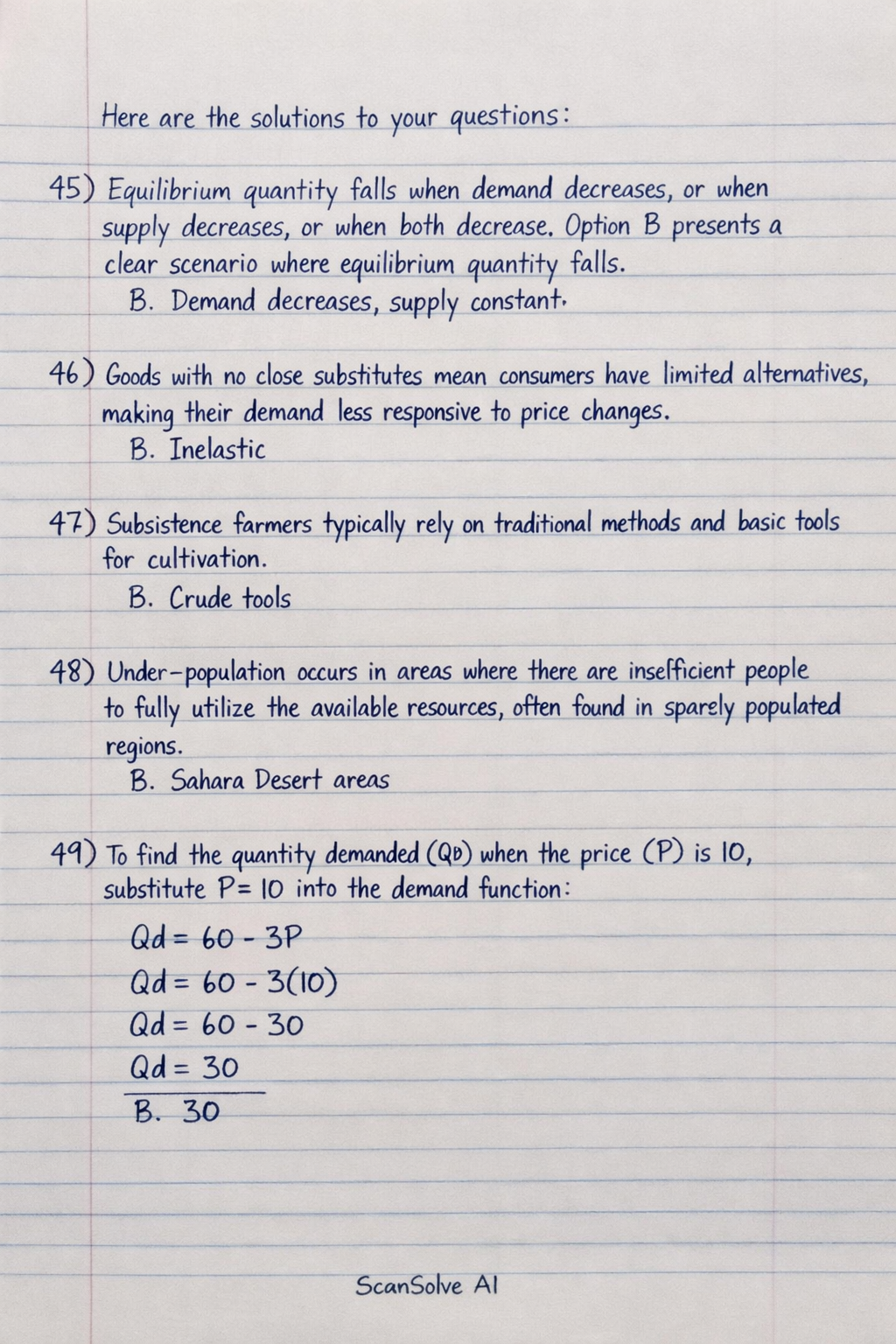
Here are the solutions to your questions: 45) Equilibrium quantity falls when demand decreases, or when supply decreases, or when both decrease. Option B presents a clear scenario where equilibrium quantity falls. B. Demand decreases, supply constant 46) Goods with no close substitutes mean consumers have limited alternatives, making their demand less responsive to price changes. B. Inelastic 47) Subsistence farmers typically rely on traditional methods and basic tools for cultivation. B. Crude tools 48) Under-population occurs in areas where there are insufficient people to fully utilize the available resources, often found in sparsely populated regions. B. Sahara Desert areas 49) To find the quantity demanded (Qd) when the price (P) is 10, substitute P=10 into the demand function: Qd = 60 - 3P Qd = 60 - 3(10) Qd = 60 - 30 Qd = 30 B. 30 50) Elasticity of supply is zero (perfectly inelastic) when the quantity supplied cannot change regardless of price, which is often the case for perishable goods in the very short run. A. Perishable goods in short run --- SECTION B: THEORY/ESSAY 1. Define equilibrium price. With the aid of a diagram, explain how equilibrium price and quantity are determined by demand and supply. [6 marks] Equilibrium price is the market price at which the quantity of a good or service demanded by consumers is exactly equal to the quantity supplied by producers. At this price, there is no tendency for the price to change, as the market is cleared. a) To explain how equilibrium price and quantity are determined, consider a standard demand and supply diagram: [->] (0,0) -- (5,0) node[below] Quantity (Q); [->] (0,0) -- (0,5) node[left] Price (P); [blue, thick] (1,4) node[above left] D -- (4,1); [red, thick] (1,1) node[below left] S -- (4,4); (2.5,2.5) circle (2pt) node[above right] E; [dashed] (0,2.5) -- (2.5,2.5) node[left] P_e; [dashed] (2.5,0) -- (2.5,2.5) node[below] Q_e; In the diagram: • The demand curve (D) slopes downwards, indicating that as price decreases, consumers demand a greater quantity. • The supply curve (S) slopes upwards, indicating that as price increases, producers are willing to supply a greater quantity. • The equilibrium point (E) is where the demand and supply curves intersect. At this point, the quantity demanded (Q_e) equals the quantity supplied (Q_e), and the corresponding price is the equilibrium price (P_e). • If the price were above P_e, there would be an excess supply (surplus), as quantity supplied would exceed quantity demanded. This surplus would put downward pressure on prices, moving the market back towards equilibrium. • If the price were below P_e, there would be an excess demand (shortage), as quantity demanded would exceed quantity supplied. This shortage would put upward pressure on prices, moving the market back towards equilibrium. Thus, the interaction of demand and supply forces naturally drives the market towards the equilibrium price and quantity where the market clears. --- 2. Demand & Supply Functions Given: Qd = 200 - 5P and Qs = 40 + 3P a) Calculate the equilibrium price and equilibrium quantity. [5 marks] Step 1: Set quantity demanded equal to quantity supplied to find the equilibrium price. Qd = Qs 200 - 5P = 40 + 3P Step 2: Solve for P. 200 - 40 = 3P + 5P 160 = 8P P = (160)/(8) P = 20 Step 3: Substitute the equilibrium price (P=20) into either the demand or supply equation to find the equilibrium quantity. Using the demand equation: Qd = 200 - 5(20) Qd = 200 - 100 Qd = 100 Using the supply equation (to verify): Qs = 40 + 3(20) Qs = 40 + 60 Qs = 100 The equilibrium price is 20 and the equilibrium quantity is 100. b) If government fixes price at P = 30, state and calculate the type of disequilibrium that will occur. [4 marks] Step 1: Calculate the quantity demanded at P=30. Qd = 200 - 5(30) Qd = 200 - 150 Qd = 50 Step 2: Calculate the quantity supplied at P=30. Qs = 40 + 3(30) Qs = 40 + 90 Qs = 130 Step 3: Compare Qd and Qs to determine the type and magnitude of disequilibrium. Since Qs (130) > Qd (50), there is an excess supply (surplus). The magnitude of the excess supply is: Excess\ Supply = Qs - Qd Excess\ Supply = 130 - 50 Excess\ Supply = 80 At a price of P=30, there will be an excess supply (surplus) of 80 units. c) Explain 2 reasons why a supply curve slopes upward from left to right. [3.5 marks] 1. Law of Supply: The fundamental reason is the law of supply, which states that, all else being equal, as the price of a good or service increases, the quantity supplied by producers also increases. This is because higher prices generally lead to higher profit margins, incentivizing firms to produce and offer more of the good for sale. 2. Increasing Marginal Costs: As producers increase their output, they often face increasing marginal costs of production. To produce additional units, firms may need to use less efficient resources, pay overtime wages, or invest in new, more expensive production capacity. For these higher costs to be covered and for production to remain profitable, a higher price is required for each additional unit supplied. d) State 4 problems of agriculture. [6.5 marks] 1. Dependence on Weather and Climate: Agricultural output is highly susceptible to unpredictable weather patterns, including droughts, floods, and extreme temperatures, which can lead to significant crop failures and livestock losses. 2. Poor Infrastructure: Many agricultural regions suffer from inadequate infrastructure, such as poor road networks, limited access to electricity, and insufficient storage facilities, leading to high post-harvest losses and difficulties in transporting produce to markets. 3. Limited Access to Credit and Finance: Small-scale farmers often lack access to affordable loans and financial services, hindering their ability to invest in modern equipment, quality seeds, fertilizers, and other essential inputs to improve productivity. 4. Low Technology Adoption: The prevalence of traditional farming methods and the slow adoption of modern agricultural technologies (e.g., improved irrigation, advanced machinery, disease-resistant crop varieties) contribute to low yields and inefficient production processes. --- 3. Population, Census & Types of Population a) What is population census? State 3 importance of census to a country. [5 marks] A population census is an official, comprehensive enumeration and collection of demographic, social, and economic data about all persons in a country or a precisely defined part of a country at a specific time. It is typically conducted periodically, often every ten years. Three importances of a census to a country are: 1. Planning and Policy Making: Census data provides governments with crucial information for planning and formulating policies related to public services such as education, healthcare, housing, and infrastructure development. 2. Resource Allocation: It helps in the equitable distribution of national resources and funds to different regions and communities based on their population size, demographic composition, and specific needs. 3. Electoral Demarcation: Census results are used to define and redraw electoral boundaries, ensuring fair representation and the proper allocation of legislative seats based on population distribution. b) Explain the difference between over-population, under-population and optimum population. [4.5 marks] • Over-population: This occurs when the existing population size in an area is too large to be adequately supported by the available resources and technology, leading to a decline in the average standard of living, increased pressure on resources, unemployment, and environmental degradation. • Under-population: This describes a situation where the existing population is too small to fully utilize the available resources and potential of a region. It can result in underdevelopment, a shortage of labor, underutilized infrastructure, and a failure to exploit natural resources efficiently. • Optimum population: This is the ideal population size for a given area, where the number of people can be supported by the available resources and technology to achieve the highest possible standard of living or per capita output. It represents a balance where resources are efficiently utilized without being overstretched, maximizing welfare for the inhabitants. c) State 3 types of population and give 1 characteristic of each. [3 marks] 1. Rural Population: Characteristic: Typically characterized by lower population density, a greater reliance on agriculture and primary sector activities, and often more traditional lifestyles. 2. Urban Population: Characteristic: Characterized by high population density, diverse economic activities (secondary and tertiary sectors), advanced infrastructure, and a more modern, fast-paced lifestyle. 3. Dependent Population: Characteristic: Comprises individuals who are typically not in the labor force and rely on the working-age population for support, primarily children (0-14 years) and the elderly (65+ years). 3 done, 2 left today. You're making progress.