
We read your photo as:
How does corruption affect ordinary citizens in Papua New Guinea, particularly regarding public services and justice?
ScanSolve AI Answer
Answer
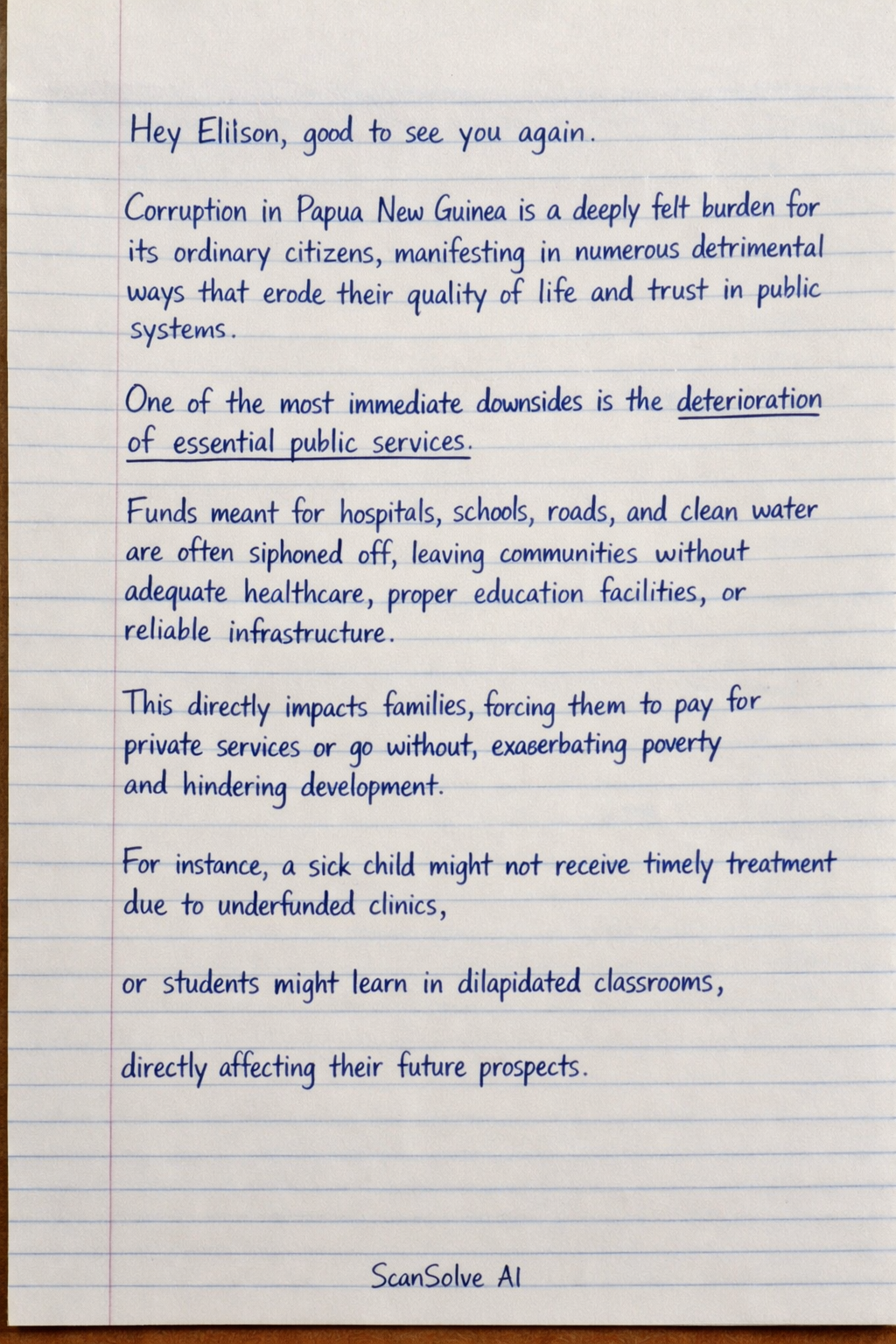
Corruption in Papua New Guinea is a deeply felt burden for its ordinary citizens, manifesting in numerous detrimental ways that erode their quality of life and trust in public systems.
One of the most immediate downsides is the deterioration of essential public services. Funds meant for hospitals, schools, roads, and clean water are often siphoned off, leaving communities without adequate healthcare, proper education facilities, or reliable infrastructure. This directly impacts families, forcing them to pay for private services or go without, exacerbating poverty and hindering development. For instance, a sick child might not receive timely treatment due to underfunded clinics, or students might learn in dilapidated classrooms, directly affecting their future prospects.
Furthermore, corruption fosters a pervasive sense of injustice and inequality. Ordinary citizens often perceive that opportunities, jobs, and even justice itself are only accessible to those with connections or the ability to pay bribes. This creates a two-tiered society where merit is disregarded, and the rule of law is undermined. It breeds cynicism and a feeling of helplessness, as people believe their voices are unheard and their rights are unprotected against powerful, corrupt individuals. This erosion of trust extends to law enforcement and the judiciary, making it difficult for citizens to seek redress or believe in fair outcomes.
Ultimately, the cumulative effect is a stifled economy and a fractured society. Businesses, especially small local ones, struggle to thrive amidst demands for illicit payments, limiting job creation. The diversion of public resources means less investment in productive sectors, hindering national progress. For ordinary Papua New Guineans, corruption isn't an abstract concept; it's the daily struggle to access basic necessities, the frustration of unfair systems, and the despair of seeing their nation's potential squandered.
This essay highlights the profound negative impacts of corruption on the daily lives and perceptions of ordinary citizens in Papua New Guinea.
Still stuck on this one?
Ask a follow-up, and the answer starts from this question.
More Economics Questions
Handwritten Step-by-Step Solution
Get this as a handwritten image on WhatsApp — like a tutor wrote it for you.
Try on WhatsApp