
We read your photo as:
Explain the five alternative approaches to Gross National Product (GNP) estimation, detailing their calculation methods and key differences.
ScanSolve AI Answer
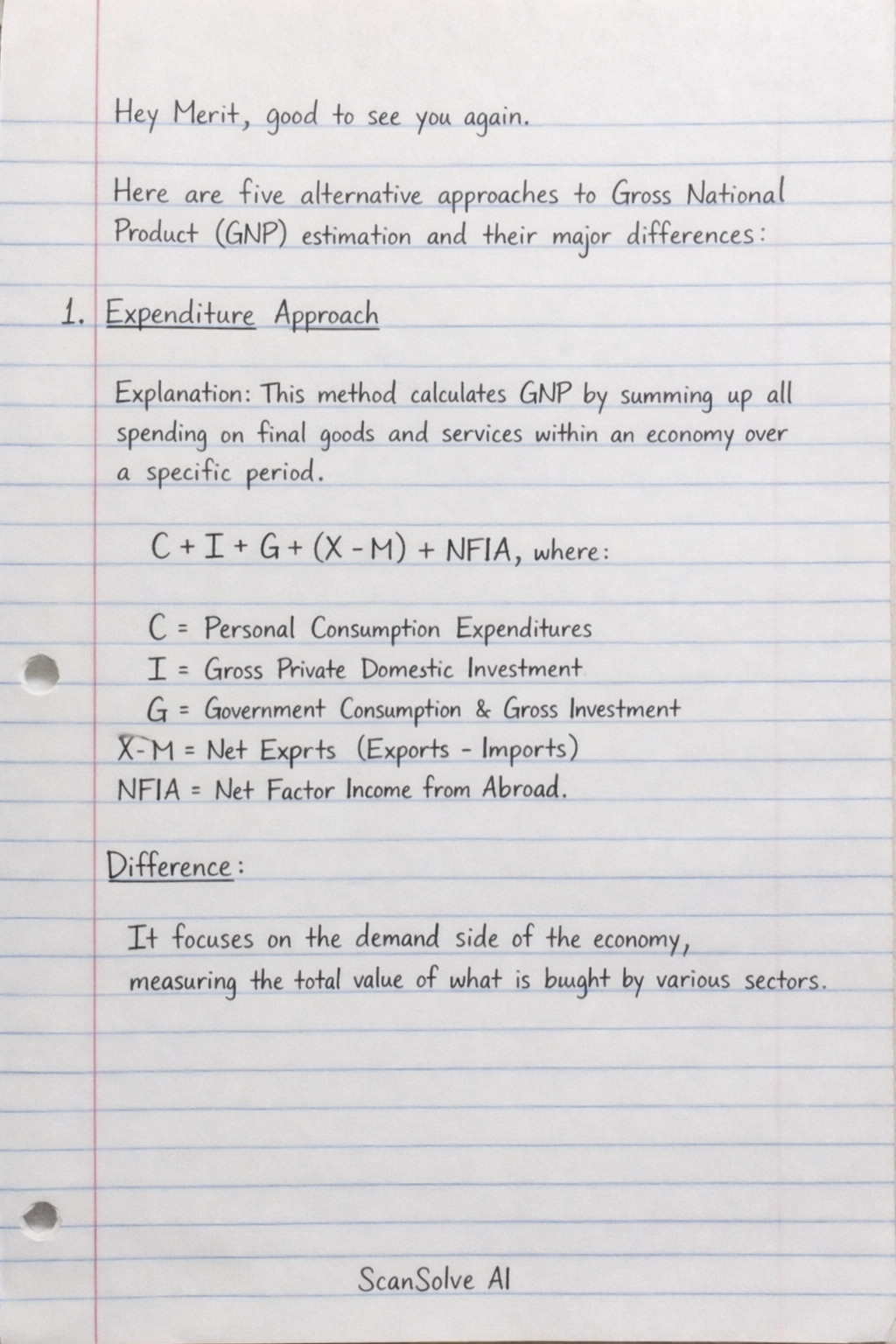
Here are five alternative approaches to Gross National Product (GNP) estimation and their major differences:
-
Expenditure Approach
- Explanation: This method calculates GNP by summing up all spending on final goods and services within an economy over a specific period. It includes personal consumption expenditures (), gross private domestic investment (), government consumption and gross investment (), net exports (), and Net Factor Income from Abroad (NFIA).
- Difference: It focuses on the demand side of the economy, measuring the total value of what is bought by various sectors.
-
Income Approach
- Explanation: This approach estimates GNP by summing all the incomes earned by the factors of production (labor, capital, land, and entrepreneurship) in the production of goods and services. This includes compensation of employees (wages), proprietors' income, rental income, corporate profits, net interest, indirect business taxes, and depreciation, plus Net Factor Income from Abroad (NFIA).
- Difference: It focuses on the supply side of the economy, measuring the total value of what is earned by those involved in production.
-
Production (or Value Added) Approach
- Explanation: This method calculates GNP by summing the market value of all final goods and services produced by all sectors of the economy. Alternatively, it sums the "value added" at each stage of production (sales revenue minus the cost of intermediate goods) to avoid double-counting.
- Difference: It focuses on the output generated by different industries and sectors, ensuring only the final value of goods and services is counted.
-
Net Factor Income from Abroad (NFIA) Adjustment
- Explanation: While not a standalone estimation method for the entire GNP, this is a crucial adjustment approach that converts Gross Domestic Product (GDP) to GNP. It involves adding income earned by domestic residents from their investments and work abroad and subtracting income earned by foreign residents within the domestic economy.
- Difference: This approach specifically highlights the national ownership aspect, distinguishing GNP (what nationals produce, regardless of location) from GDP (what is produced within a country's borders).
-
Real GNP Estimation (Inflation-Adjusted Approach)
- Explanation: This approach estimates GNP by adjusting the nominal (current price) GNP for inflation, using a base year's prices to value current production. This provides a measure of economic output that reflects changes in the actual quantity of goods and services produced.
- Difference: It provides a more accurate picture of economic growth over time by removing the distorting effects of price changes, unlike nominal GNP which uses current market prices.
The primary difference among the first three approaches lies in what aspect of economic activity they measure (spending, income, or production), though theoretically, they should yield the same GNP value. The NFIA adjustment differentiates between domestic and national output, while Real GNP estimation focuses on measuring actual volume of output by removing price effects, unlike nominal GNP.
Five alternative approaches to GNP estimation and their differences are listed above.
Still stuck on this one?
Ask a follow-up, and the answer starts from this question.
More Economics Questions
Handwritten Step-by-Step Solution
Get this as a handwritten image on WhatsApp — like a tutor wrote it for you.
Try on WhatsApp