
We read your photo as:
Explain five characteristics of money and five factors that may cause a decline in demand for wooden furniture.
Economics
ScanSolve AI Answer
This answer stops before the end.
It was cut off when it was first written. Ask ScanSolve this question again for the full working.
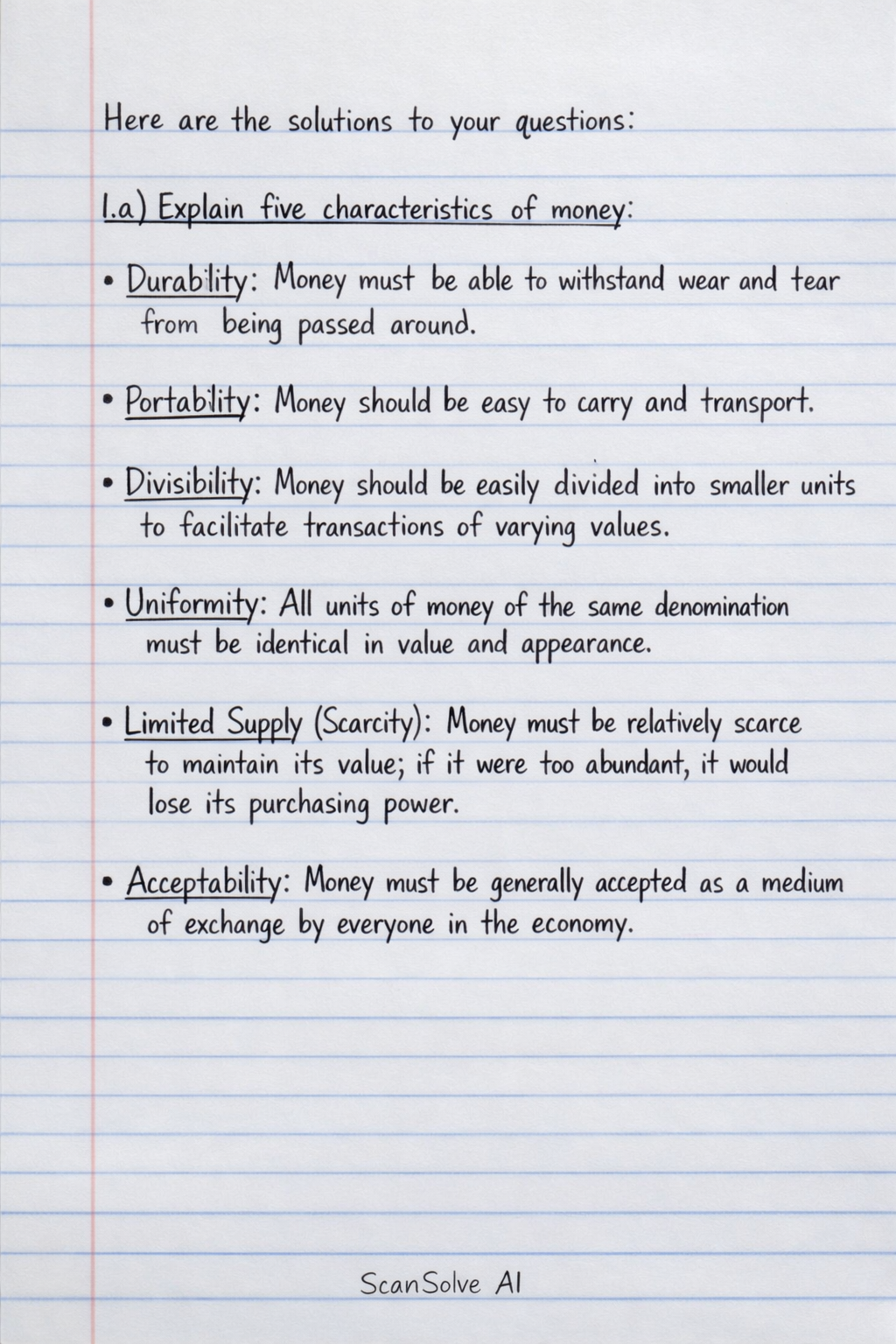
Here are the solutions to your questions:
1.a) Explain five characteristics of money.
- Durability: Money must be able to withstand wear and tear from being passed around.
- Portability: Money should be easy to carry and transport.
- Divisibility: Money should be easily divided into smaller units to facilitate transactions of varying values.
- Uniformity: All units of money of the same denomination must be identical in value and appearance.
- Limited Supply (Scarcity): Money must be relatively scarce to maintain its value; if it were too abundant, it would lose its purchasing power.
- Acceptability: Money must be generally accepted as a medium of exchange by everyone in the economy.
1.b) There has been a decline in the demand for wooden furniture. Explain five factors that may have caused this trend.
- Changes in Consumer Tastes and Preferences: Modern interior design trends may favor furniture made from alternative materials like metal, glass, or plastic, or minimalist styles that use less wood.
- Increased Availability of Alternative Materials: The market is flooded with furniture made from cheaper or more durable materials, such as engineered wood, plastics, or metals, offering consumers more choices.
- Environmental Concerns: Growing awareness about deforestation and sustainability issues may lead environmentally conscious consumers to opt for furniture made from recycled materials or non-wood sources.
- Rising Prices of Wooden Furniture: Increased costs of timber, labor, and production can make wooden furniture more expensive, pushing consumers towards more affordable alternatives.
- Durability and Maintenance Issues: Some consumers might perceive wooden furniture as requiring more maintenance (e.g., polishing, protection from moisture) or being less durable than certain synthetic materials.
2.a) Explain the procedure of making an insurance claim.
- Notification of Loss: The insured must promptly inform the insurance company about the incident that led to the loss or damage, usually within a specified timeframe.
- Gathering Evidence and Documentation: The insured collects all relevant documents and evidence, such as the insurance policy, police reports (for theft/accidents), medical reports (for health claims), photographs of damage, and purchase receipts.
- Completion of Claim Form: The insured fills out the insurer's official claim form, providing accurate and detailed information about the incident, the extent of the loss, and the circumstances surrounding it.
- Investigation and Assessment: The insurance company will then investigate the claim, which may involve sending an assessor or surveyor to inspect the damage or verify the facts presented.
- Settlement of Claim: If the claim is found to be valid and falls within the policy terms, the insurer will offer a settlement, which could be in the form of cash payment, repair, or replacement of the damaged item.
2.b) Explain five measures that a country may take to reduce unemployment.
- Fiscal Policy Measures: The government can increase its spending on infrastructure projects (e.g., roads, bridges) which creates direct and indirect jobs, or reduce taxes to stimulate business investment and consumer spending, leading to job creation.
- Monetary Policy Measures: The central bank can lower interest rates, making it cheaper for businesses to borrow money for expansion, investment in new projects, and hiring more staff.
- Education and Training Programs: Investing in vocational training, skills development, and re-skilling programs helps equip the workforce with the skills demanded by industries, reducing structural unemployment.
- Support for Small and Medium Enterprises (SMEs): Providing financial incentives, grants, loans, and business advisory services to SMEs encourages their growth, as they are often significant job creators.
- Attracting Foreign Direct Investment (FDI): Offering incentives to foreign companies to establish operations within the country can bring in capital, technology, and create new employment opportunities.
3.a) Prepare a trading profit and loss account.
\begin{array}{|l|r|r|}
\hline
Details & Ksh & Ksh \\
\hline
Sales & & 1,200,000 \\
Less: Returns Inwards (Sales Returns) & & (50,000) \\
Net Sales & & 1,150,000 \\
Less: Cost of Goods Sold & & \\
\text{Opening Stock
Was this helpful?
Still stuck on this one?
Ask a follow-up, and the answer starts from this question.
Got a different question?Ask your own question
More Economics Questions
QExplain 5 characteristics of money.QIdentify motives for demand of money, factors determining money demanded by traders, define money…QExplain the difference between a decrease in demand and a decrease in quantity demanded, and list…QOutline four factors that may lead to an increase in the demand for commodity X.QWhat are the functions, motives for demand, and characteristics of money, with specific reference to…
Browse by topic:Microeconomics
Handwritten Step-by-Step Solution
Get this as a handwritten image on WhatsApp — like a tutor wrote it for you.
Try on WhatsApp