
We read your photo as:
Explain five problems in measuring national income using the output approach and five causes of unemployment in Kenya.
Economics
ScanSolve AI Answer
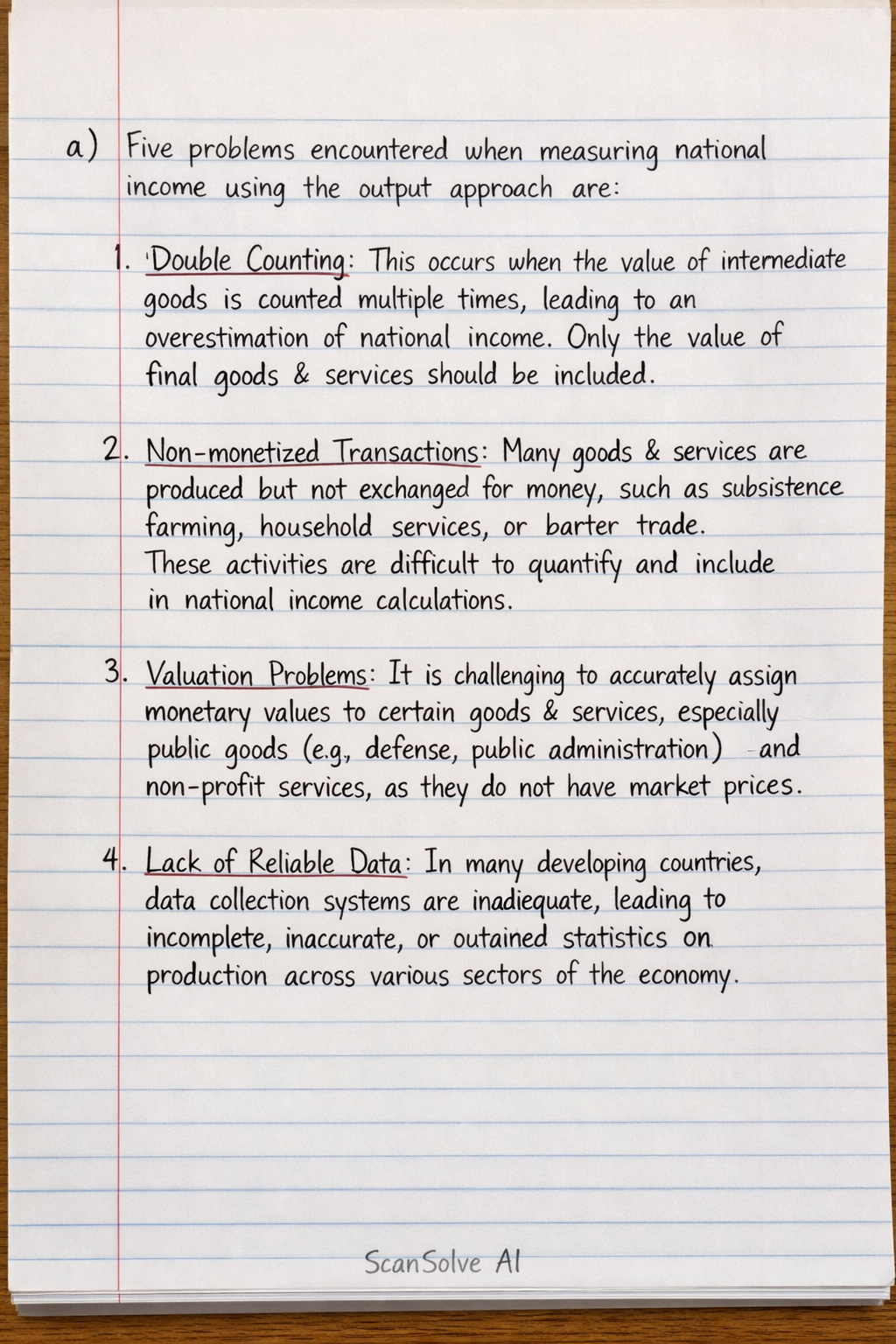
a) Five problems encountered when measuring national income using the output approach are:
- Double Counting: This occurs when the value of intermediate goods (goods used in the production of other goods) is counted multiple times, leading to an overestimation of national income. Only the value of final goods and services should be included.
- Non-monetized Transactions: Many goods and services are produced but not exchanged for money, such as subsistence farming, household services, or barter trade. These activities are difficult to quantify and include in national income calculations.
- Valuation Problems: It is challenging to accurately assign monetary values to certain goods and services, especially public goods (like defense or public administration) and services provided by non-profit organizations, as they do not have market prices.
- Lack of Reliable Data: In many developing countries, data collection systems are inadequate, leading to incomplete, inaccurate, or outdated statistics on production across various sectors of the economy.
- Informal Sector/Underground Economy: A significant portion of economic activity occurs in the informal or black market, which is not officially recorded. This leads to an underestimation of the true national income.
b) Five causes of unemployment in Kenya are:
- High Population Growth: A rapidly increasing population, particularly of young people, leads to a larger labor force that the economy struggles to absorb, resulting in a surplus of job seekers.
- Inappropriate Education System/Skills Mismatch: The education system may not be aligned with the demands of the job market, producing graduates with skills that do not match available job opportunities, leading to structural unemployment.
- Slow Economic Growth: If the economy is not expanding at a sufficient rate, it cannot generate enough new jobs to accommodate the growing labor force, leading to high unemployment rates.
- Inappropriate Technology: The adoption of capital-intensive technologies in industries, especially in a labor-abundant country like Kenya, can displace workers and reduce the overall demand for labor.
- Rural-Urban Migration: High rates of migration from rural areas to urban centers in search of better opportunities often lead to an oversupply of labor in urban areas, exacerbating urban unemployment as job creation lags behind migration.
Was this helpful?
Still stuck on this one?
Ask a follow-up, and the answer starts from this question.
Got a different question?Ask your own question
More Economics Questions
QDiscuss the importance of studying national income and the problems associated with its measurement.QExplain five other measures the government may take to solve youth unemployment in Kenya.QWhat are the limitations of using national income statistics to measure economic welfare?QOutline four problems facing forestry in Kenya and explain how to draw a compound bar graph for crop…QWhen will an increase in national income indicate an improvement in the standard of living for a…
Browse by topic:Macroeconomics
Handwritten Step-by-Step Solution
Get this as a handwritten image on WhatsApp — like a tutor wrote it for you.
Try on WhatsApp