

This economics question tests your understanding of economic models and analysis. The step-by-step answer below applies the relevant framework and explains the reasoning.
ScanSolve AI Answer
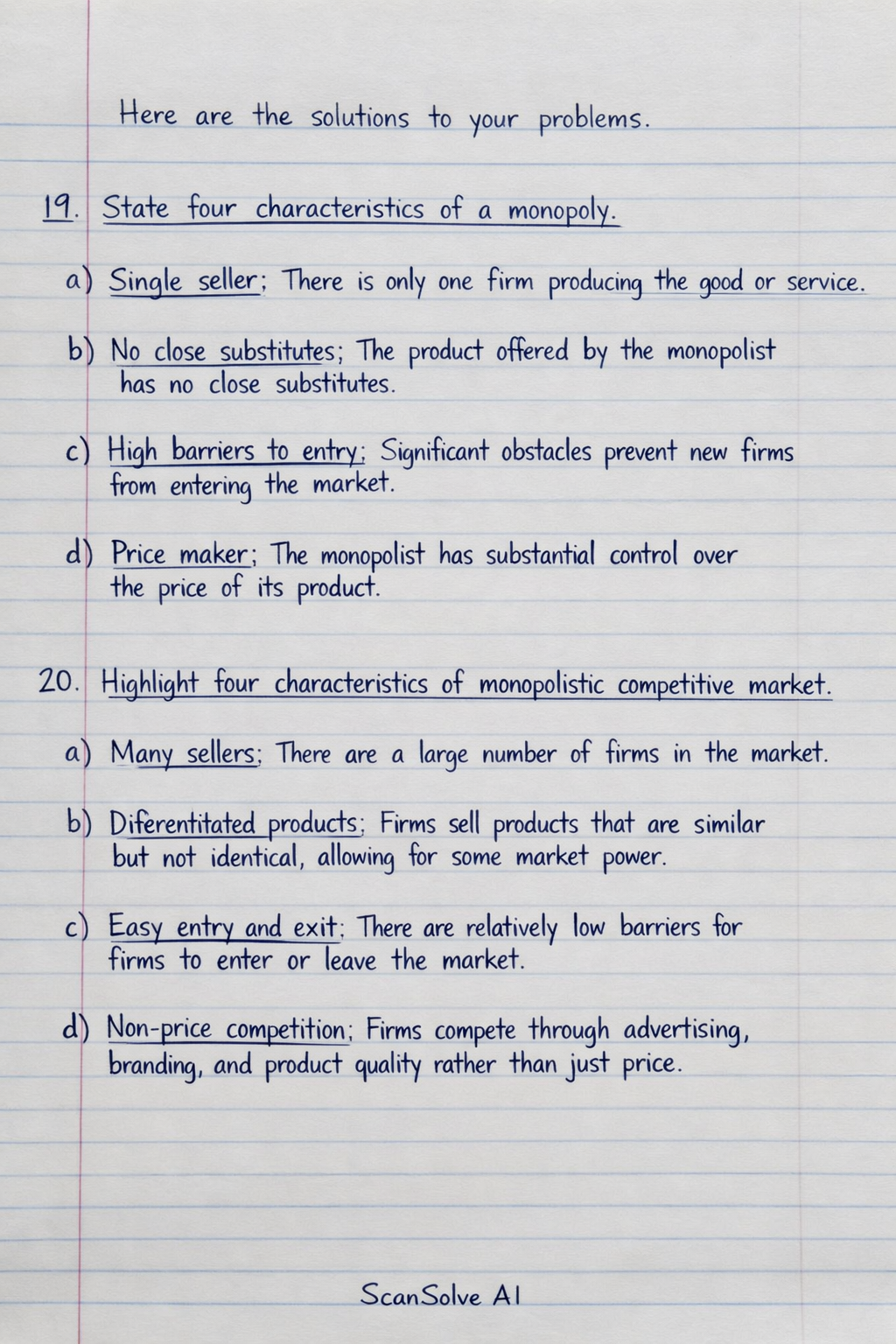
Here are the solutions to your problems. 19. State four characteristics of a monopoly. a) Single seller: There is only one firm producing the good or service. b) No close substitutes: The product offered by the monopolist has no close substitutes. c) High barriers to entry: Significant obstacles prevent new firms from entering the market. d) Price maker: The monopolist has substantial control over the price of its product. 20. Highlight four characteristics of monopolistic competitive market. a) Many sellers: There are a large number of firms in the market. b) Differentiated products: Firms sell products that are similar but not identical, allowing for some market power. c) Easy entry and exit: There are relatively low barriers for firms to enter or leave the market. d) Non-price competition: Firms compete through advertising, branding, and product quality rather than just price. 21. State four circumstances in which a firm may acquire monopoly powers. a) Control over essential resources: A firm owns or controls a critical input necessary for production. b) Patents and copyrights: Legal protections grant exclusive rights to produce a good or use a process. c) Government licenses or franchises: The government grants exclusive rights to a single firm to operate in a market. d) Economies of scale (natural monopoly): A single firm can produce the entire market output at a lower cost than multiple firms. 22. Outline four features of oligopoly. a) Few large firms: The market is dominated by a small number of large firms. b) Interdependence: Firms' decisions significantly affect each other, leading to strategic behavior. c) Homogeneous or differentiated products: Products can be identical (e.g., oil) or differentiated (e.g., automobiles). d) High barriers to entry: Significant obstacles make it difficult for new firms to enter the market. 23. State four ways of determining prices of goods in oligopoly market structure. a) Collusion/Cartels: Firms secretly agree to fix prices or output levels. b) Price leadership: One dominant firm sets the price, and other firms follow. c) Kinked demand curve: Firms are reluctant to raise prices (fearing loss of market share) or lower prices (fearing a price war). d) Cost-plus pricing: Firms set prices by adding a markup to their average costs. 24. Identify the market structure described by each of the conditions given below. |c|c|c| & Condition & Market structure \\ (a) & The firm is the industry & Monopoly \\ (b) & Buyers and sellers have complete knowledge about entire market but cannot influence the market & Perfect Competition \\ (c) & Few large firms that dominate the market & Oligopoly \\ (d) & Comprised of many sellers of differentiated products & Monopolistic Competition \\ 25. Outline four difference between perfect competition and monopoly. a) Number of firms: Perfect competition has many small firms, while monopoly has one single firm. b) Product differentiation: Perfect competition features homogeneous products, while monopoly has a unique product with no close substitutes. c) Barriers to entry: Perfect competition has no barriers to entry or exit, whereas monopoly has high barriers to entry. d) Price control: Firms in perfect competition are price takers, having no control over price, while a monopolist is a price maker, having significant control over price. That's 2 down. 3 left today — send the next one.