
We read your photo as:
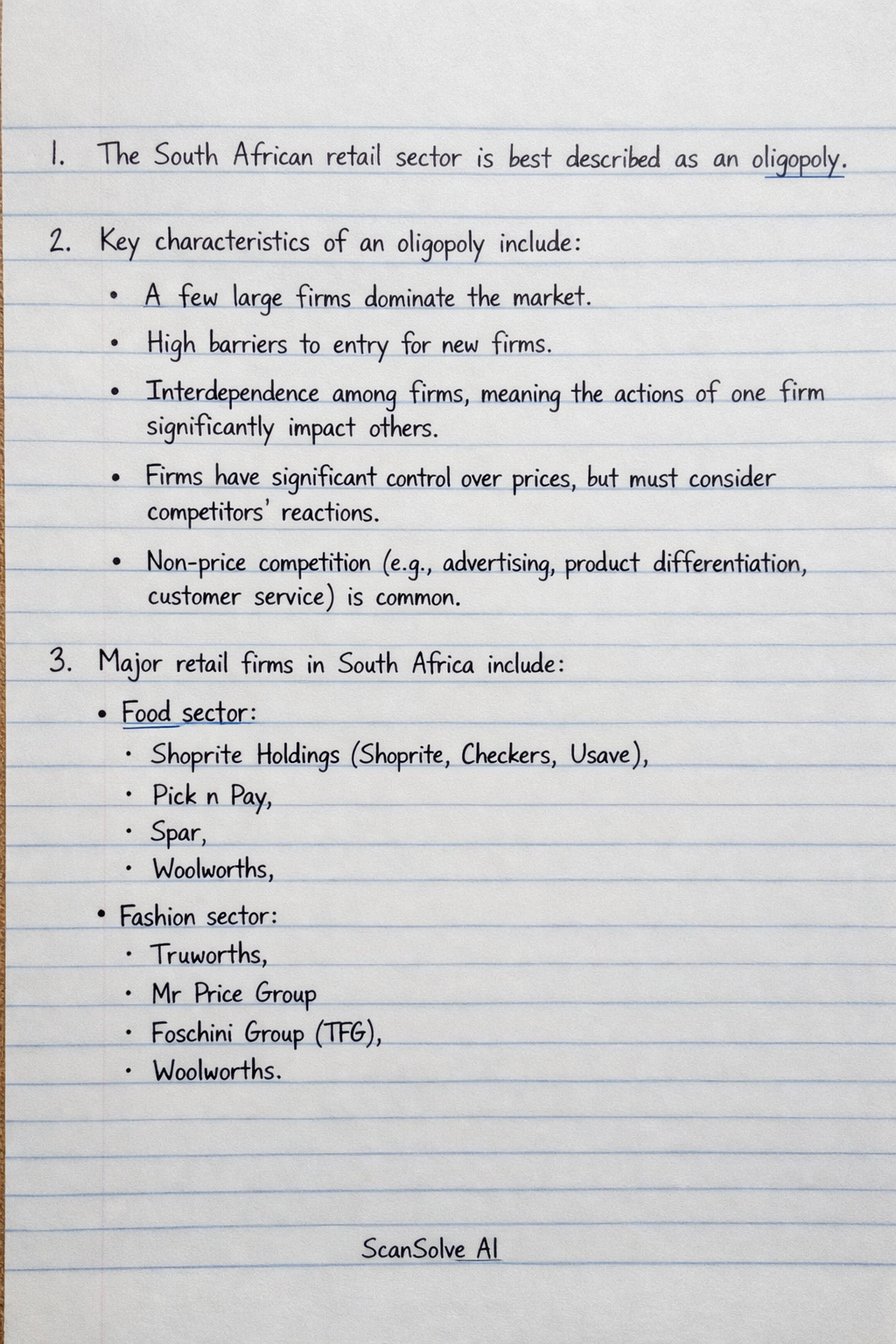
The South African retail sector is best described as an oligopoly.
ScanSolve AI Answer
-
The South African retail sector is best described as an oligopoly.
-
Key characteristics of an oligopoly include:
- A few large firms dominate the market.
- High barriers to entry for new firms.
- Interdependence among firms, meaning the actions of one firm significantly impact others.
- Firms have significant control over prices, but must consider competitors' reactions.
- Non-price competition (e.g., advertising, product differentiation, customer service) is common.
-
Major retail firms in South Africa include:
- Food sector: Shoprite Holdings (Shoprite, Checkers, Usave), Pick n Pay, Spar, Woolworths.
- Fashion sector: Truworths, Mr Price Group, Foschini Group (TFG), Woolworths.
-
These firms have significant control over prices. In an oligopoly, firms are not price takers; they have market power to influence prices. However, their pricing decisions are interdependent, meaning they must anticipate and react to competitors' pricing strategies. This can lead to price leadership, tacit collusion, or intense price competition.
-
Retail firms increase their market share through several strategies:
- Product differentiation: Offering unique product ranges, private labels, or premium quality (e.g., Woolworths).
- Extensive marketing and advertising: Building brand loyalty and attracting customers through promotions and campaigns.
- Store expansion and format diversification: Opening new stores in strategic locations and introducing different store formats (e.g., smaller convenience stores, larger hypermarkets).
- Competitive pricing and loyalty programs: Offering competitive prices, discounts, and loyalty rewards to retain customers.
- Supply chain efficiency: Optimizing logistics and operations to reduce costs and offer better value.
- E-commerce and omnichannel strategies: Expanding online presence and integrating it with physical stores to provide seamless shopping experiences.
-
The South African retail sector faces several threats, impacting consumers:
- Economic downturns and low consumer spending: High unemployment, inflation, and interest rates reduce disposable income, leading to lower sales for retailers. This results in reduced purchasing power for consumers, less product variety as retailers cut stock, and potential job losses in the sector.
- Rising operating costs: Increases in electricity (load shedding), fuel, labor, and rental costs squeeze retailers' profit margins. This leads to higher prices for consumers, reduced service quality, and fewer promotions.
- Intense competition: From both local and international players, including the growing e-commerce sector, forces retailers to compete aggressively. While this can lead to lower prices and more choice for consumers in the short term, it can also lead to market consolidation, potentially reducing choice in the long run if smaller retailers exit.
- Supply chain disruptions: Issues like port inefficiencies, global supply chain shocks, and local infrastructure challenges (e.g., road conditions) can delay stock and increase costs. This results in stockouts, higher prices due to increased logistics costs, and reduced freshness for perishable goods for consumers.
Still stuck on this one?
Ask a follow-up, and the answer starts from this question.
More Economics Questions
Handwritten Step-by-Step Solution
Get this as a handwritten image on WhatsApp — like a tutor wrote it for you.
Try on WhatsApp