From the complete table, identify any two relationships that exist between total utility and marginal utility.

Economics
From the complete table, identify any two relationships that exist between total utility and marginal utility.

ScanSolve AI Answer

Answer

30

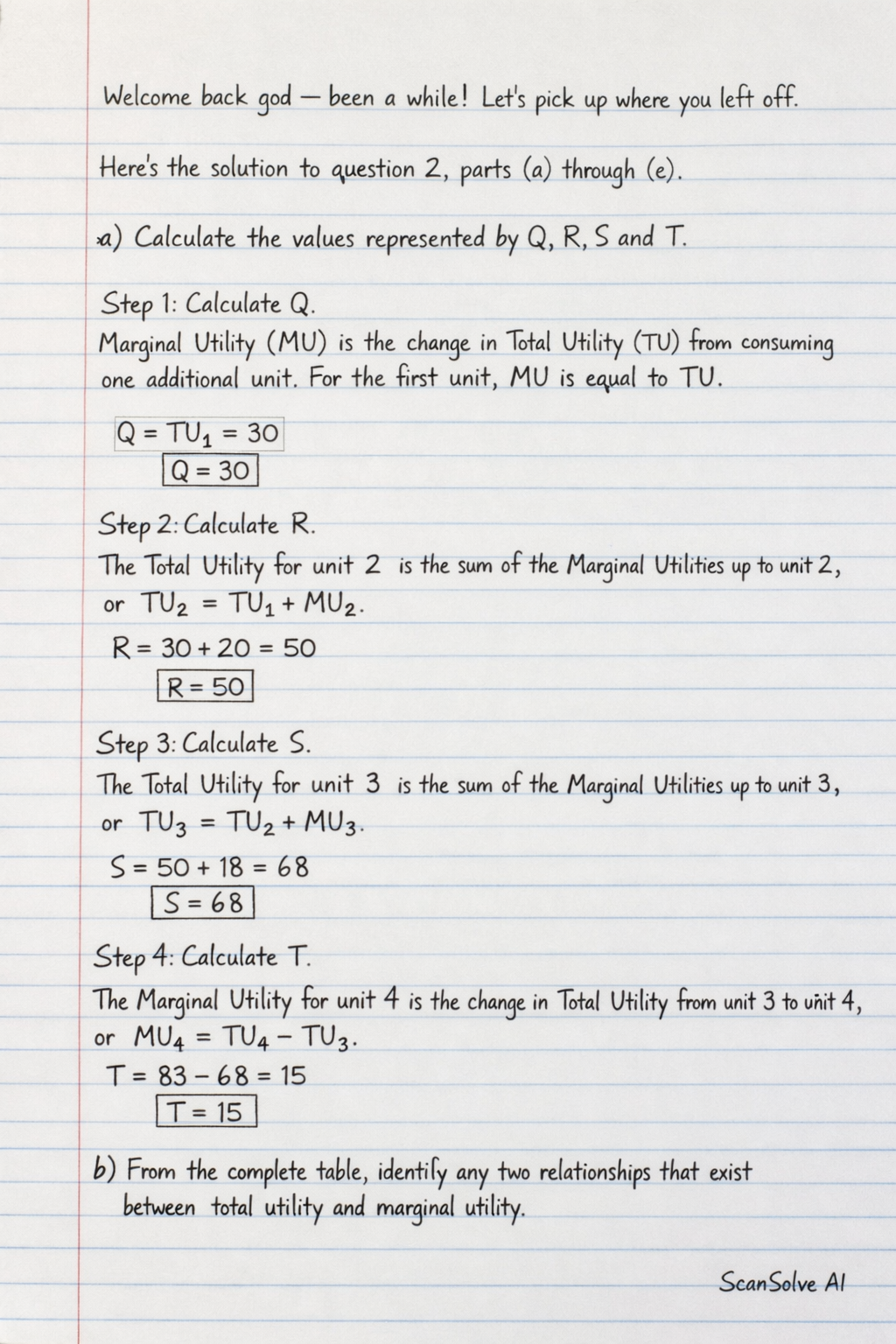
Here's the solution to question 2, parts (a) through (e).

a) Calculate the values represented by Q, R, S and T.

Step 1: Calculate Q. Marginal Utility (MU) is the change in Total Utility (TU) from consuming one additional unit. For the first unit, MU is equal to TU. Q=TU1=30Q = TU_1 = 30 Q=30Q = \text{30}

Step 2: Calculate R. The Total Utility for unit 2 is the sum of the Marginal Utilities up to unit 2, or TU2=TU1+MU2TU_2 = TU_1 + MU_2. R=30+20=50R = 30 + 20 = 50 R=50R = \text{50}

Step 3: Calculate S. The Total Utility for unit 3 is the sum of the Marginal Utilities up to unit 3, or TU3=TU2+MU3TU_3 = TU_2 + MU_3. S=50+18=68S = 50 + 18 = 68 S=68S = \text{68}

Step 4: Calculate T. The Marginal Utility for unit 4 is the change in Total Utility from unit 3 to unit 4, or MU4=TU4TU3MU_4 = TU_4 - TU_3. T=8368=15T = 83 - 68 = 15 T=15T = \text{15}

b) From the complete table, identify any two relationships that exist between total utility and marginal utility.

• Total utility increases as long as marginal utility is positive. • Total utility is maximized when marginal utility is zero. • When marginal utility is negative, total utility decreases. • Marginal utility decreases as total utility increases (Law of Diminishing Marginal Utility).

c) At what range of consumption is total utility increasing at a decreasing rate?

Total utility increases at a decreasing rate when marginal utility is positive but decreasing. From the table, this occurs from the 1st unit to the 4th unit.

The range is from the 1st unit to the 4th unit.

d) If the consumer were to be rational: (i) at what unit(s) will she be at equilibrium? Give a reason for your answer; (ii) state one factor that can cause the consumer to increase consumption beyond the level(s) identified in 2(d)(i).

(i) At equilibrium, a rational consumer maximizes utility. Given the price of a peanut is 15persachet,theconsumerwillconsumeuptothepointwhereMarginalUtility(MU)equalstheprice.Fromthetable,15 per sachet, the consumer will consume up to the point where Marginal Utility (MU) equals the price. From the table, MU_4 = 15.Theconsumerwillbeatequilibriumatthe4thunit.Reason:Atthispoint,themarginalutilityderivedfromconsumingthe4thsachet(. The consumer will be at equilibrium at the *4th unit*. Reason: At this point, the marginal utility derived from consuming the 4th sachet (15) is equal to the price of the sachet ($15), meaning the consumer gets maximum satisfaction for their money.

(ii) One factor that can cause the consumer to increase consumption beyond the 4th unit is a decrease in the price of peanuts. If the price falls below $15, the consumer would be willing to consume more units as long as the marginal utility is greater than or equal to the new lower price.

e) Explain the effect of the consumption of the 6th sachet on the consumer.

The consumption of the 6th sachet results in a negative marginal utility of -5. This means that consuming the 6th sachet actually decreases the consumer's total utility from 83 to 78, causing dissatisfaction or disutility.

Send me the next one 📸

Was this helpful?

Need help with your own homework?

Get instant step-by-step solutions to any question. Free to start.

Ask Your Question
Handwritten step-by-step solution preview

Handwritten Step-by-Step Solution

Get this as a handwritten image on WhatsApp — like a tutor wrote it for you.

Try on WhatsApp

Still have questions?

Quick Answer
  1. Here's the solution to question 2, parts (a) through (e).
  2. a) Calculate the values represented by Q, R, S and T.
  3. Marginal Utility (MU) is the change in Total Utility (TU) from consuming one additional unit.
  4. For the first unit, MU is equal to TU.
From the complete table, identify any two relationships that exist between total utility and marginal utility.
Economics

This economics question tests your understanding of economic models and analysis. The step-by-step answer below applies the relevant framework and explains the reasoning.

ScanSolve AI Answer
Here's the solution to question 2, parts (a) through (e). a) Calculate the values represented by Q, R, S and T. Step 1: Calculate Q. Marginal Utility (MU) is the change in Total Utility (TU) from consuming one additional unit. For the first unit, MU is equal to TU. Q = TU_1 = 30 Q = 30 Step 2: Calculate R. The Total Utility for unit 2 is the sum of the Marginal Utilities up to unit 2, or TU_2 = TU_1 + MU_2. R = 30 + 20 = 50 R = 50 Step 3: Calculate S. The Total Utility for unit 3 is the sum of the Marginal Utilities up to unit 3, or TU_3 = TU_2 + MU_3. S = 50 + 18 = 68 S = 68 Step 4: Calculate T. The Marginal Utility for unit 4 is the change in Total Utility from unit 3 to unit 4, or MU_4 = TU_4 - TU_3. T = 83 - 68 = 15 T = 15 b) From the complete table, identify any two relationships that exist between total utility and marginal utility. • Total utility increases as long as marginal utility is positive. • Total utility is maximized when marginal utility is zero. • When marginal utility is negative, total utility decreases. • Marginal utility decreases as total utility increases (Law of Diminishing Marginal Utility). c) At what range of consumption is total utility increasing at a decreasing rate? Total utility increases at a decreasing rate when marginal utility is positive but decreasing. From the table, this occurs from the 1st unit to the 4th unit. The range is from the 1st unit to the 4th unit. d) If the consumer were to be rational: (i) at what unit(s) will she be at equilibrium? Give a reason for your answer; (ii) state one factor that can cause the consumer to increase consumption beyond the level(s) identified in 2(d)(i). (i) At equilibrium, a rational consumer maximizes utility. Given the price of a peanut is 15 per sachet, the consumer will consume up to the point where Marginal Utility (MU) equals the price. From the table, MU_4 = 15. The consumer will be at equilibrium at the 4th unit. Reason: At this point, the marginal utility derived from consuming the 4th sachet (15) is equal to the price of the sachet (15), meaning the consumer gets maximum satisfaction for their money. (ii) One factor that can cause the consumer to increase consumption beyond the 4th unit is a decrease in the price of peanuts. If the price falls below 15, the consumer would be willing to consume more units as long as the marginal utility is greater than or equal to the new lower price. e) Explain the effect of the consumption of the 6th sachet on the consumer. The consumption of the 6th sachet results in a negative marginal utility of -5. This means that consuming the 6th sachet actually decreases the consumer's total utility from 83 to 78, causing dissatisfaction or disutility. Send me the next one 📸