

This economics question tests your understanding of economic models and analysis. The step-by-step answer below applies the relevant framework and explains the reasoning.
ScanSolve AI Answer
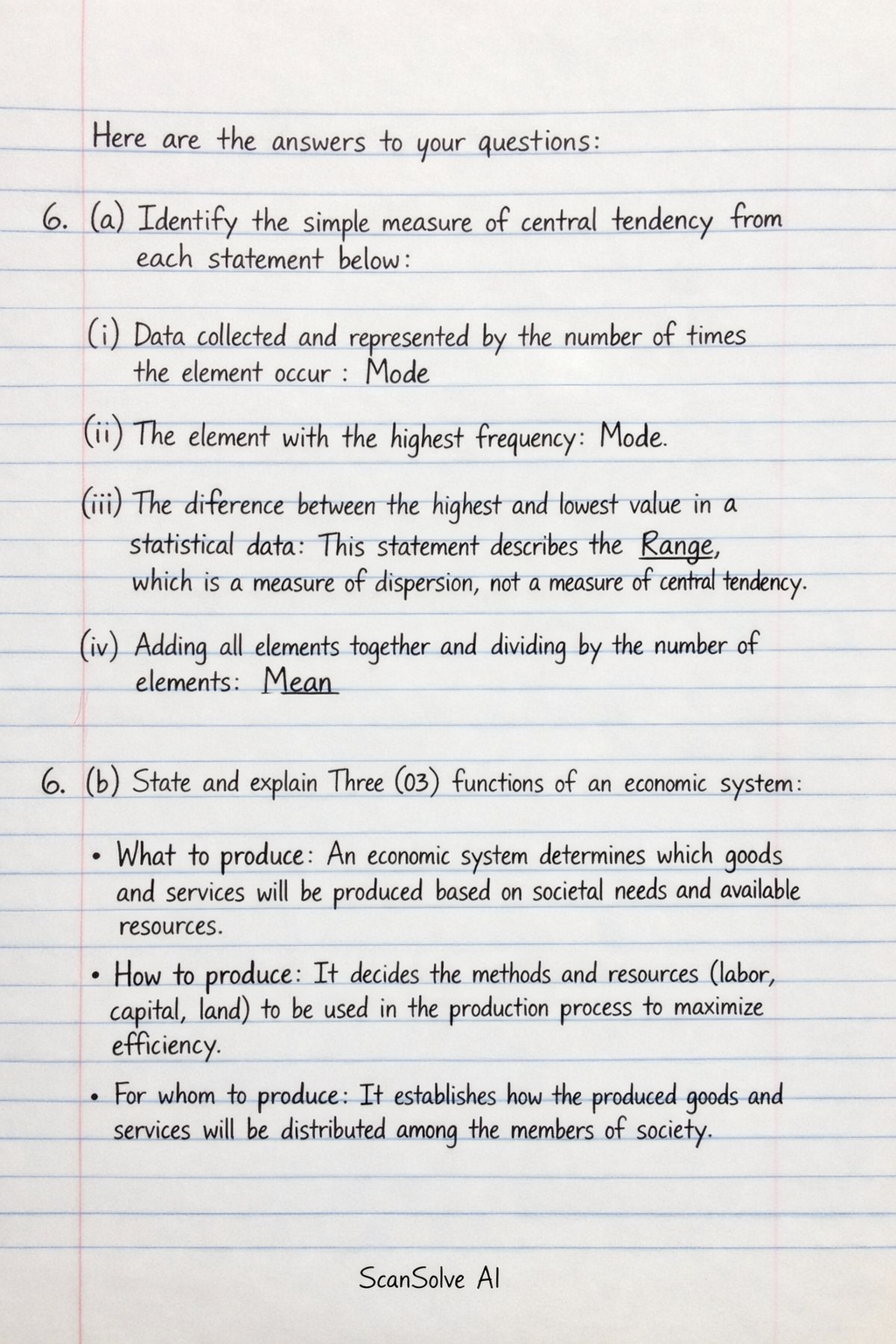
Here are the answers to your questions: 6. (a) Identify the simple measure of central tendency from each statement below: (i) Data collected and represented by the number of times the element occur: Mode* (ii) The element with the highest frequency: Mode* (iii) The difference between the highest and lowest value in a statistical data: This statement describes the Range*, which is a measure of dispersion, not a measure of central tendency. (iv) Adding all elements together and dividing by the number of elements: Mean* 6. (b) State and explain Three (03) functions of an economic system. What to produce: An economic system determines which goods and services will be produced based on societal needs and available resources. How to produce: It decides the methods and resources (labor, capital, land) to be used in the production process to maximize efficiency. For whom to produce: It establishes how the produced goods and services will be distributed among the members of society. 6. (c) What are the characteristics of the economic system practiced by your country? Assuming a mixed economy (common in many countries, including Cameroon): Private ownership of resources: Individuals and private firms own and control most productive assets. Government intervention: The government plays a significant role in regulating markets, providing public goods, and redistributing income. Market forces: Prices and production are largely determined by supply and demand, but with some government influence. 6. (d) State and explain Two (2) advantages of a market economy. Efficiency: Market economies tend to be efficient in allocating resources because competition encourages firms to produce goods and services at the lowest possible cost. Innovation and growth: The profit motive and competition incentivize businesses to innovate, develop new products, and improve production methods, leading to economic growth. 7. (a) Define the following: (i) Central bank: The primary financial institution of a country, responsible for managing monetary policy, issuing currency, and regulating commercial banks. (ii) Cheque: A written order instructing a bank to pay a specified sum of money from the drawer's account to the person or entity named on the cheque. (iii) Collateral: An asset pledged by a borrower to a lender as security for a loan, which can be seized by the lender if the borrower defaults. (iv) Token coin: A coin whose face value is significantly higher than the intrinsic metallic value of the material it is made from. 7. (b) (i) State and explain Three (03) advantages of using a cheque. Security: Cheques reduce the risk of carrying large amounts of cash, as they can be cancelled if lost or stolen. Record-keeping: Cheques provide a clear paper trail of transactions, making it easier to track payments and manage finances. Convenience: They allow for large payments to be made easily without the need for physical cash, and can be mailed to payees. 7. (b) (ii) Explain Three (03) functions of BEAC to member countries. Issuance of currency: BEAC (Banque des États de l'Afrique Centrale) is the sole issuer of the CFA franc currency for its member states. Monetary policy: It formulates and implements monetary policy to maintain price stability and support economic growth within the CEMAC zone. Banker to governments: BEAC acts as the banker for the governments of its member countries, managing their accounts and providing financial services. 8. (a) Distinguish between the following: (i) Birth rate and death rate: Birth rate is the number of live births per 1,000 people in a population per year, while death rate* is the number of deaths per 1,000 people in a population per year. (ii) Emigration and immigration: Emigration is the act of leaving one's own country to settle permanently in another, whereas immigration* is the act of coming to live permanently in a foreign country. (iii) Overpopulation and underpopulation: Overpopulation occurs when a population exceeds the carrying capacity of its environment, leading to resource scarcity and environmental degradation. Underpopulation* occurs when a population is too small to fully utilize its available resources and achieve optimal economic development. (iv) A growing population and an aging population: A growing population is characterized by a high birth rate and a large proportion of young people, leading to an increase in overall population size. An aging population* is characterized by a low birth rate and an increasing proportion of elderly people, often resulting from increased life expectancy and declining fertility. 8. (b) State and explain Four (04) reasons why the Cameroon government will decide to carry out a population census. Resource allocation: A census provides accurate data on population distribution, age structure, and household size, which is crucial for allocating resources for public services like healthcare, education, and housing. Infrastructure planning: Census data helps the government plan and develop essential infrastructure such as roads, schools, hospitals, and utilities to meet the needs of the population. Policy formulation: It provides vital demographic information for developing and evaluating social and economic policies, including employment strategies, poverty reduction programs, and family planning initiatives. Electoral boundary demarcation: Census results are used to redraw electoral boundaries, ensuring fair representation based on the distribution of the population. Send me the next one 📸