If a person's expenditure increased by 15% and their savings decreased from 24% to 22.5% of their income, by what percentage did their income increase?
|Economics
If a person's expenditure increased by 15% and their savings decreased from 24% to 22.5% of their income, by what percentage did their income increase?
ScanSolve AI Answer
Answer
12.77%
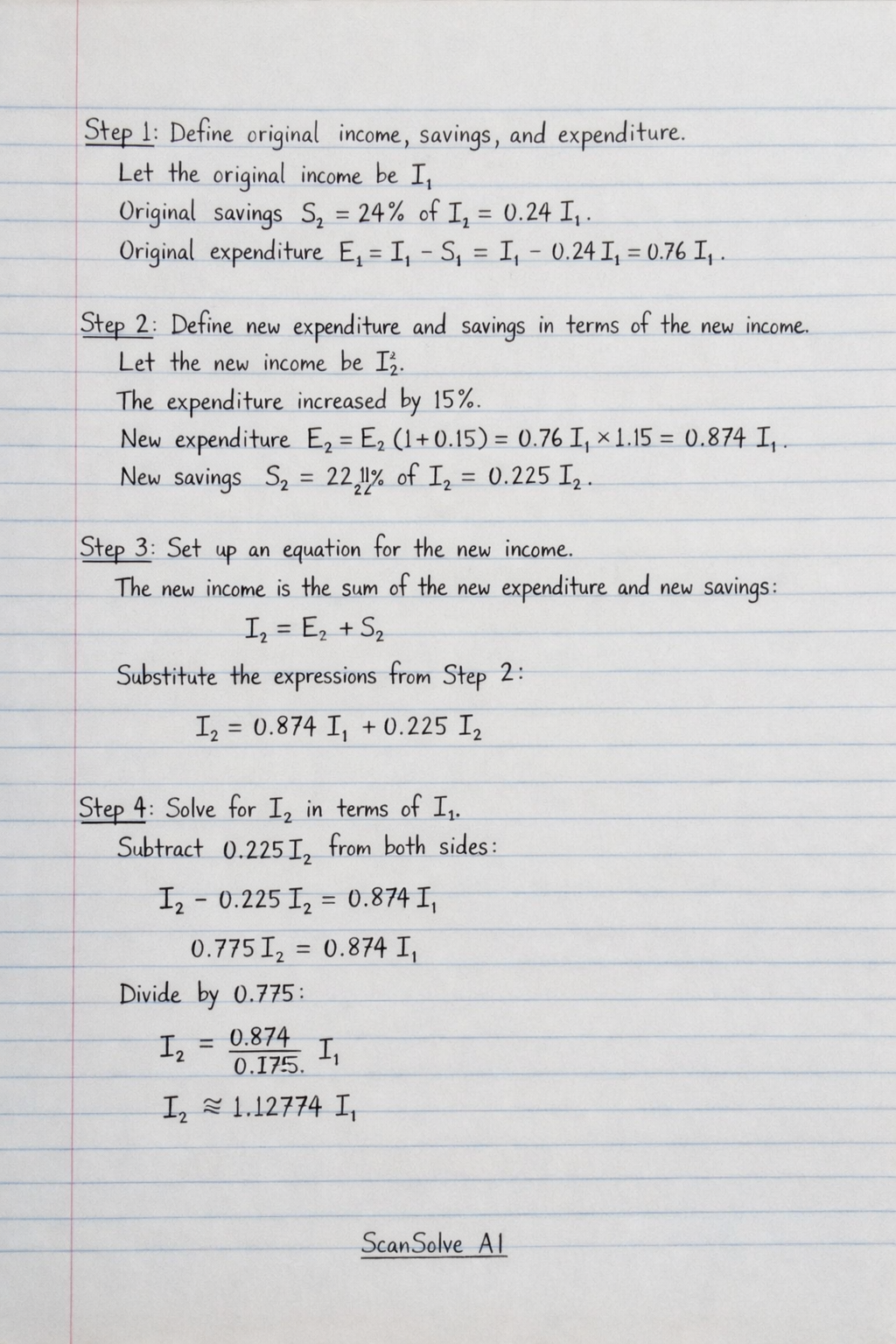
Step 1: Define original income, savings, and expenditure.
Let the original income be I1.
Original savings S1=24% of I1=0.24I1.
Original expenditure E1=I1−S1=I1−0.24I1=0.76I1.
Step 2: Define new expenditure and savings in terms of the new income.
Let the new income be I2.
The expenditure increased by 15%.
New expenditure E2=E1×(1+0.15)=0.76I1×1.15=0.874I1.
New savings S2=2221% of I2=0.225I2.
Step 3: Set up an equation for the new income.
The new income is the sum of the new expenditure and new savings:
I2=E2+S2
Substitute the expressions from Step 2:
I2=0.874I1+0.225I2
Step 4: Solve for I2 in terms of I1.
Subtract 0.225I2 from both sides:
I2−0.225I2=0.874I10.775I2=0.874I1
Divide by 0.775:
I2=0.7750.874I1I2≈1.12774I1
Step 5: Calculate the percentage increase in income.
Percentage increase =I1I2−I1×100%Percentageincrease=(I11.12774I1−I1)×100%Percentageincrease=(1.12774−1)×100%Percentageincrease=0.12774×100%Percentageincrease≈12.77%
The percentage increase of his income is 12.77%.
Step 1: Find the position vector of T, the mid-point of BL.
The position vectors are OB=(8−4) and OL=(46).
OT=21(OB+OL)=21((8−4)+(46))OT=21(8+4−4+6)=21(122)=(61)
Step 2: Find the position vector of I, the mid-point of UL.
The position vectors are OU=(−6−8) and OL=(46).
OI=21(OU+OL)=21((−6−8)+(46))OI=21(−6+4−8+6)=21(−2−2)=(−1−1)
Step 3: Find the vector TI.
TI=OI−OTTI=(−1−1)−(61)=(−1−6−1−1)=(−7−2)
Step 4: Find the magnitude of TI.
The magnitude of a vector (xy) is x2+y2.
∣TI∣=(−7)2+(−2)2∣TI∣=49+4∣TI∣=53
The magnitude of TI is 53.
Step 1: Understand the problem.
The man takes an exact number of steps, whether his stride is 60 cm or 64 cm. This means the total width of the road must be a common multiple of 60 cm and 64 cm. To find the least width, we need to find the Least Common Multiple (LCM).
Step 2: Find the prime factorization of 60 and 64.
60=2×30=2×2×15=22×3×564=2×32=2×2×16=2×2×2×8=2×2×2×2×4=2×2×2×2×2×2=26
Step 3: Calculate the LCM of 60 and 64.
To find the LCM, take the highest power of all prime factors present in either number.
LCM(60,64)=26×31×51LCM(60,64)=64×3×5LCM(60,64)=64×15LCM(60,64)=960cm
Step 4: Convert the width to metres.
Since 1 metre = 100 cm:
960cm=100960m=9.6m
The least width of the road is 9.6metres.
3 done, 2 left today. You're making progress.
Was this helpful?
Need help with your own homework?
Get instant step-by-step solutions to any question. Free to start.
Define original income, savings, and expenditure. Let the original income be I_1.
If a person's expenditure increased by 15% and their savings decreased from 24% to 22.5% of their income, by what percentage did their income increase?
This economics question tests your understanding of economic models and analysis. The step-by-step answer below applies the relevant framework and explains the reasoning.
ScanSolve AI Answer
Step 1: Define original income, savings, and expenditure. Let the original income be I_1. Original savings S_1 = 24\% of I_1 = 0.24 I_1. Original expenditure E_1 = I_1 - S_1 = I_1 - 0.24 I_1 = 0.76 I_1. Step 2: Define new expenditure and savings in terms of the new income. Let the new income be I_2. The expenditure increased by 15\%. New expenditure E_2 = E_1 × (1 + 0.15) = 0.76 I_1 × 1.15 = 0.874 I_1. New savings S_2 = 22 (1)/(2)\% of I_2 = 0.225 I_2. Step 3: Set up an equation for the new income. The new income is the sum of the new expenditure and new savings: I_2 = E_2 + S_2 Substitute the expressions from Step 2: I_2 = 0.874 I_1 + 0.225 I_2 Step 4: Solve for I_2 in terms of I_1. Subtract 0.225 I_2 from both sides: I_2 - 0.225 I_2 = 0.874 I_1 0.775 I_2 = 0.874 I_1 Divide by 0.775: I_2 = (0.874)/(0.775) I_1 I_2 ≈ 1.12774 I_1 Step 5: Calculate the percentage increase in income. Percentage increase = (I_2 - I_1)/(I_1) × 100\% Percentage increase = ((1.12774 I_1 - I_1)/(I_1)) × 100\% Percentage increase = (1.12774 - 1) × 100\% Percentage increase = 0.12774 × 100\% Percentage increase ≈ 12.77\% The percentage increase of his income is 12.77\%. Step 1: Find the position vector of T, the mid-point of BL. The position vectors are OB = 8 \\ -4 and OL = 4 \\ 6 . OT = (1)/(2)(OB + OL) = (1)/(2)( 8 \\ -4 + 4 \\ 6 ) OT = (1)/(2) 8+4 \\ -4+6 = (1)/(2) 12 \\ 2 = 6 \\ 1 Step 2: Find the position vector of I, the mid-point of UL. The position vectors are OU = -6 \\ -8 and OL = 4 \\ 6 . OI = (1)/(2)(OU + OL) = (1)/(2)( -6 \\ -8 + 4 \\ 6 ) OI = (1)/(2) -6+4 \\ -8+6 = (1)/(2) -2 \\ -2 = -1 \\ -1 Step 3: Find the vector TI. TI = OI - OT TI = -1 \\ -1 - 6 \\ 1 = -1-6 \\ -1-1 = -7 \\ -2 Step 4: Find the magnitude of TI. The magnitude of a vector x \\ y is sqrt(x^2 + y^2). |TI| = sqrt((-7)^2 + (-2)^2) |TI| = sqrt(49 + 4) |TI| = sqrt(53) The magnitude of TI is sqrt(53). Step 1: Understand the problem. The man takes an exact number of steps, whether his stride is 60 cm or 64 cm. This means the total width of the road must be a common multiple of 60 cm and 64 cm. To find the least width, we need to find the Least Common Multiple (LCM). Step 2: Find the prime factorization of 60 and 64. 60 = 2 × 30 = 2 × 2 × 15 = 2^2 × 3 × 5 64 = 2 × 32 = 2 × 2 × 16 = 2 × 2 × 2 × 8 = 2 × 2 × 2 × 2 × 4 = 2 × 2 × 2 × 2 × 2 × 2 = 2^6 Step 3: Calculate the LCM of 60 and 64. To find the LCM, take the highest power of all prime factors present in either number. LCM(60, 64) = 2^6 × 3^1 × 5^1 LCM(60, 64) = 64 × 3 × 5 LCM(60, 64) = 64 × 15 LCM(60, 64) = 960 cm Step 4: Convert the width to metres. Since 1 metre = 100 cm: 960 cm = (960)/(100) m = 9.6 m The least width of the road is 9.6 metres. 3 done, 2 left today. You're making progress.