
We read your photo as:
In reference to the present PPC, which of the point(s) indicate that resources are fully utilized? Give a reason why; production cannot continue to point D? In solving an economic problem, using the economic method, briefly and precisely state the very first step to take.
ScanSolve AI Answer
here are the answers to the questions based on the Production Possibility Curve (PPC):
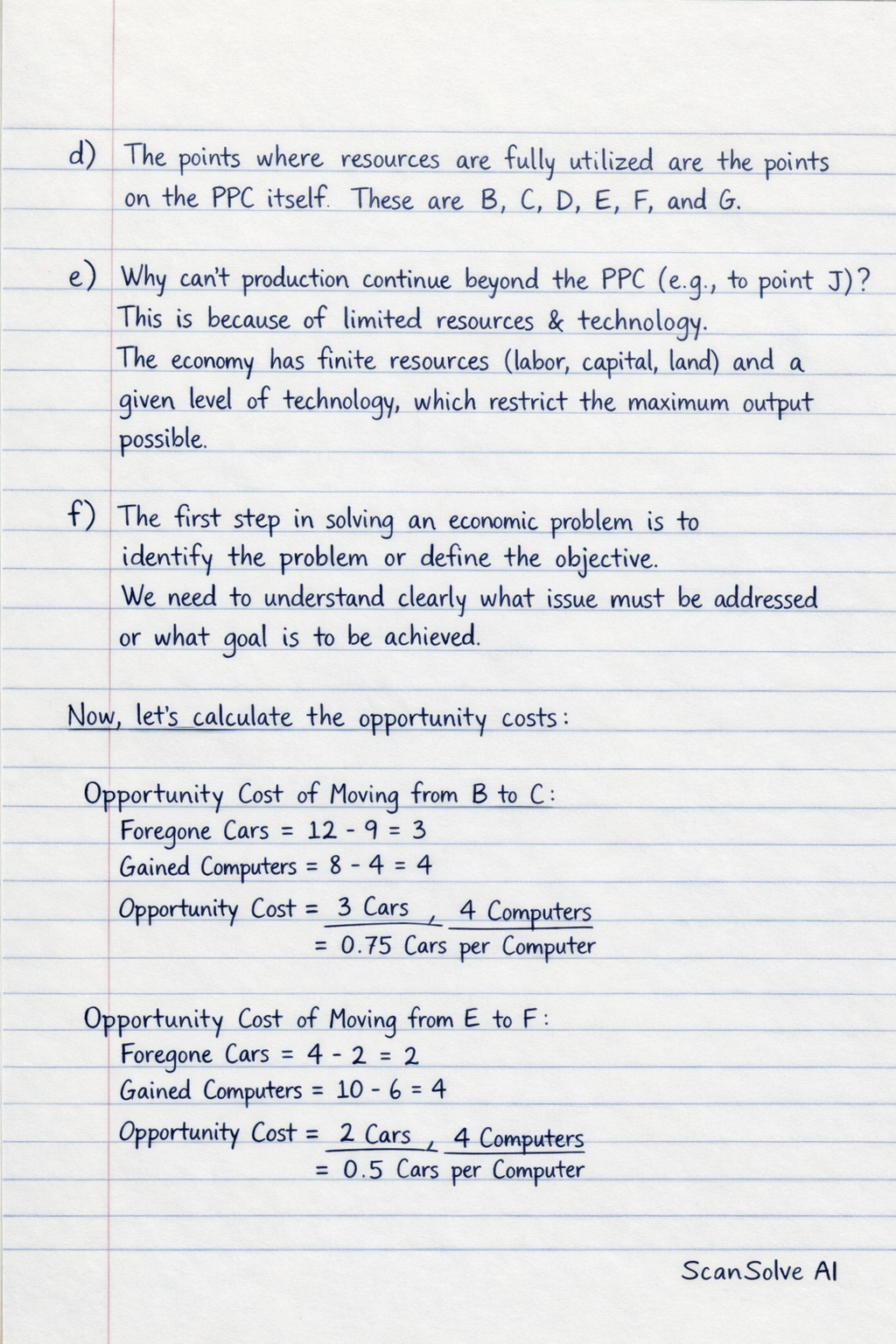
d) In reference to the present PPC, the point(s) that indicate resources are fully utilized are the points lying on the curve itself. These are B, C, D, E, F, and G.
e) The question "production cannot continue to point D?" is likely a typo, as point D is on the PPC and is attainable. Assuming it means "why production cannot continue beyond the PPC (e.g., to point J)", the reason is limited resources and technology. The economy has a finite amount of resources (like labor, capital, land) and a given level of technology, which restricts the maximum output it can achieve.
f) In solving an economic problem, using the economic method, the very first step to take is to identify the problem or define the objective. This involves clearly understanding what issue needs to be addressed or what goal needs to be achieved.
Now, let's calculate the opportunity costs:
a) To calculate the opportunity cost of producing 30 units of capital goods, we look at the shift from producing 0 capital goods to 30 capital goods.
Moving from point G (350 Consumer Goods, 0 Capital Goods) to point D (200 Consumer Goods, 30 Capital Goods):
The opportunity cost of producing 30 units of capital goods is 150 units of consumer goods.
b) To calculate the opportunity cost of producing 200 units of consumer goods, we look at the shift from producing 0 consumer goods to 200 consumer goods.
Moving from point A (0 Consumer Goods, 60 Capital Goods) to point D (200 Consumer Goods, 30 Capital Goods):
The opportunity cost of producing 200 units of consumer goods is 30 units of capital goods.
c) To calculate the opportunity cost of producing capital goods at point A, we consider moving from point B to point A (increasing capital goods).
Moving from point B (100 Consumer Goods, 50 Capital Goods) to point A (0 Consumer Goods, 60 Capital Goods):
The opportunity cost of producing 1 unit of capital good is .
d) To calculate the opportunity cost of producing consumer goods at point G, we consider moving from point F to point G (increasing consumer goods).
Moving from point F (300 Consumer Goods, 10 Capital Goods) to point G (350 Consumer Goods, 0 Capital Goods):
The opportunity cost of producing 1 unit of consumer good is .
e) To calculate the opportunity cost of producing capital goods from point C-D, we consider moving from point D to point C (increasing capital goods).
Moving from point D (200 Consumer Goods, 30 Capital Goods) to point C (150 Consumer Goods, 40 Capital Goods):
The opportunity cost of producing 1 unit of capital good is .
f) To calculate the opportunity cost of producing consumer goods from point F-E, we consider moving from point E to point F (increasing consumer goods).
Moving from point E (250 Consumer Goods, 20 Capital Goods) to point F (300 Consumer Goods, 10 Capital Goods):
The opportunity cost of producing 1 unit of consumer good is .
Still stuck on this one?
Ask a follow-up, and the answer starts from this question.
More Economics Questions
Handwritten Step-by-Step Solution
Get this as a handwritten image on WhatsApp — like a tutor wrote it for you.
Try on WhatsApp