

This economics question tests your understanding of economic models and analysis. The step-by-step answer below applies the relevant framework and explains the reasoning.
ScanSolve AI Answer
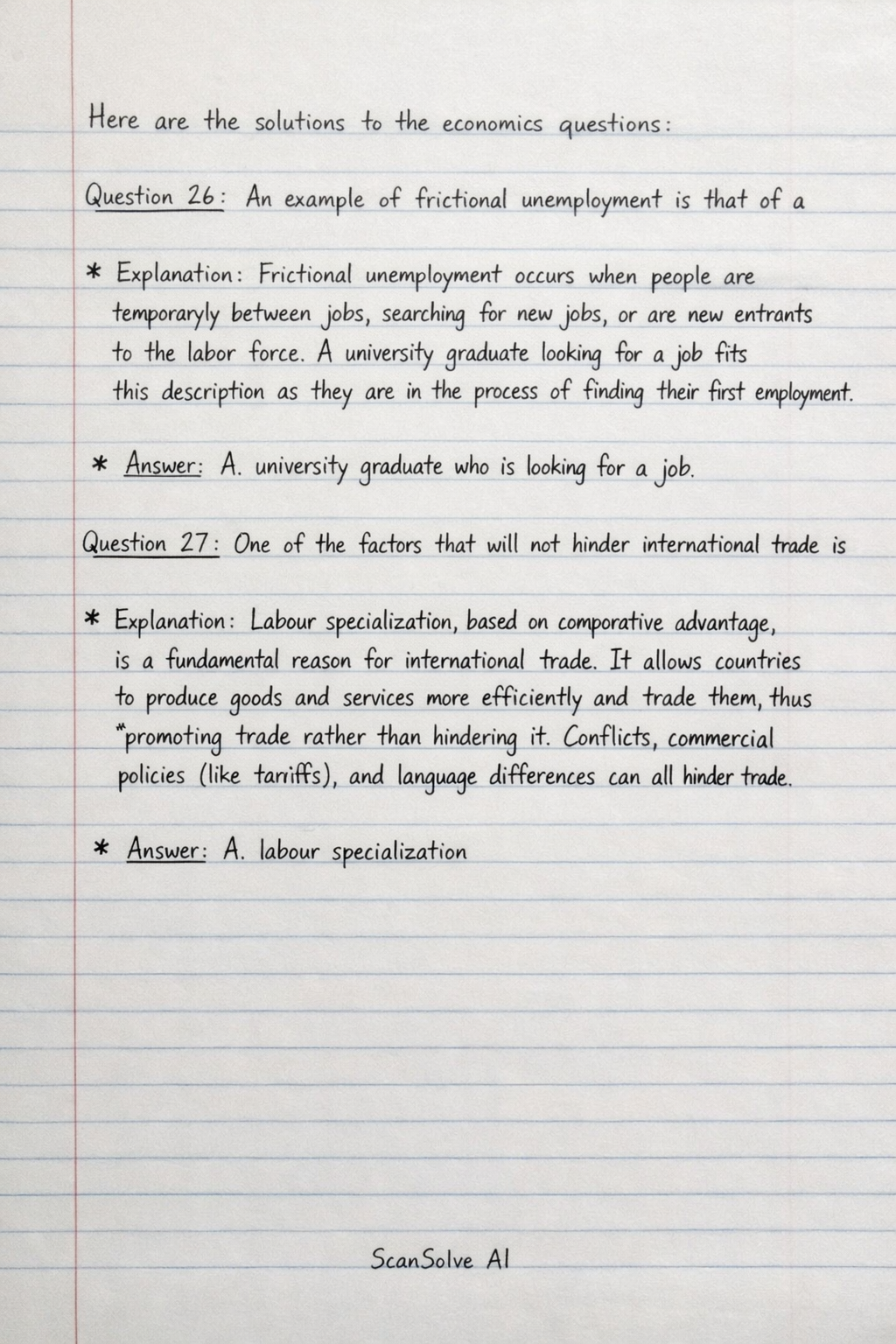
Here are the solutions to the economics questions: Question 26: An example of frictional unemployment is that of a Explanation: Frictional unemployment occurs when people are temporarily between jobs, searching for new jobs, or are new entrants to the labor force. A university graduate looking for a job fits this description as they are in the process of finding their first employment. Answer: A. university graduate who is looking for a job* Question 27: One of the factors that will not hinder international trade is Explanation: Labour specialization, based on comparative advantage, is a fundamental reason for international trade. It allows countries to produce goods and services more efficiently and trade them, thus promoting* trade rather than hindering it. Conflicts, commercial policies (like tariffs), and language differences can all hinder trade. Answer: A. labour specialization* Question 28: In capitalism, market forces do not determine the provision of Explanation: In a capitalist system, market forces (supply and demand) primarily determine the provision of most goods (producer, consumer, and economic goods). However, public goods* (e.g., national defense, street lighting) are typically not efficiently provided by market forces due to their non-rivalrous and non-excludable nature, leading to the free-rider problem. Governments usually step in to provide these. Answer: B. public goods* Question 29: In the short run, perishable foods like fresh tomatoes have Explanation: The supply of perishable goods in the short run is generally inelastic*. This means that the quantity supplied does not change significantly in response to a change in price because the goods cannot be stored for long, and production cannot be quickly adjusted. Answer: D. inelastic supply* Question 30: The monetary measure that can cause an increase in the supply of money is Explanation: Open market operations are a key monetary policy tool. When the Central Bank purchases securities* from the open market, it injects money into the banking system, increasing commercial banks' reserves and their ability to lend, thereby increasing the money supply. Answer: C. purchase of securities by the Central Bank from the open market* Question 31: Point S indicates that the Explanation: In a Production Possibility Curve (PPC), points outside* the curve (like S) represent combinations of goods that are currently unattainable with the economy's existing resources and technology. To reach such a point, the economy needs to experience economic growth, which means an increase in resources or technological advancement. Answer: D. economy must grow to produce there* Question 32: The estimated cost of inputs personally-owned and used by an entrepreneur in his business is Explanation: Implicit costs* are the opportunity costs of using resources that the firm or entrepreneur already owns, for which no direct monetary payment is made. Examples include the entrepreneur's own time, or the use of their own building. These are estimated values, unlike explicit costs which are direct out-of-pocket expenses. Answer: D. implicit cost* Question 33: If the demand for chicken is inelastic between October and December but elastic at other months in the year, then to increase total revenue, the farmer should Explanation: When demand is inelastic, an increase in price leads to an increase in total revenue. So, between October and December, the farmer should increase price*. When demand is elastic, a decrease in price leads to an increase in total revenue. So, in other months, the farmer should reduce price*. Answer: D. increase price between October and December and reduce price at other months in the year* 3 done, 2 left today. You're making progress.