
We read your photo as:
Define the informal sector in South Africa and outline the key steps for researching its economic impact.
ScanSolve AI Answer
Step-by-step solution
10 stepsThe informal sector in South Africa refers to economic activities that are not regulated or protected by the state. These jobs are often characterized by low entry barriers, small scale of operation, and lack of formal contracts or social security. It is also known as the "second economy" and plays a significant role in providing livelihoods, especially for those unable to find formal employment.
Here's a breakdown of the research study steps:
Hypothesis
A hypothesis is a testable statement or educated guess about the relationship between variables. For your topic, an example could be: "The informal sector significantly contributes to local employment and economic activity in South Africa, particularly for low-income households."
Research Question/Problem Statement
This defines the specific issue your research will address. It should be clear and focused.
Example: "What is the impact of the informal sector on the local economy and employment in South Africa?"Aims/Objectives
These are the specific goals your research intends to achieve. They should be measurable and directly relate to your research question.
Examples:- To identify the types of jobs available in the informal sector.
- To analyze the contribution of the informal sector to local economic growth.
- To assess the impact of the informal sector on employment rates and poverty reduction.
Data Collection Methods
This describes how you will gather information. Common methods include:
- Surveys: Questionnaires distributed to informal sector workers or consumers.
- Interviews: One-on-one conversations with key informants (e.g., informal traders, local government officials, community leaders).
- Observation: Directly observing activities in informal markets or areas.
- Secondary data analysis: Reviewing existing reports, academic articles, government statistics (e.g., from Statistics South Africa).
Data Analysis
This involves processing and interpreting the collected data to find patterns, trends, and insights.
- Qualitative analysis: Thematic analysis of interview transcripts or observational notes to identify recurring themes.
- Quantitative analysis: Statistical analysis of survey data (e.g., calculating percentages, averages) to identify numerical relationships.
Findings/Results
This section presents the raw data and the outcomes of your analysis without interpretation. It should directly answer your research questions and support or refute your hypothesis. Use graphs, tables, and descriptive statistics where appropriate.
Conclusion
Summarize your main findings and state whether your hypothesis was supported or rejected. This section should directly address your research question and objectives, providing a concise overview of what you discovered.
Recommendations
Based on your findings, suggest practical actions or policies. These should be specific and actionable.
Example: "Based on the significant employment provided by the informal sector, local municipalities should implement policies to formalize and support informal traders through training and access to micro-finance."Limitations
Acknowledge any constraints or weaknesses in your research design or execution. This demonstrates critical thinking.
Examples: "The study was limited to a specific geographic area, which may affect the generalizability of the findings," or "Time constraints limited the sample size for interviews."Bibliography
List all sources you consulted and cited in your research, following a consistent referencing style (e.g., Harvard, APA). This gives credit to original authors and allows readers to find your sources.
Example:- Statistics South Africa. (2023). Quarterly Labour Force Survey. Pretoria: Stats SA.
- Chen, M. A. (2012). The Informal Economy: Definitions, Theories and Policies. WIEGO Working Paper No. 1.
Still stuck on this one?
Ask a follow-up, and the answer starts from this question.
More Economics Questions
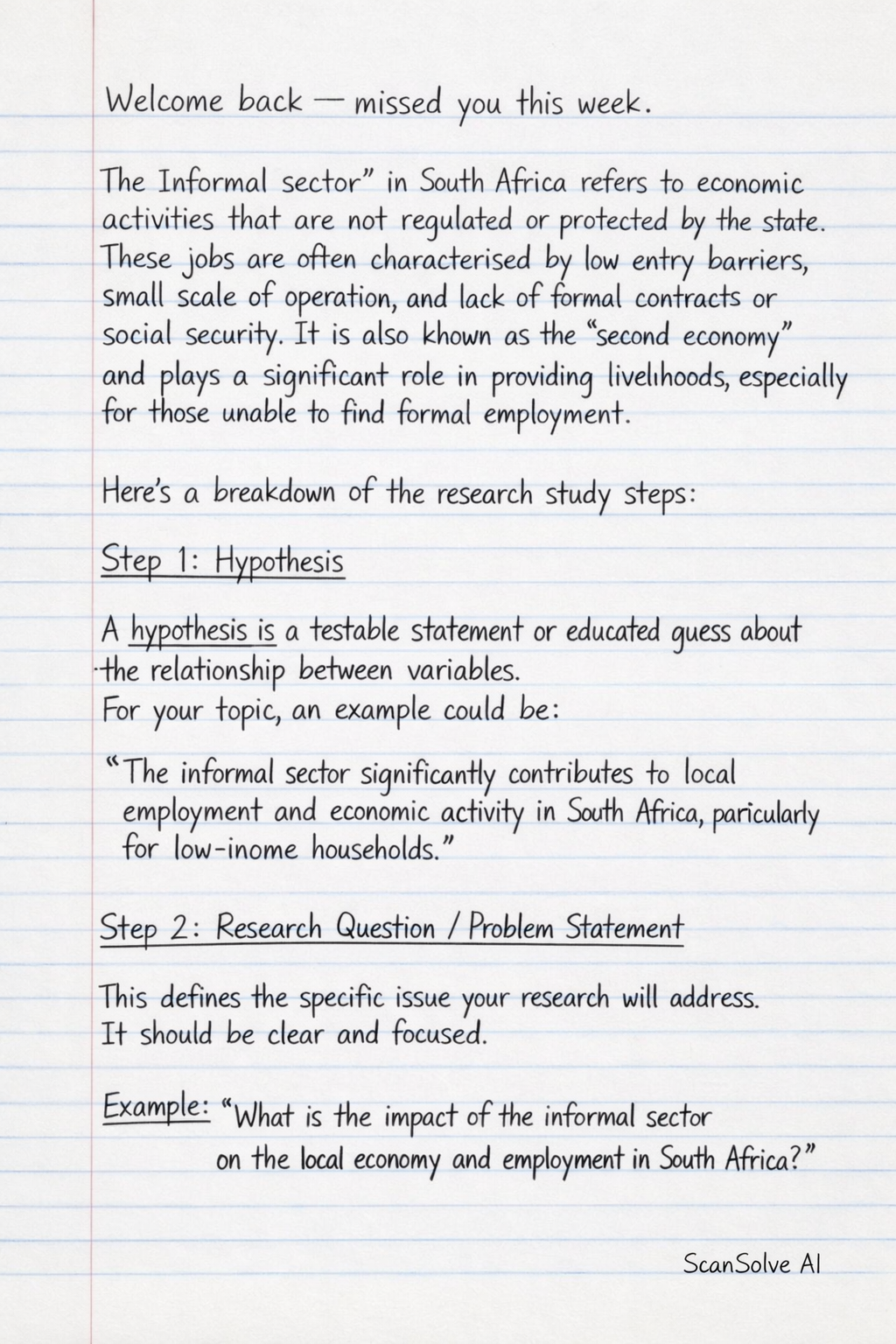
Handwritten Step-by-Step Solution
Get this as a handwritten image on WhatsApp — like a tutor wrote it for you.
Try on WhatsApp