
We read your photo as:
How is long-run equilibrium achieved in a perfect market after a short-run economic loss?
Economics
ScanSolve AI Answer
Answer
To explain how long-run equilibrium is achieved in a perfect market when an economic loss was made in the short run, we use two graphs: one for the individual firm and one for the entire industry.
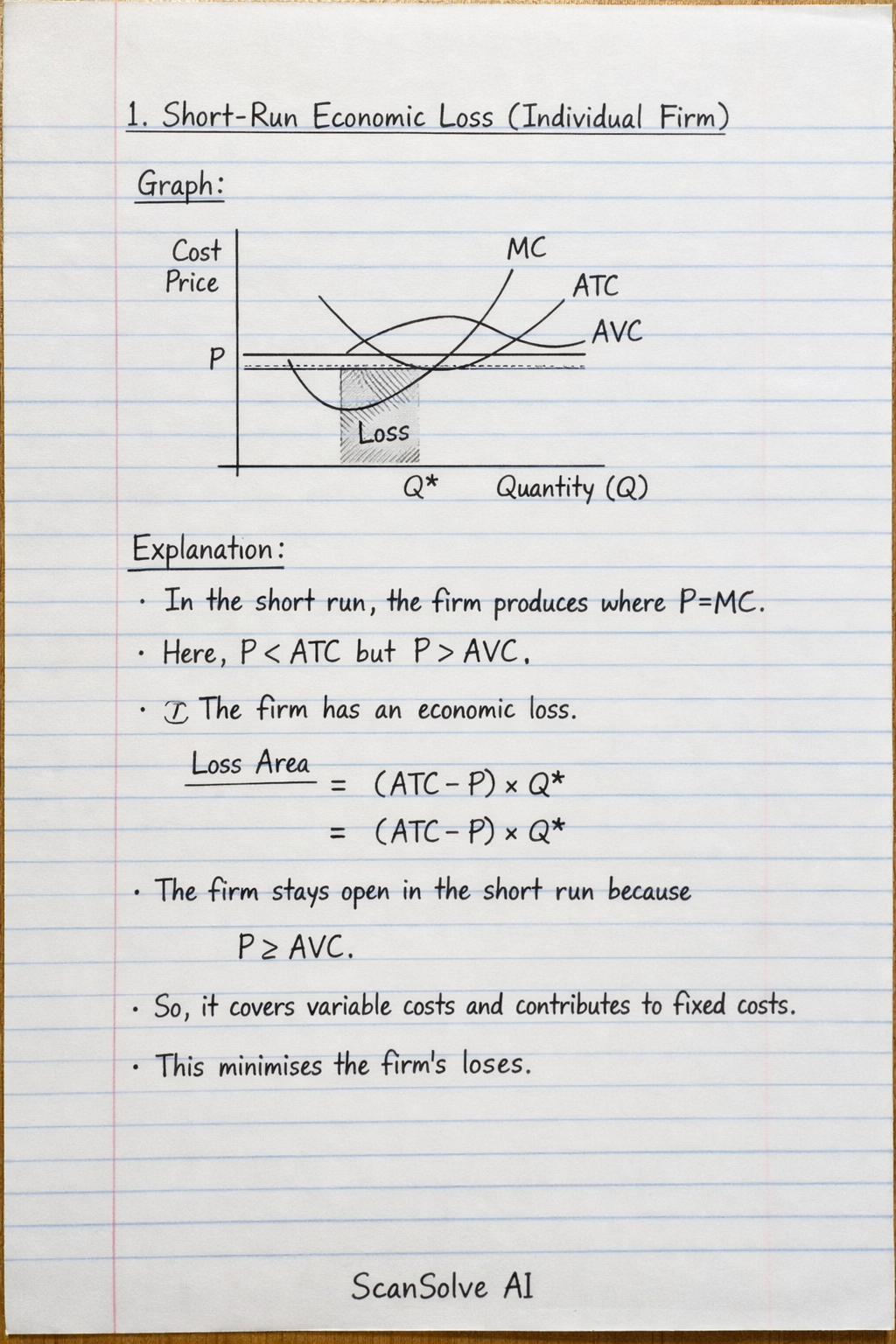
1. Short-Run Economic Loss (Individual Firm Graph)
- Graph Description:
- Horizontal axis: Quantity (Q)
- Vertical axis: Cost/Price
- Curves: Marginal Cost (MC), Average Total Cost (ATC), Average Variable Cost (AVC).
- Market Price (P): A horizontal line, which is also the firm's Marginal Revenue (MR) and Average Revenue (AR).
- Explanation: In the short run, the firm produces at the quantity where . If this price (P) is below the minimum point of the ATC curve but above the minimum point of the AVC curve, the firm is making an economic loss. It continues to operate to cover variable costs and contribute to fixed costs, thus minimizing its losses.
2. Industry Response and Long-Run Adjustment (Industry Graph)
- Graph Description:
- Horizontal axis: Industry Quantity (Q)
- Vertical axis: Price (P)
- Curves: Industry Demand (D) and Industry Supply (S).
- Explanation: When firms in the industry are experiencing economic losses, it signals that resources are not earning their normal rate of return. In the long run, firms will begin to exit the industry.
- As firms exit, the industry supply curve (S) shifts to the left, indicating a decrease in total market supply.
- With a reduced supply and unchanged demand, the market price (P) will increase.
3. Achieving Long-Run Equilibrium (Both Graphs)
- Individual Firm Adjustment: The rising market price (P) for the individual firm means its horizontal demand/MR/AR curve shifts upwards. This reduces the economic losses for the remaining firms.
- Long-Run Equilibrium Condition: Firms will continue to exit, and the market price will continue to rise, until the price reaches the minimum point of the Average Total Cost (ATC) curve for the typical firm.
- At this point, .
- Firms are now earning zero economic profit (or normal profit). This means they are covering all their explicit and implicit costs, including the opportunity cost of capital.
- Stability: With zero economic profit, there is no incentive for new firms to enter the industry (because there are no supernormal profits) and no incentive for existing firms to exit (because they are covering all their costs). The industry is in a stable long-run equilibrium.
Was this helpful?
Still stuck on this one?
Ask a follow-up, and the answer starts from this question.
Got a different question?Ask your own question
More Economics Questions
QTo explain how long-run equilibrium is achieved in a perfect market when an economic loss was made…QThis question asks to identify the equilibrium point for an individual firm, explain why the…QTo explain the economic loss of a firm in a perfectly competitive market using a graph:QExplain the characteristics of a perfect market and analyze a firm's profit maximization and…QExplain why imperfect competition leads to market failure.
Handwritten Step-by-Step Solution
Get this as a handwritten image on WhatsApp — like a tutor wrote it for you.
Try on WhatsApp