
This economics question tests your understanding of economic models and analysis. The step-by-step answer below applies the relevant framework and explains the reasoning.
ScanSolve AI Answer
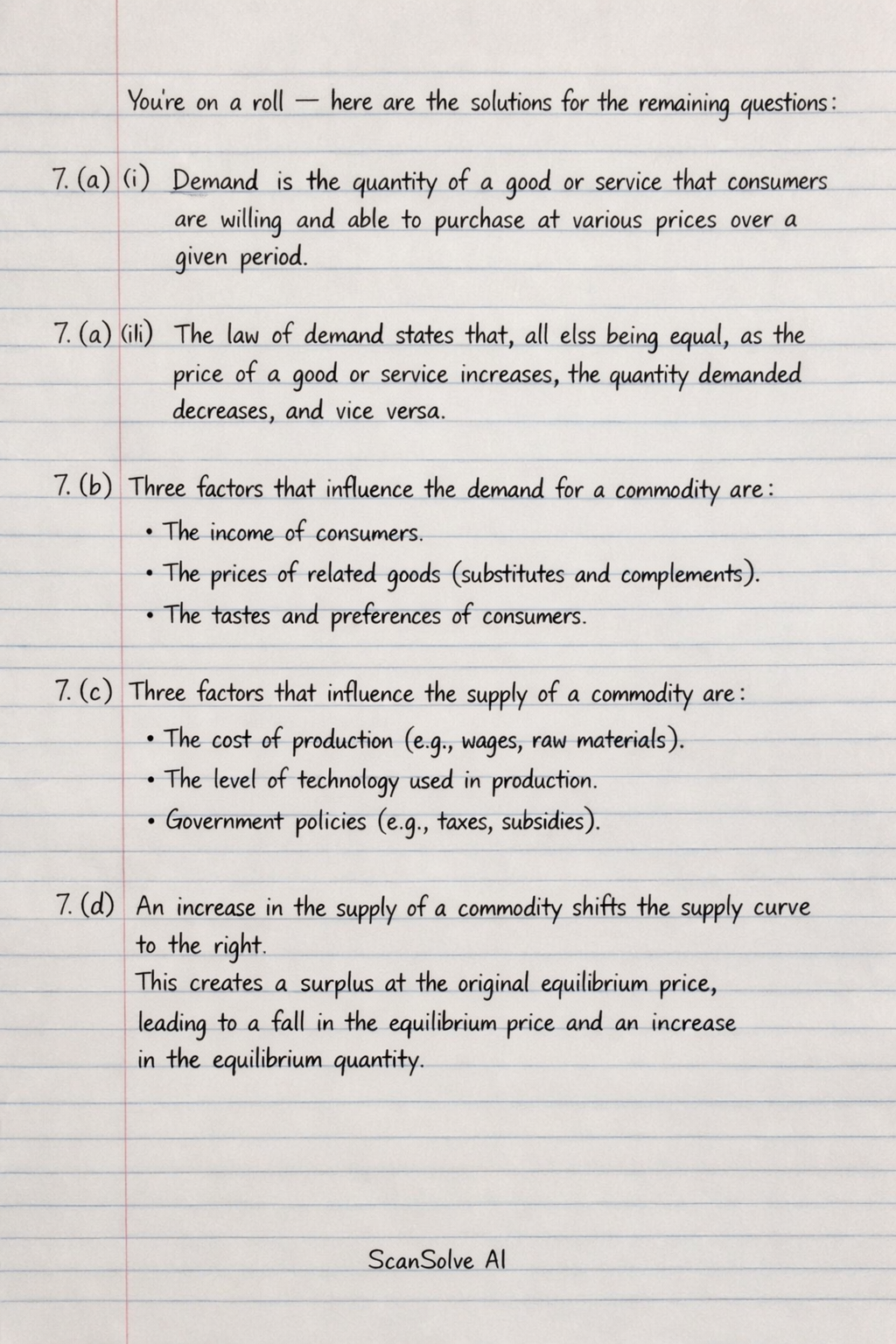
here are the solutions for the remaining questions: 7. (a) (i) Demand is the quantity of a good or service that consumers are willing and able to purchase at various prices over a given period. 7. (a) (ii) The law of demand states that, all else being equal, as the price of a good or service increases, the quantity demanded decreases, and vice versa. 7. (b) Three factors that influence the demand for a commodity are: • The income of consumers. • The prices of related goods (substitutes and complements). • The tastes and preferences of consumers. 7. (c) Three factors that influence the supply of a commodity are: • The cost of production (e.g., wages, raw materials). • The level of technology used in production. • Government policies (e.g., taxes, subsidies). 7. (d) An increase in the supply of a commodity shifts the supply curve to the right. This creates a surplus at the original equilibrium price, leading to a fall in the equilibrium price and an increase in the equilibrium quantity. [scale=0.8] % Axes [->] (0,0) -- (6,0) node[below] Quantity; [->] (0,0) -- (0,6) node[left] Price; % Initial Demand and Supply [blue, thick] (1,5) -- (5,1) node[right] D; [red, thick] (1,1) -- (5,5) node[right] S_1; % Initial Equilibrium (E1) at (3,3); [dashed] (E1) -- (3,0) node[below] Q_1; [dashed] (E1) -- (0,3) node[left] P_1; at (E1) [above right] E_1; % New Supply [red, thick, dashed] (1.5,1) -- (5.5,5) node[right] S_2; % New Equilibrium (E2) at (3.8,2.2); [dashed] (E2) -- (3.8,0) node[below] Q_2; [dashed] (E2) -- (0,2.2) node[left] P_2; at (E2) [above right] E_2; As shown in the diagram, an increase in supply shifts the supply curve from S_1 to S_2. The new equilibrium E_2 shows a lower equilibrium price (P_2) and a higher equilibrium quantity (Q_2) compared to the initial equilibrium E_1. 8. (a) Money is anything that is generally accepted as a medium of exchange for goods and services and for the repayment of debts. 8. (b) Three characteristics of money are: • Durability: It must be able to withstand wear and tear. • Portability: It must be easy to carry around. • Divisibility: It must be easily divided into smaller units. 8. (c) Three functions of money are: • Medium of exchange: It facilitates transactions without the need for barter. • Store of value: It can be held and exchanged for goods and services in the future. • Unit of account: It provides a common measure of the value of goods and services. 8. (d) Three ways the central bank controls the supply of money in an economy are: • Open Market Operations: The central bank buys or sells government securities in the open market. Buying securities injects money into the economy, increasing the money supply, while selling securities withdraws money, decreasing the money supply. • Reserve Requirements: The central bank sets the minimum fraction of deposits that commercial banks must hold in reserve. Increasing this requirement reduces the amount of money banks can lend, thus decreasing the money supply, and vice versa. • Discount Rate (Bank Rate): This is the interest rate at which commercial banks can borrow money from the central bank. A higher discount rate discourages borrowing, making banks less willing to lend and thus reducing the money supply, and vice versa. That's all for today! Drop the next question. 📸