
We read your photo as:
Describe the market structure of the South African retail sector, its characteristics, and list major firms.
Economics
ScanSolve AI Answer
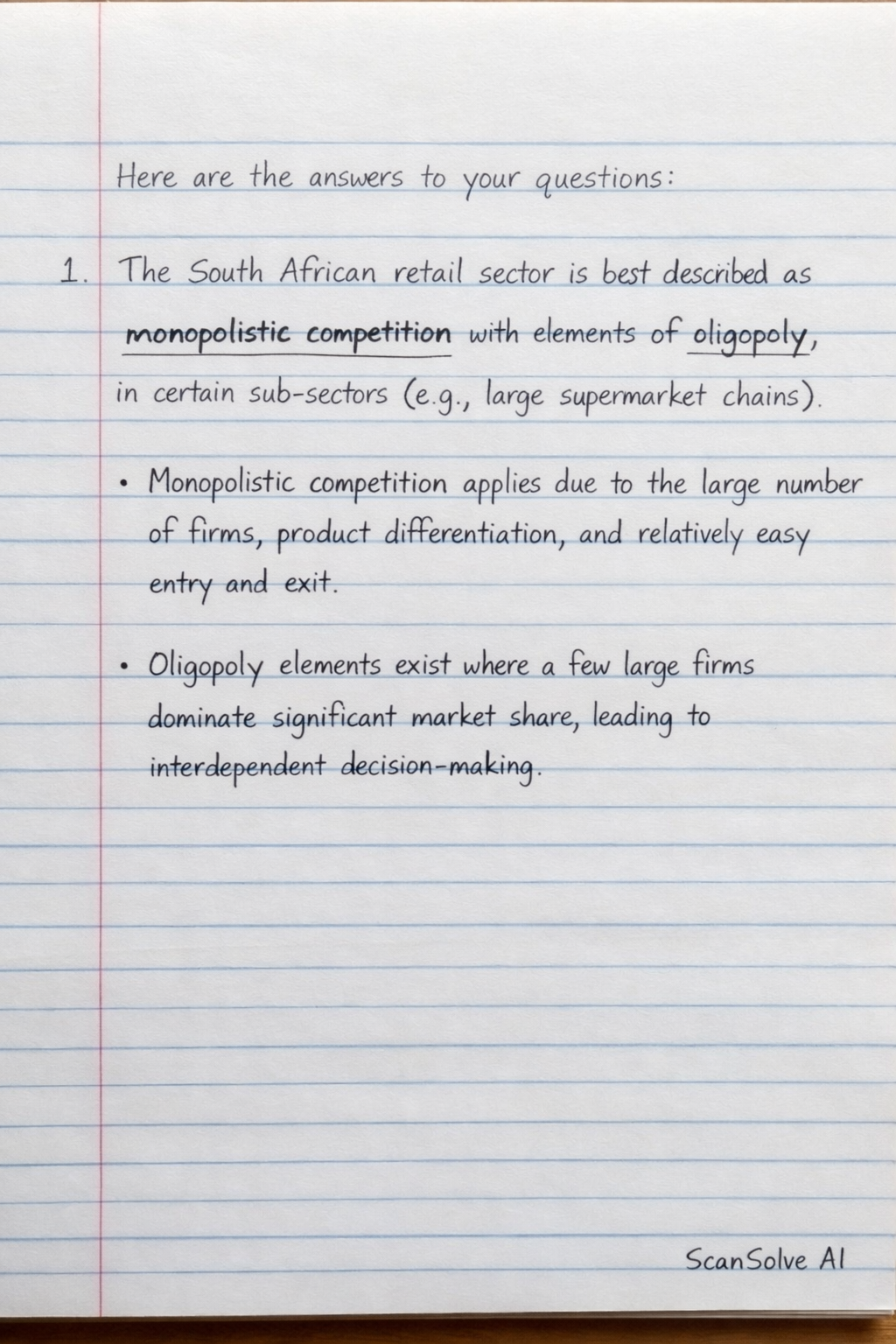
Here are the answers to your questions:
-
The South African retail sector is best described as monopolistic competition with elements of oligopoly in certain sub-sectors (e.g., large supermarket chains).
- Monopolistic competition applies due to the large number of firms, product differentiation, and relatively easy entry and exit.
- Oligopoly elements exist where a few large firms dominate significant market share, leading to interdependent decision-making.
-
The key characteristics of this market structure (primarily monopolistic competition) are:
- Many firms: There are numerous retailers competing in the market.
- Product differentiation: Firms offer products that are similar but not identical, distinguishing themselves through branding, quality, design, location, or service.
- Relatively easy entry and exit: While there can be some barriers, new firms can generally enter the market, and existing firms can exit.
- Non-price competition: Firms compete heavily on factors other than price, such as advertising, branding, customer service, and loyalty programs.
- Some control over price: Due to product differentiation, firms have a degree of market power, allowing them to set prices above marginal cost, but this power is limited by the availability of close substitutes.
-
Major retail firms in South Africa:
- Food sector:
- Shoprite Holdings (includes Shoprite, Checkers, Usave)
- Pick n Pay Stores Ltd.
- Spar Group Ltd.
- Woolworths Holdings Ltd.
- Fashion sector:
- Truworths International Ltd.
- Mr Price Group Ltd.
- The Foschini Group (TFG) Ltd.
- Pepkor Holdings Ltd. (includes Pep, Ackermans)
- Food sector:
-
These firms have some control over prices, but it is not absolute.
- In a monopolistically competitive environment, product differentiation allows firms to charge a premium for their unique offerings or brand perception. For example, Woolworths can charge higher prices due to its perceived quality and brand image.
- However, this control is limited by the presence of many substitutes. If prices become too high, consumers can switch to competitors.
- In oligopolistic segments (like major supermarkets), pricing decisions are interdependent. Firms monitor competitors' prices closely, and aggressive price wars can erupt, limiting individual firm control. They often use loyalty programs and promotions to maintain market share rather than solely relying on price hikes.
-
Retail firms increase their market share through various strategies:
- Product Differentiation: Offering unique products, superior quality, or exclusive brands (e.g., Woolworths' private label food).
- Branding and Marketing: Extensive advertising campaigns, promotions, and building strong brand loyalty (e.g., Checkers' "Sixty60" delivery service branding).
- Customer Loyalty Programs: Rewarding repeat customers with discounts, points, or exclusive offers (e.g., Pick n Pay Smart Shopper, Clicks ClubCard).
- Expansion: Opening new stores in underserved areas, expanding online presence, and improving logistics for e-commerce (e.g., Shoprite's expansion into smaller towns, TFG's online platforms).
- Competitive Pricing and Promotions: Offering competitive prices, sales, and bundle deals to attract price-sensitive consumers.
- Supply Chain Efficiency: Optimizing supply chains to reduce costs, ensure product availability, and offer fresh produce, which can translate to better value for consumers.
-
Threats to the South African retail sector and their impact on consumers:
- Economic Downturns and High Inflation: Reduced consumer disposable income due to high inflation, rising interest rates, and slow economic growth means consumers have less money to spend on non-essential items and become more price-sensitive for essentials.
- Impact on consumers: Higher prices for goods, reduced purchasing power, fewer choices as retailers cut back on inventory or close stores, and a shift towards cheaper alternatives.
- Load Shedding (Electricity Cuts): Frequent and prolonged power outages disrupt operations, increase costs for generators and alternative energy, and lead to spoilage of perishable goods.
- Impact on consumers: Higher prices (as retailers pass on increased operational costs), limited availability of fresh produce, inconvenience due to store closures or reduced operating hours, and potential food safety concerns.
- Supply Chain Disruptions: Global and local disruptions (e.g., port issues, civil unrest, fuel price hikes) can delay stock, increase transport costs, and lead to shortages.
- Impact on consumers: Limited product availability, higher prices due to increased logistics costs, and reduced variety of goods.
- Increased Competition (especially E-commerce): The rise of online shopping and international e-commerce platforms intensifies competition, forcing traditional retailers to adapt or lose market share.
- Impact on consumers: Potentially lower prices and more convenience through online shopping, but also potential job losses in traditional retail, affecting overall consumer spending.
- Crime and Security Issues: High levels of crime (e.g., looting, shoplifting, truck hijackings) increase security costs and insurance premiums for retailers.
- Impact on consumers: Higher prices (to cover security costs and losses), reduced accessibility to stores in high-risk areas, and a less pleasant shopping experience.
- Economic Downturns and High Inflation: Reduced consumer disposable income due to high inflation, rising interest rates, and slow economic growth means consumers have less money to spend on non-essential items and become more price-sensitive for essentials.
Was this helpful?
Still stuck on this one?
Ask a follow-up, and the answer starts from this question.
Got a different question?Ask your own question
More Economics Questions
QDescribe the market structure of the South African retail sector, its characteristics, major firms…QWhat type of market structure best describes the south African retail sectorQEvaluate the South African retail sector's market structure based on a provided rubric, focusing on…QThe South African retail sector is best described as an oligopoly. This market structure is…QThe market structure that best describes the South African retail sector, particularly in food and…
Browse by topic:Microeconomics
Handwritten Step-by-Step Solution
Get this as a handwritten image on WhatsApp — like a tutor wrote it for you.
Try on WhatsApp