
We read your photo as:
Multiple choice questions on taxation, state-owned companies, market failures, and price controls.
ScanSolve AI Answer
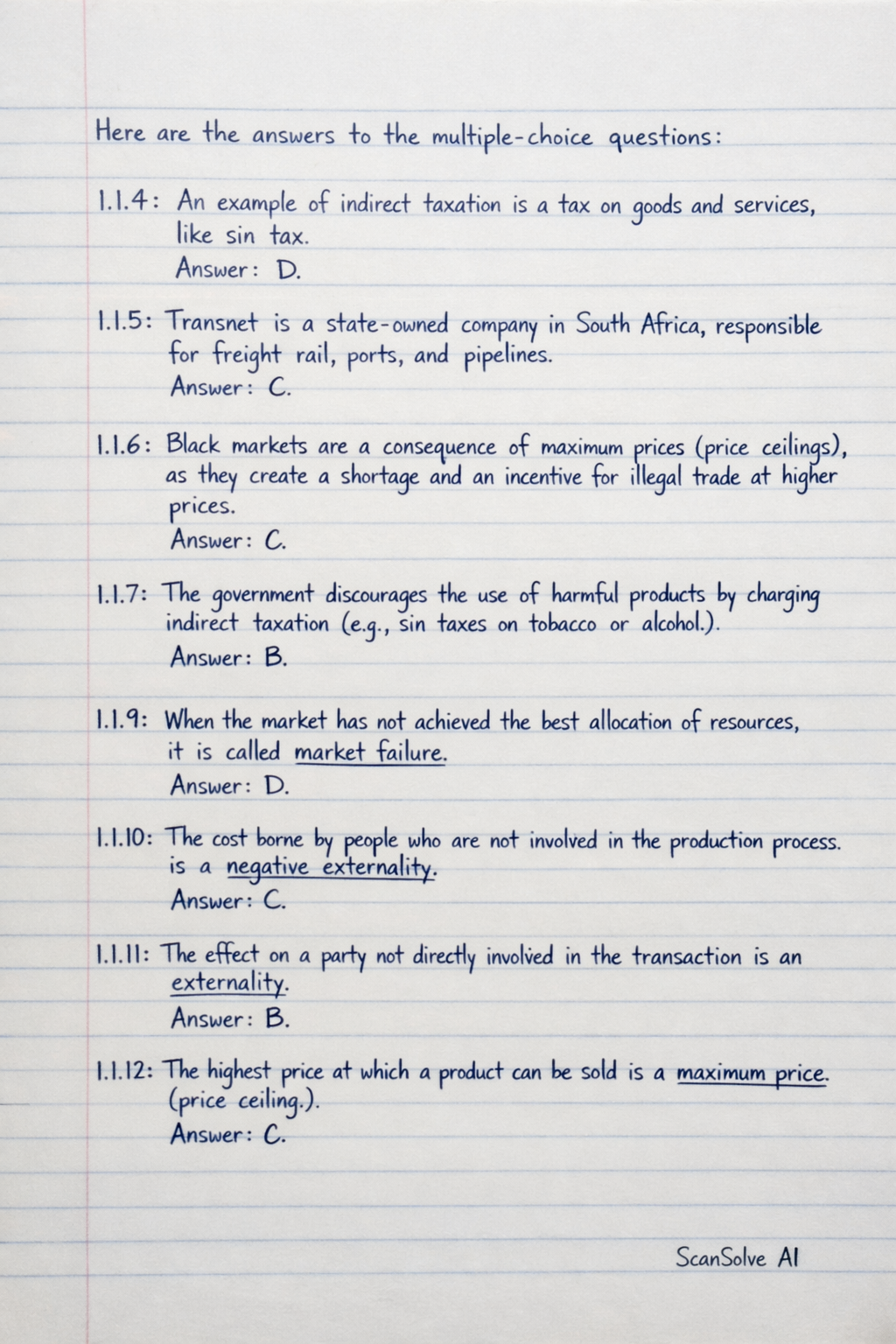
Here are the answers to the multiple-choice questions:
1.1.4: An example of indirect taxation is a tax on goods and services, like sin tax.
Answer: D
1.1.5: Transnet is a state-owned company in South Africa, responsible for freight rail, ports, and pipelines.
Answer: C
1.1.6: Black markets are a consequence of maximum prices (price ceilings), as they create a shortage and an incentive for illegal trade at higher prices.
Answer: C
1.1.7: The government discourages the use of harmful products by charging indirect taxation (e.g., sin taxes on tobacco or alcohol).
Answer: B
1.1.9: When the market has not achieved the best allocation of resources, it is called market failure.
Answer: D
1.1.10: The cost borne by people who are not involved in the production process is a negative externality.
Answer: C
1.1.11: The effect on a party not directly involved in the transaction is an externality.
Answer: B
1.1.12: The highest price at which a product can be sold is a maximum price (price ceiling).
Answer: C
1.1.13: The lowest price that consumers of a product are obliged to pay is known as the minimum price (price floor).
Answer: D
1.1.14: Law is NOT a reason for market failure. Market failure reasons include undersupply of goods, unreasonable quantity and prices, and unequal distribution of income and wealth.
Answer: D
1.1.15: The following is a reason for implementing minimum price: Governments hope to guarantee a steady income to producers.
Answer: B
Still stuck on this one?
Ask a follow-up, and the answer starts from this question.
More Economics Questions
Handwritten Step-by-Step Solution
Get this as a handwritten image on WhatsApp — like a tutor wrote it for you.
Try on WhatsApp