
We read your photo as:
Define and explain budget surplus, deficit, and balanced budget. Provide three reasons for adopting each budget type.
ScanSolve AI Answer
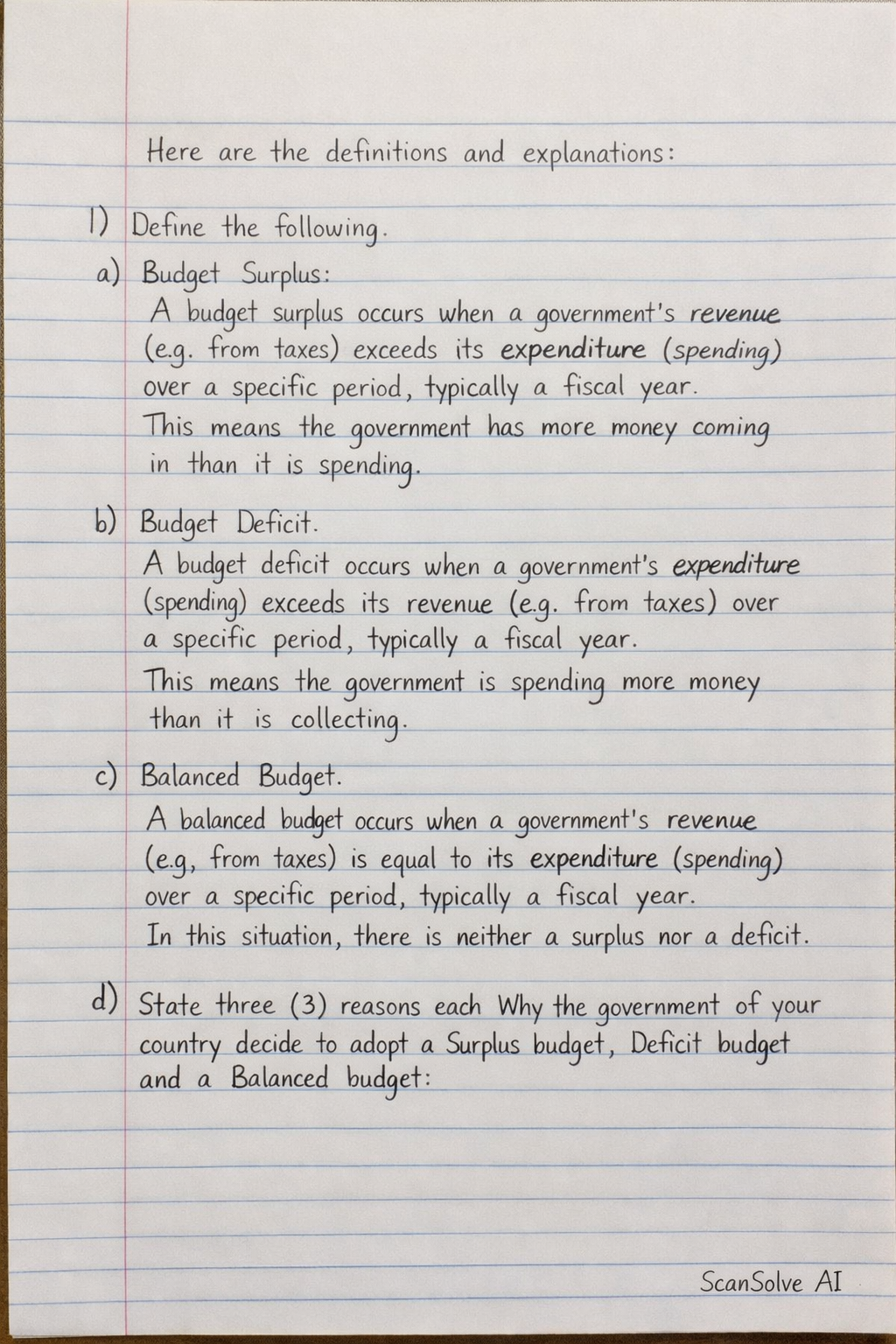
Here are the definitions and explanations:
- Define the following.
a) Budget surplus.
A budget surplus occurs when a government's revenue (e.g., from taxes) exceeds its expenditure (spending) over a specific period, typically a fiscal year. This means the government has more money coming in than it is spending.
b) Budget Deficit.
A budget deficit occurs when a government's expenditure (spending) exceeds its revenue (e.g., from taxes) over a specific period, typically a fiscal year. This means the government is spending more money than it is collecting.
c) Balance Budget.
A balanced budget occurs when a government's revenue (e.g., from taxes) is equal to its expenditure (spending) over a specific period, typically a fiscal year. In this situation, there is neither a surplus nor a deficit.
d) State three (3) reasons each Why the government of your country decide to adopt a Surplus budget, Deficit budget and a Balanced budget.
Reasons for adopting a Surplus Budget:
- Debt Reduction: A surplus allows the government to pay down its national debt, reducing future interest payments and improving fiscal health.
- Saving for Future Needs: The extra funds can be saved for future investments, emergencies, or to prepare for demographic shifts (e.g., an aging population).
- Controlling Inflation: By reducing government spending or increasing taxes, a surplus can help cool down an overheating economy and curb inflationary pressures.
Reasons for adopting a Deficit Budget:
- Stimulating Economic Growth: During a recession or economic downturn, a deficit budget (through increased government spending or tax cuts) can boost aggregate demand, create jobs, and stimulate economic recovery.
- Funding Public Investments: Deficits can be used to finance large-scale public infrastructure projects (e.g., roads, schools, hospitals) that have long-term economic benefits but require significant upfront investment.
- Responding to Emergencies: In times of crisis, such as natural disasters, pandemics, or wars, governments often run deficits to fund immediate relief efforts and recovery programs.
Reasons for adopting a Balanced Budget:
- Fiscal Discipline: A balanced budget promotes responsible financial management by ensuring that the government lives within its means, preventing excessive borrowing and accumulation of debt.
- Economic Stability: It can foster confidence among investors and citizens by signaling that the government is financially stable and not accumulating unsustainable debt, which can lead to lower interest rates and stable economic conditions.
- Intergenerational Equity: A balanced budget avoids shifting the burden of current government spending onto future generations, as it ensures that current expenditures are paid for by current revenues.
Q2a) State and explain five (5) Qualities of a good tax.
- Equity: A good tax system should be fair, meaning that individuals with similar incomes and circumstances should pay similar amounts of tax (horizontal equity), and those with higher incomes should contribute a larger proportion of their income (vertical equity).
- Certainty: Taxpayers should be clear about when, how, and what amount of tax they are required to pay. The rules should be unambiguous and easy to understand to avoid confusion and disputes.
- Convenience: The tax system should be easy to pay for the taxpayer and easy to collect for the government. This includes simple payment methods and minimal administrative burden.
- Economy: The cost of collecting the tax should be low relative to the revenue it generates. An efficient tax system minimizes administrative expenses for the government and compliance costs for taxpayers.
- Elasticity: A good tax system should be flexible and able to generate more revenue when the economy grows or when the government needs more funds, without requiring frequent changes to tax laws.
Q2b) State and explain five (5) sources of government revenue.
- Direct Taxes: These are taxes levied directly on the income or wealth of individuals and corporations. Examples include income tax (on wages, salaries, profits) and corporate tax (on company profits).
- Indirect Taxes: These are taxes levied on goods and services, which are ultimately paid by consumers through higher prices. Examples include Value Added Tax (VAT) or Goods and Services Tax (GST), excise duties (on specific goods like alcohol, tobacco, fuel), and customs duties (on imported goods).
- Non-Tax Revenue: This category includes revenue generated from sources other than taxes. Examples include fees and charges for government services (e.g., passport fees, driving license fees), fines and penalties, and profits from state-owned enterprises.
- Borrowing: Governments often borrow money from domestic or international sources to finance their expenditures, especially when facing a budget deficit. This can be done by issuing government bonds or taking loans from financial institutions or other countries.
- Grants and Aid: Governments may receive financial assistance or grants from international organizations, foreign governments, or donor agencies. These funds are often provided for specific development projects or humanitarian aid.
Still stuck on this one?
Ask a follow-up, and the answer starts from this question.
More Economics Questions
Handwritten Step-by-Step Solution
Get this as a handwritten image on WhatsApp — like a tutor wrote it for you.
Try on WhatsApp