
We read your photo as:
Which of the following best distinguishes a trade surplus from a trade deficit in terms of their typical macroeconomic consequences?
ScanSolve AI Answer
Step-by-step solution
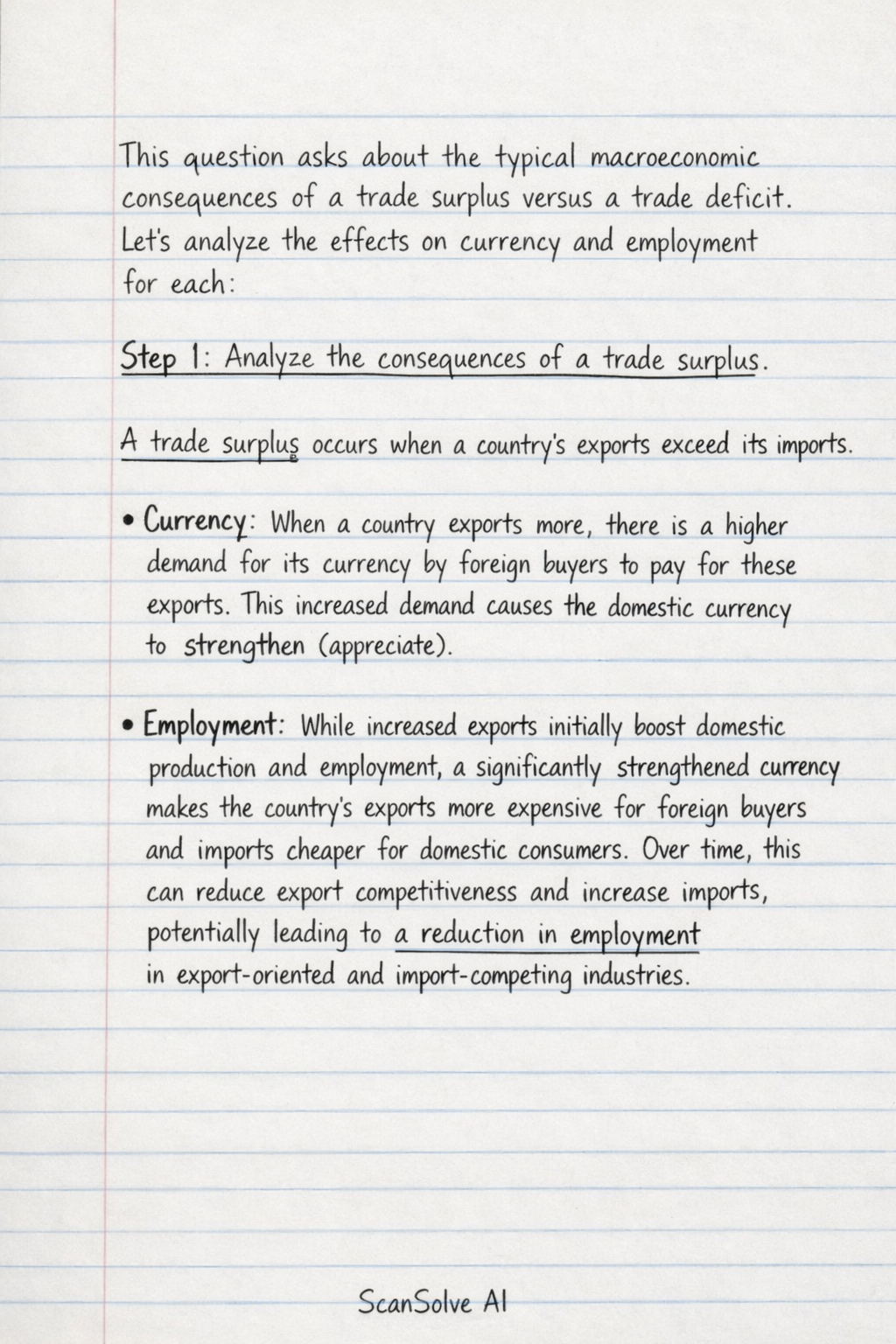
3 stepsThis question asks about the typical macroeconomic consequences of a trade surplus versus a trade deficit. Let's analyze the effects on currency and employment for each:
Analyze the consequences of a trade surplus.
A trade surplus occurs when a country's exports exceed its imports.
- Currency: When a country exports more, there is a higher demand for its currency by foreign buyers to pay for these exports. This increased demand causes the domestic currency to strengthen (appreciate).
- Employment: While increased exports initially boost domestic production and employment, a significantly strengthened currency makes the country's exports more expensive for foreign buyers and imports cheaper for domestic consumers. Over time, this can reduce export competitiveness and increase imports, potentially leading to a reduction in employment in export-oriented and import-competing industries.
Analyze the consequences of a trade deficit.
A trade deficit occurs when a country's imports exceed its exports.
- Currency: When a country imports more, there is a higher supply of its currency (as domestic buyers sell it to acquire foreign currency for imports). This increased supply causes the domestic currency to weaken (depreciate).
- Employment: While increased imports initially displace domestic production and reduce employment, a significantly weakened currency makes the country's exports cheaper for foreign buyers and imports more expensive for domestic consumers. Over time, this can boost export competitiveness and reduce imports, potentially leading to an increase in employment in export-oriented and import-competing industries.
Evaluate the given options based on this analysis.
-
A. A trade surplus strengthens the currency and may reduce employment; a trade deficit weakens the currency and may increase employment.
- Trade surplus: strengthens currency (Correct), may reduce employment (Correct, due to the effects of a strong currency).
- Trade deficit: weakens currency (Correct), may increase employment (Correct, due to the effects of a weak currency). This option accurately describes the typical macroeconomic consequences, including the feedback loop where currency changes influence employment.
-
B. A trade surplus weakens the currency and increases employment; a trade deficit strengthens the currency and reduces employment.
- This option incorrectly reverses the currency effects for both a surplus and a deficit.
-
C. Both trade surplus and deficit strengthen the currency; employment rises in both cases.
- This is incorrect as trade surpluses and deficits have opposite effects on currency and generally opposite effects on employment.
-
D. A trade surplus and deficit both lead to weaker currency but rising prices.
- This is incorrect as a trade surplus strengthens the currency, and the employment/price effects are not universally the same for both.
Therefore, option A best distinguishes the macroeconomic consequences of a trade surplus from a trade deficit.
The final answer is .
-
Still stuck on this one?
Ask a follow-up, and the answer starts from this question.
More Economics Questions
Handwritten Step-by-Step Solution
Get this as a handwritten image on WhatsApp — like a tutor wrote it for you.
Try on WhatsApp