
We read your photo as:
Which of the following business owners are likely to be successful? Check all that are true.
ScanSolve AI Answer
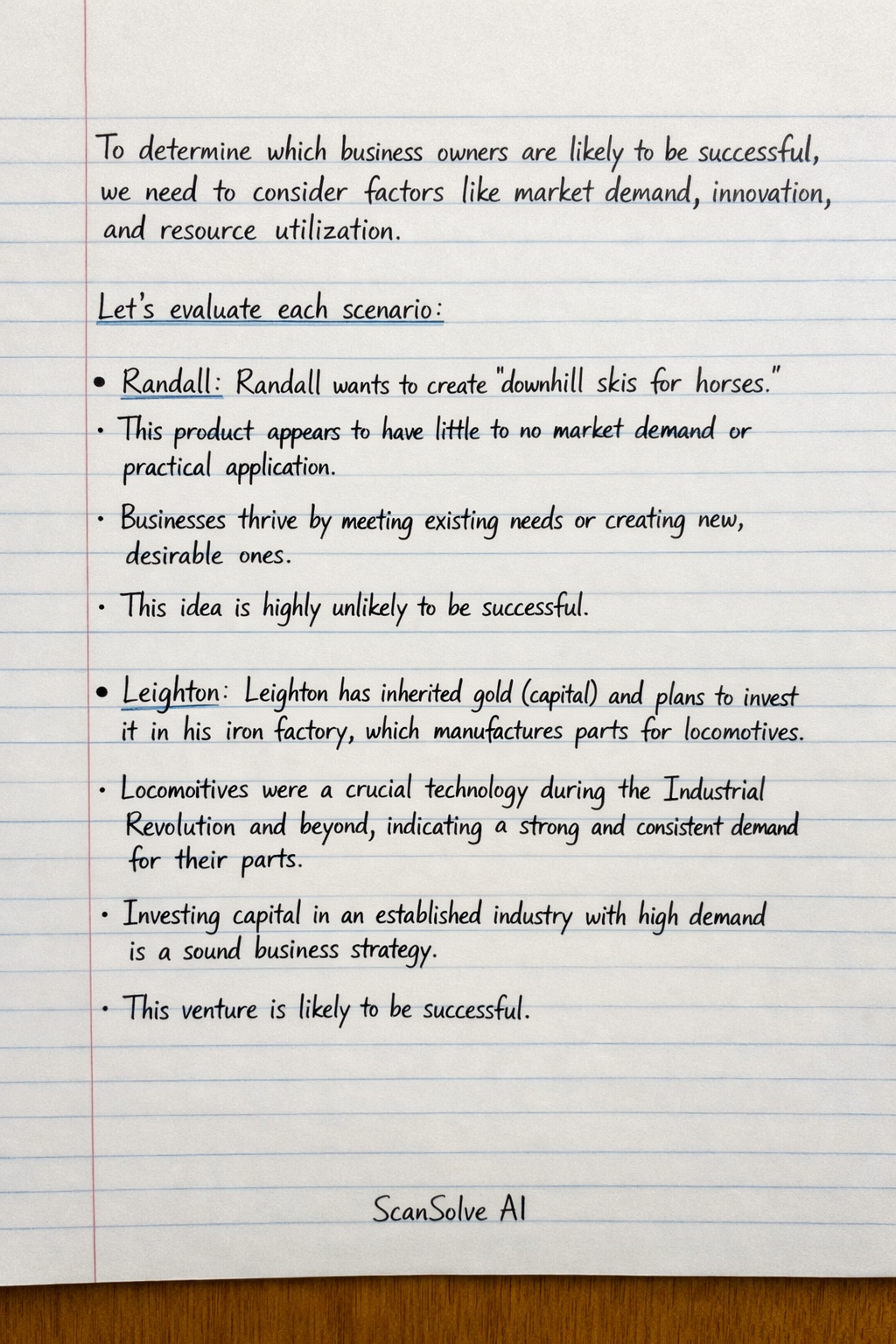
To determine which business owners are likely to be successful, we need to consider factors like market demand, innovation, and resource utilization.
Let's evaluate each scenario:
-
Randall: Randall wants to create "downhill skis for horses." This product appears to have little to no market demand or practical application. Businesses thrive by meeting existing needs or creating new, desirable ones. This idea is highly unlikely to be successful.
-
Leighton: Leighton has inherited gold (capital) and plans to invest it in his iron factory, which manufactures parts for locomotives. Locomotives were a crucial technology during the Industrial Revolution and beyond, indicating a strong and consistent demand for their parts. Investing capital in an established industry with high demand is a sound business strategy. This venture is likely to be successful.
-
Quigley: Quigley is poor but has an idea for a machine that will significantly improve the efficiency of the loom and make weaving cloth very fast. Innovations that drastically increase productivity, especially in key industries like textiles, have historically been highly successful (e.g., the power loom). Even without initial capital, a truly groundbreaking invention can attract investors or revolutionize an industry, leading to great success. This venture is likely to be successful.
-
Doreen: Doreen owns a number of cows, which few others in her town possess, and wants to begin selling their milk. This indicates a unique resource (cows) and a basic commodity (milk) with likely local demand and limited competition. Having a scarce resource to produce a needed product in a local market provides a strong competitive advantage. This venture is likely to be successful.
Therefore, Leighton, Quigley, and Doreen are likely to be successful.
The correct options are:
- Leighton has inherited gold from his father. He plans to invest the money in his iron factory, which manufactures parts for locomotives.
- Quigley is very poor, but he has an idea for a machine that will improve the efficiency of the loom and make weaving cloth very fast.
- Doreen owns a number of cows, which few others in her town possess. She wants to begin selling their milk, but... (assuming the rest of the sentence doesn't negate the initial strong premise).
Still stuck on this one?
Ask a follow-up, and the answer starts from this question.
More Economics Questions
Handwritten Step-by-Step Solution
Get this as a handwritten image on WhatsApp — like a tutor wrote it for you.
Try on WhatsApp