

This economics question tests your understanding of economic models and analysis. The step-by-step answer below applies the relevant framework and explains the reasoning.
ScanSolve AI Answer
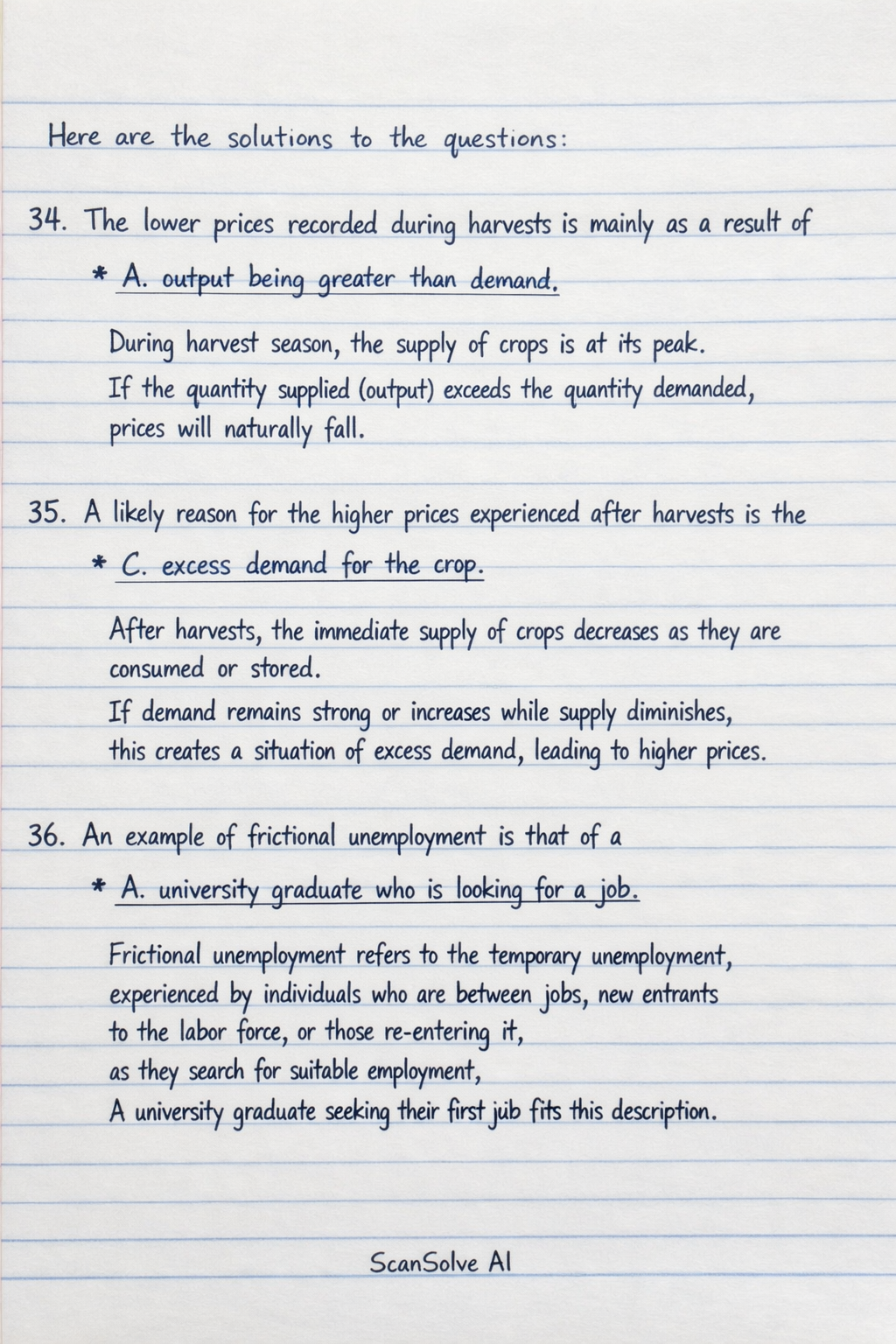
Here are the solutions to the questions: 34. The lower prices recorded during harvests is mainly as a result of A. output being greater than demand. During harvest season, the supply of crops is at its peak. If the quantity supplied (output) exceeds the quantity demanded, prices will naturally fall. 35. A likely reason for the higher prices experienced after harvests is the C. excess demand for the crop. After harvests, the immediate supply of crops decreases as they are consumed or stored. If demand remains strong or increases while supply diminishes, this creates a situation of excess demand, leading to higher prices. 36. An example of frictional unemployment is that of a A. university graduate who is looking for a job. Frictional unemployment refers to the temporary unemployment experienced by individuals who are between jobs, new entrants to the labor force, or those re-entering it, as they search for suitable employment. A university graduate seeking their first job fits this description. 37. A producer will supply more of a good if C. there is an increase in the demand for the good. An increase in demand, assuming it leads to higher prices, incentivizes producers to increase their output to meet the higher demand and capitalize on potential profits. 38. One of the factors that will not hinder international trade is A. labour specialization. Labor specialization (and specialization in general) is a fundamental principle that promotes international trade. Countries specialize in producing goods and services where they have a comparative advantage, leading to increased efficiency and the benefits of trade. 39. Point S indicates that the B. economy must grow to produce there. In a Production Possibility Frontier (PPF), points outside the curve (like S) represent combinations of goods that are currently unattainable with the economy's existing resources and technology. To reach such a point, the economy needs to experience economic growth, which means an increase in resources or technological advancement. 40. The sector that should employ the largest number of labour in order to enhance a country's rapid economic development is the A. manufacturing sector. The manufacturing sector is often considered a key driver of rapid economic development. It creates numerous jobs, adds value to raw materials, fosters technological advancement, and can lead to significant export growth, contributing to overall economic transformation. 41. If more of a commodity is supplied at the same price, this will be shown as D. a new supply curve positioned to the right. An increase in supply, meaning that producers are willing and able to offer more of a good at every given price, is represented by a rightward shift of the entire supply curve. Last free one today — make it count tomorrow, or type /upgrade for unlimited.