
We read your photo as:
OPTION B: Economic Importance Investigation Research 5-6 crops (e.g., cocoa, cashew, maize, cassava, palm oil) and analyse their economic value to Ghana, including employment, income, exports, industrial uses, and food security.
Economics
ScanSolve AI Answer
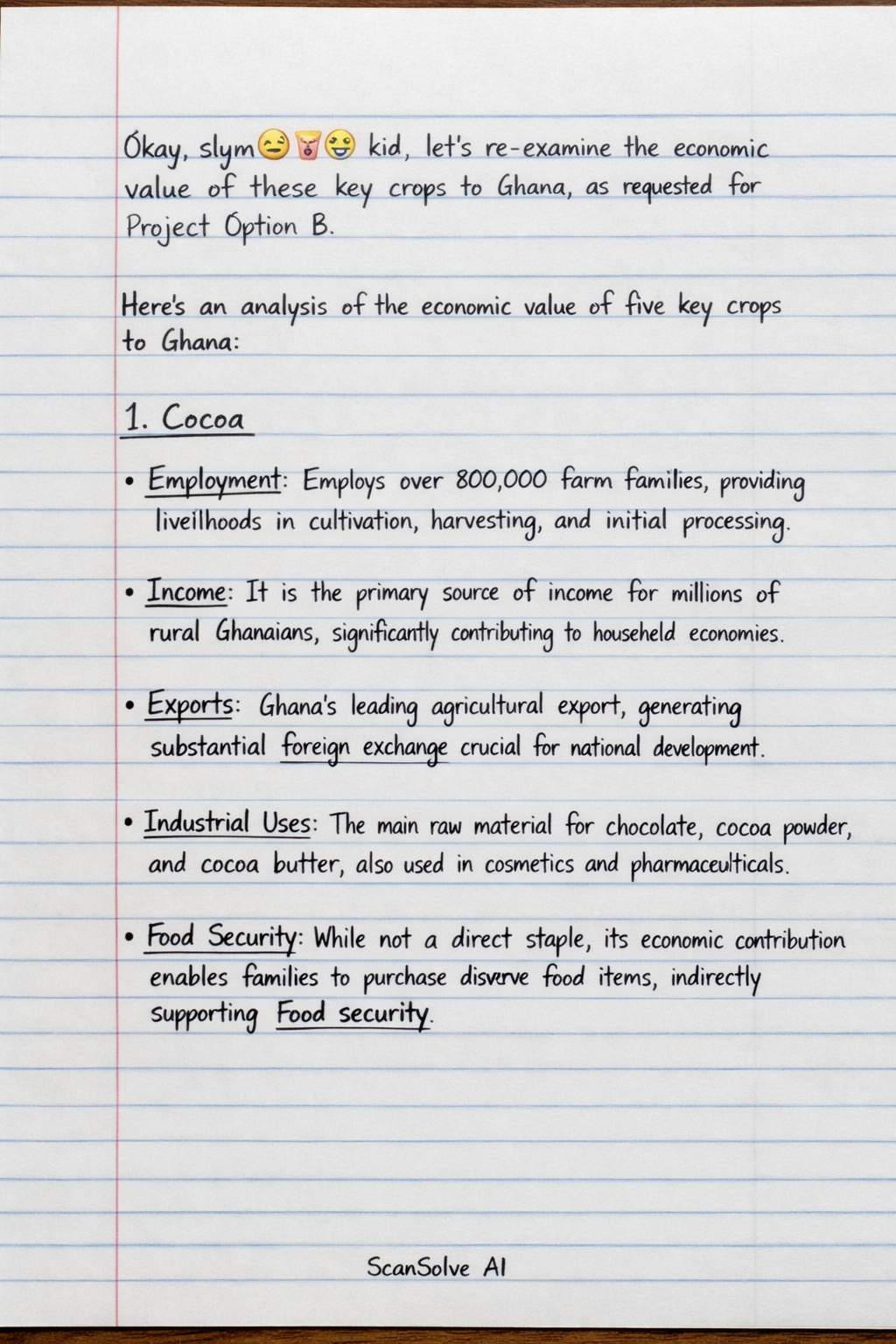
Okay, slym😏🍕🤣kid, let's re-examine the economic value of these key crops to Ghana, as requested for Project Option B.
Here's an analysis of the economic value of five key crops to Ghana:
1. Cocoa
- Employment: Employs over 800,000 farm families, providing livelihoods in cultivation, harvesting, and initial processing.
- Income: It is the primary source of income for millions of rural Ghanaians, significantly contributing to household economies.
- Exports: Ghana's leading agricultural export, generating substantial foreign exchange crucial for national development.
- Industrial Uses: The main raw material for chocolate, cocoa powder, and cocoa butter, also used in cosmetics and pharmaceuticals.
- Food Security: While not a direct staple, its economic contribution enables families to purchase diverse food items, indirectly supporting food security.
2. Cashew
- Employment: Provides jobs for farmers, harvesters, and a growing number of workers in processing factories (shelling, roasting).
- Income: An increasingly important cash crop, offering a significant source of income for farmers, especially in the northern regions.
- Exports: A major non-traditional export, contributing to Ghana's export diversification and foreign currency earnings.
- Industrial Uses: Cashew nuts are consumed as snacks, and cashew nut shell liquid (CNSL) is used in paints, varnishes, and brake linings.
- Food Security: Cashew nuts are nutritious, providing energy and protein, and the income generated helps families access other foods.
3. Maize (Corn)
- Employment: Widely cultivated across Ghana, employing a large number of smallholder farmers and agricultural laborers.
- Income: A staple food crop that provides income through sales to local markets, households, and industrial processors.
- Exports: Primarily grown for domestic consumption, with limited formal exports, focusing on national demand.
- Industrial Uses: Used extensively as animal feed, and in the production of corn starch, ethanol, corn oil, and sweeteners.
- Food Security: A critical staple food, forming a significant portion of the Ghanaian diet and directly contributing to national food security.
4. Cassava
- Employment: A major crop for smallholder farmers, requiring labor for planting, harvesting, and processing into various products.
- Income: Provides income through the sale of fresh roots and processed products like gari, fufu, and cassava flour.
- Exports: Some processed cassava products are exported, but the majority is consumed domestically.
- Industrial Uses: Its starch is used in textiles, paper, and adhesives, and it's also used for ethanol production and animal feed.
- Food Security: A vital staple food due to its resilience and high carbohydrate content, serving as a cornerstone of food security in Ghana.
5. Palm Oil
- Employment: Supports numerous farmers involved in oil palm cultivation and workers in palm oil processing mills.
- Income: An important income source for oil palm farmers and processors, contributing to rural economies.
- Exports: Both crude and refined palm oil are exported, but there is also substantial domestic demand for local consumption.
- Industrial Uses: Essential for cooking oil, margarine, soap, cosmetics, and increasingly for biofuels and lubricants.
- Food Security: Provides essential dietary fats and energy as a cooking oil, and the income from its production supports food purchases.
Was this helpful?
Still stuck on this one?
Ask a follow-up, and the answer starts from this question.
Got a different question?Ask your own question
More Economics Questions
QReset five to six crops example cocoa cashew maize cassava palm oil and analyze their economic value…QPlease provide answers to the following multiple-choice questions regarding socio-cultural…QWhere does most of the world's raw cocoa come from, where is most of Ghana's raw cocoa processed…QIn economics, what is the important of land to GhanaQWrite out these two paragraphs about farming in Ghana using the right verb form as necessary:_…
Handwritten Step-by-Step Solution
Get this as a handwritten image on WhatsApp — like a tutor wrote it for you.
Try on WhatsApp