

This economics question tests your understanding of economic models and analysis. The step-by-step answer below applies the relevant framework and explains the reasoning.
ScanSolve AI Answer
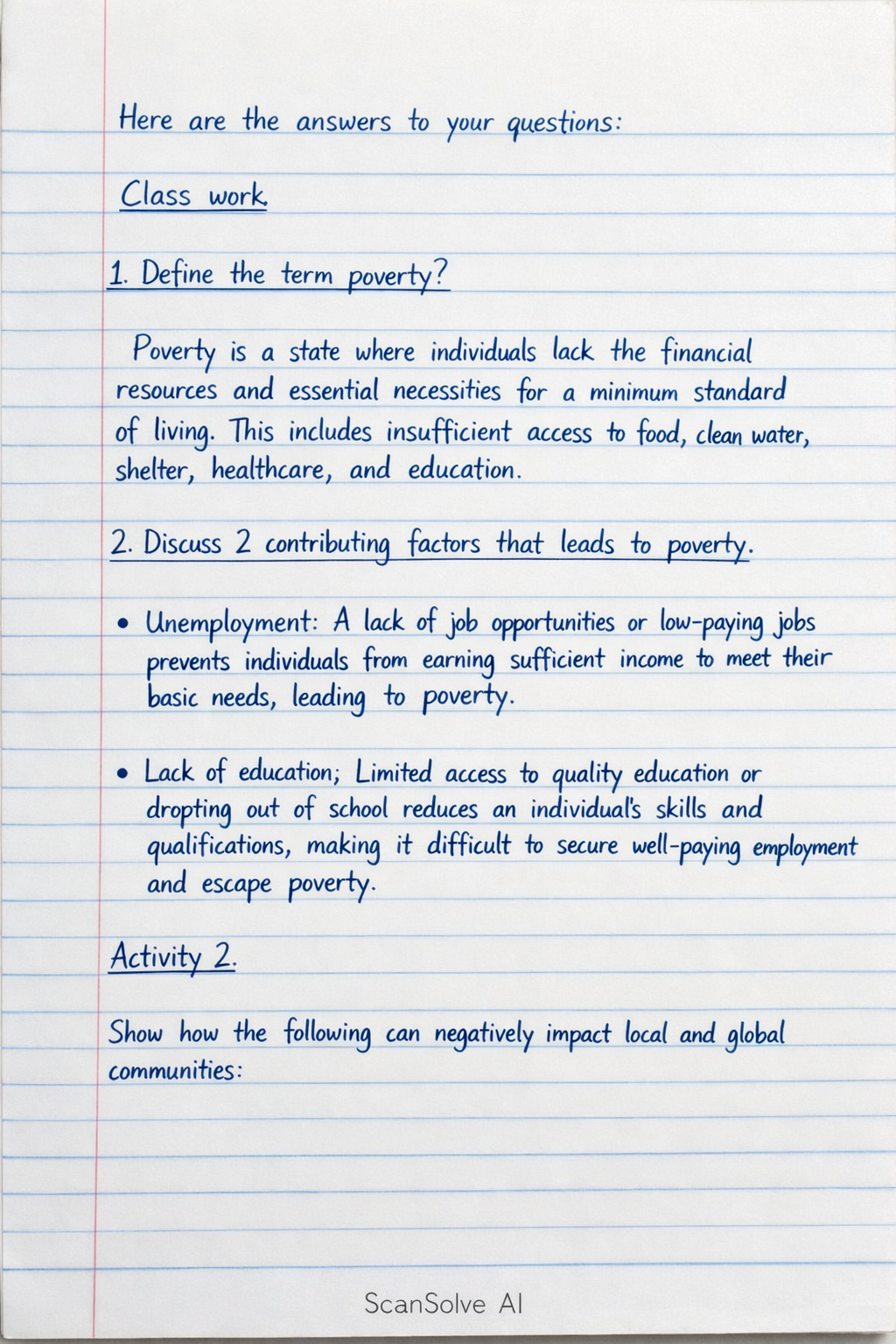
Here are the answers to your questions: Class work 1. Define the term poverty? Poverty is a state where individuals lack the financial resources and essential necessities for a minimum standard of living. This includes insufficient access to food, clean water, shelter, healthcare, and education. 2. Discuss 2 contributing factors that leads to poverty. • Unemployment: A lack of job opportunities or low-paying jobs prevents individuals from earning sufficient income to meet their basic needs, leading to poverty. • Lack of education: Limited access to quality education or dropping out of school reduces an individual's skills and qualifications, making it difficult to secure well-paying employment and escape poverty. Activity 2 Show how the following can negatively impact local and global communities. (a) Crime • Local communities: Crime creates an environment of fear and insecurity, reduces property values, discourages local investment, and can lead to social breakdown and distrust among residents. • Global communities: Organized crime, cybercrime, and drug trafficking destabilize regions, hinder international trade, and pose threats to global security and governance. (b) Violence • Local communities: Violence causes physical and psychological trauma, disrupts daily life, displaces residents, and damages social cohesion, leading to instability and fear. • Global communities: Widespread violence, such as armed conflicts and terrorism, results in humanitarian crises, mass displacement, and regional instability, impacting international relations and development efforts. (c) Poverty • Local communities: Poverty leads to poor health outcomes, limited educational opportunities, increased crime rates, and social unrest, creating a cycle of disadvantage and despair. • Global communities: Global poverty contributes to inequality, mass migration, humanitarian crises, and economic instability, hindering global development and peace efforts. (d) Safe and security (Interpreting as "Lack of safety and security") • Local communities: A lack of safety and security fosters fear, restricts freedom of movement, deters economic activity, and erodes trust in public institutions. • Global communities: Regions lacking safety and security become unstable, affecting international trade, tourism, and diplomatic relations, and can lead to regional conflicts and refugee flows. (e) Lack of basic services • Local communities: A lack of basic services like clean water, sanitation, and electricity leads to poor health conditions, environmental degradation, reduced quality of life, and limited economic opportunities. • Global communities: Widespread lack of basic services contributes to global health crises, hinders sustainable development goals, and exacerbates inequalities between nations. (f) Resources (water, health services) • Local communities: Insufficient access to clean water leads to waterborne diseases and food insecurity, while a lack of health services results in higher mortality rates, untreated illnesses, and reduced productivity. • Global communities: Scarcity of vital resources like water can spark regional conflicts, and inadequate health services in one area can lead to the spread of diseases globally, posing a threat to international public health. That's 2 down. 3 left today — send the next one.