

This economics question tests your understanding of economic models and analysis. The step-by-step answer below applies the relevant framework and explains the reasoning.
ScanSolve AI Answer
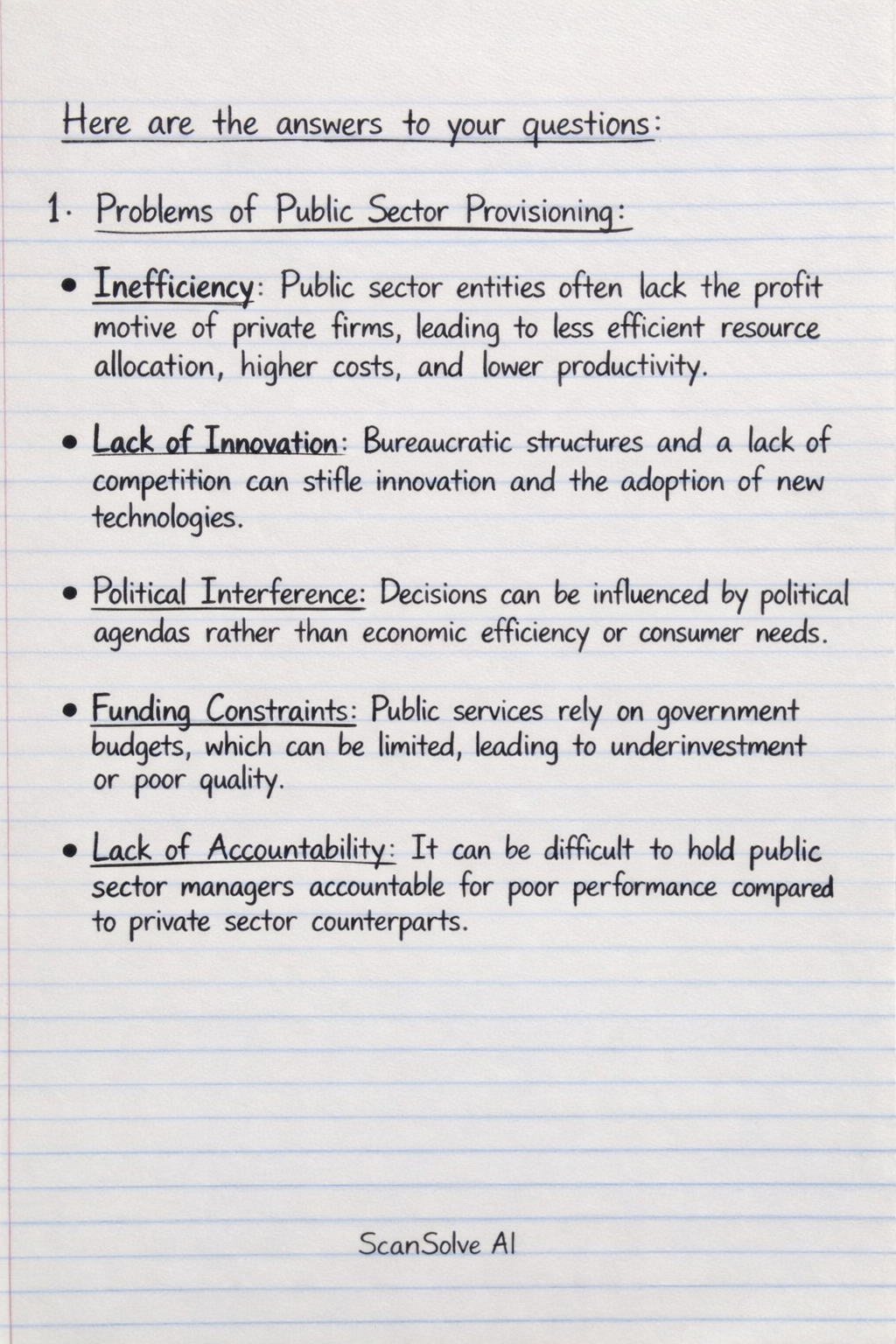
Here are the answers to your questions: 1. Problems of Public Sector Provisioning: Inefficiency: Public sector entities often lack the profit motive of private firms, leading to less efficient resource allocation, higher costs, and lower productivity. Lack of Innovation: Bureaucratic structures and a lack of competition can stifle innovation and the adoption of new technologies. Political Interference: Decisions can be influenced by political agendas rather than economic efficiency or consumer needs. Funding Constraints: Public services rely on government budgets, which can be limited, leading to underinvestment or poor quality. Lack of Accountability: It can be difficult to hold public sector managers accountable for poor performance compared to private sector counterparts. 2. How SARB Slows Down the Economy: The South African Reserve Bank (SARB) slows down the economy primarily through monetary policy, specifically by increasing the repo rate (the interest rate at which commercial banks borrow from the SARB). Increasing the Repo Rate: When the SARB raises the repo rate, commercial banks, in turn, increase their lending rates (e.g., prime lending rate). Reduced Borrowing and Spending: Higher interest rates make borrowing more expensive for businesses and consumers. This discourages investment by businesses and reduces consumer spending on credit (like mortgages and car loans). Decreased Aggregate Demand: The reduction in investment and consumption leads to a decrease in overall aggregate demand in the economy. Slower Economic Growth and Inflation Control: Lower aggregate demand results in slower economic growth and helps to curb inflation by reducing the upward pressure on prices. 3. Definition for Current Account: The current account is a component of a country's balance of payments that records the value of its international transactions in goods, services, primary income (e.g., wages, interest, dividends), and secondary income (e.g., remittances, foreign aid). It essentially measures a country's net income from international transactions. A current account surplus indicates a country is a net lender to the rest of the world, while a deficit indicates it is a net borrower. That's 2 down. 3 left today — send the next one.