
We read your photo as:
Explain the profit-maximizing condition for a monopoly and the difference between supernormal profits and barriers to entry. Define natural monopoly and its cause.
ScanSolve AI Answer
1.1.1. C.
A monopoly, like any firm, aims to maximize its profit. This occurs at the output level where marginal revenue equals marginal cost (), and the price is then set according to the demand curve at that output. Charging the highest possible price might not maximize profit if it significantly reduces the quantity demanded.
1.1.2. A.
Supernormal profits are the outcome of a monopoly's market power and the existence of barriers to entry, not a barrier to entry itself. In fact, supernormal profits would attract new firms if there were no barriers. Economies of scale, branding, and regulatory bodies can all act as barriers to entry.
1.1.3. A.
A natural monopoly occurs when a single firm can produce the entire output for a market at a lower cost than multiple firms. This is typically due to extremely large economies of scale, where the average cost of production continuously falls as output increases over the relevant range of market demand.
Still stuck on this one?
Ask a follow-up, and the answer starts from this question.
More Economics Questions
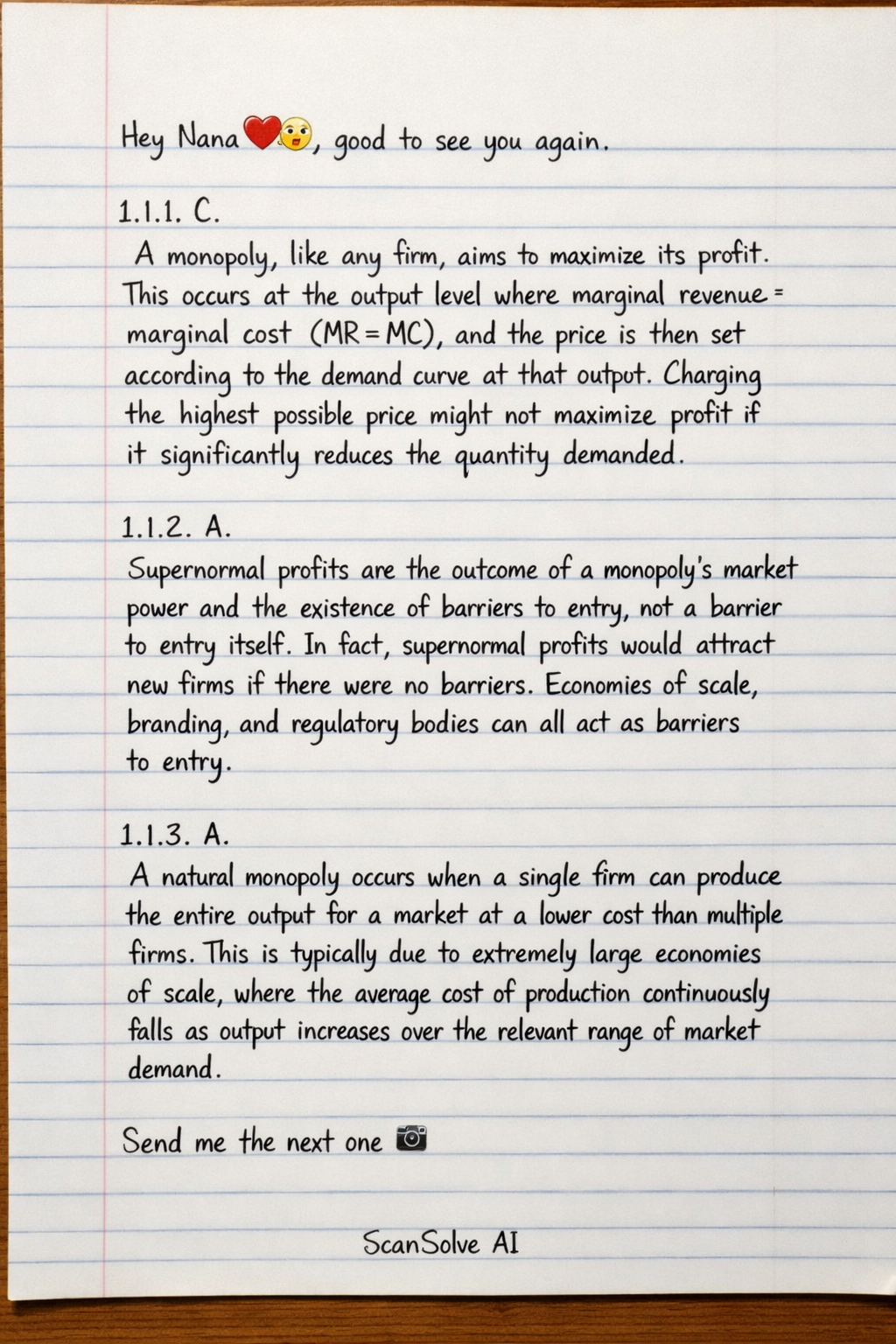
Handwritten Step-by-Step Solution
Get this as a handwritten image on WhatsApp — like a tutor wrote it for you.
Try on WhatsApp