
We read your photo as:
Describe the progress and obstacles in CEMAC's sub-regional integration efforts.
Economics
ScanSolve AI Answer
Answer
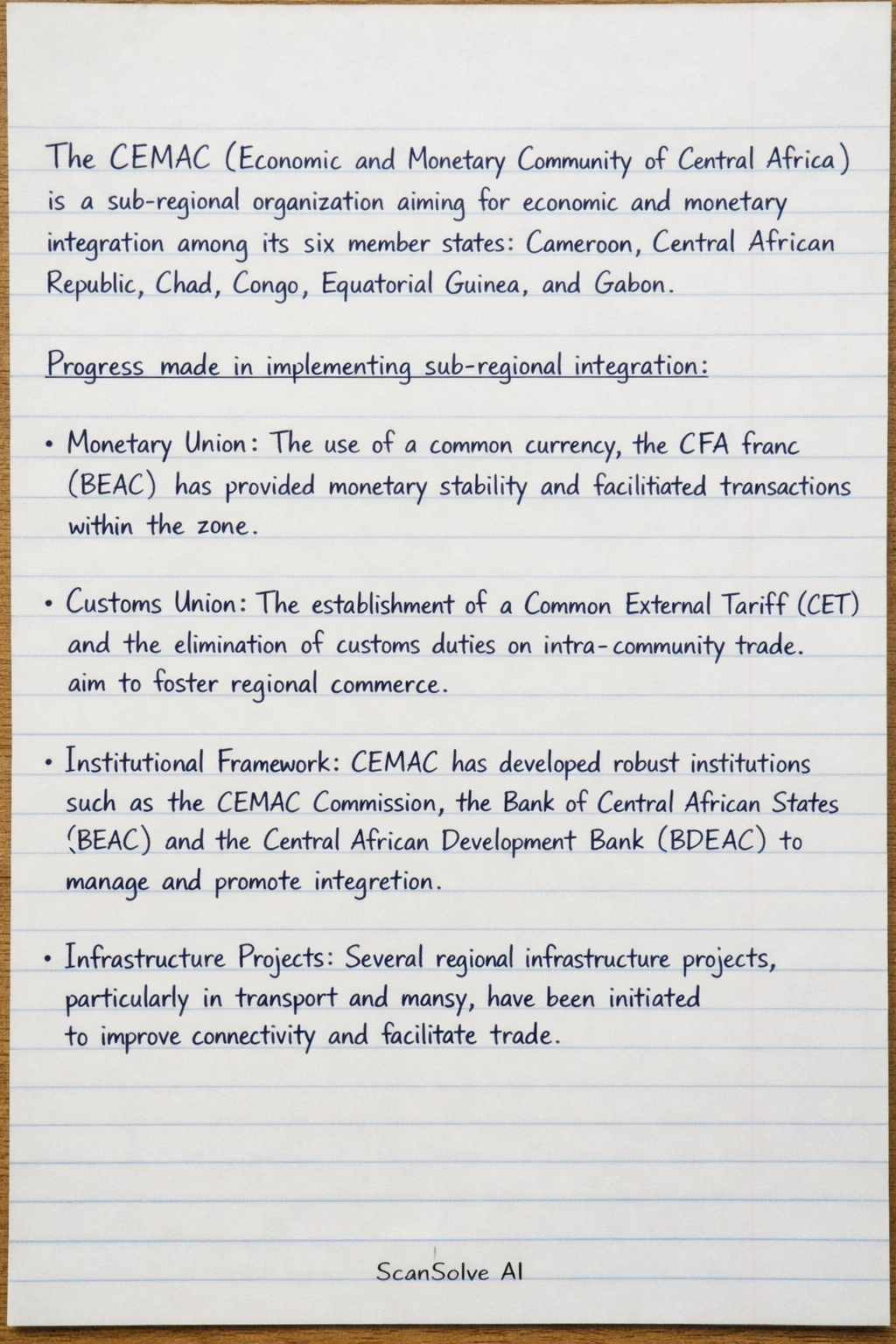
The CEMAC (Economic and Monetary Community of Central Africa) is a sub-regional organization aiming for economic and monetary integration among its six member states: Cameroon, Central African Republic, Chad, Congo, Equatorial Guinea, and Gabon.
Progress made in implementing sub-regional integration:
- Monetary Union: The use of a common currency, the CFA franc (BEAC), has provided monetary stability and facilitated transactions within the zone.
- Customs Union: The establishment of a Common External Tariff (CET) and the elimination of customs duties on intra-community trade aim to foster regional commerce.
- Institutional Framework: CEMAC has developed robust institutions such as the CEMAC Commission, the Bank of Central African States (BEAC), and the Central African Development Bank (BDEAC) to manage and promote integration.
- Infrastructure Projects: Several regional infrastructure projects, particularly in transport and energy, have been initiated to improve connectivity and facilitate trade.
- Free Movement: Efforts have been made to implement the free movement of people, goods, services, and capital, although full implementation remains a challenge.
Obstacles encountered in implementing sub-regional integration:
- Non-Tariff Barriers: Despite the customs union, significant non-tariff barriers, including administrative hurdles, corruption, and informal checkpoints, continue to impede intra-regional trade.
- Economic Diversification: The economies of CEMAC countries are heavily reliant on oil and raw materials, making them vulnerable to commodity price fluctuations and limiting industrial diversification and intra-regional trade in manufactured goods.
- Insecurity and Political Instability: Conflicts and political instability in some member states disrupt economic activities, displace populations, and divert resources, hindering integration efforts.
- Infrastructure Deficit: Despite ongoing projects, a substantial deficit in critical infrastructure, particularly in transport and energy, continues to limit economic integration and competitiveness.
- Weak Governance and Corruption: Issues of weak governance, corruption, and a lack of adherence to regional protocols undermine the effectiveness of institutions and deter investment.
- Slow Implementation of Reforms: Delays in the ratification and effective implementation of regional agreements and reforms by member states often slow down the integration process.
Was this helpful?
Still stuck on this one?
Ask a follow-up, and the answer starts from this question.
Got a different question?Ask your own question
More Economics Questions
QEconomic Integration In AfricaQHistory ordinary level papers 1 SECTION A (Cameroon since 1800) Which was the most appropriate…QWhat five major steps can the Economic Community of West African States take to prevent the collapse…QReason for the failure of east african communityQQuel est le bilan de la CEDEAO
Handwritten Step-by-Step Solution
Get this as a handwritten image on WhatsApp — like a tutor wrote it for you.
Try on WhatsApp