
We read your photo as:
Define Public Finance and explain its five key areas of focus.
ScanSolve AI Answer
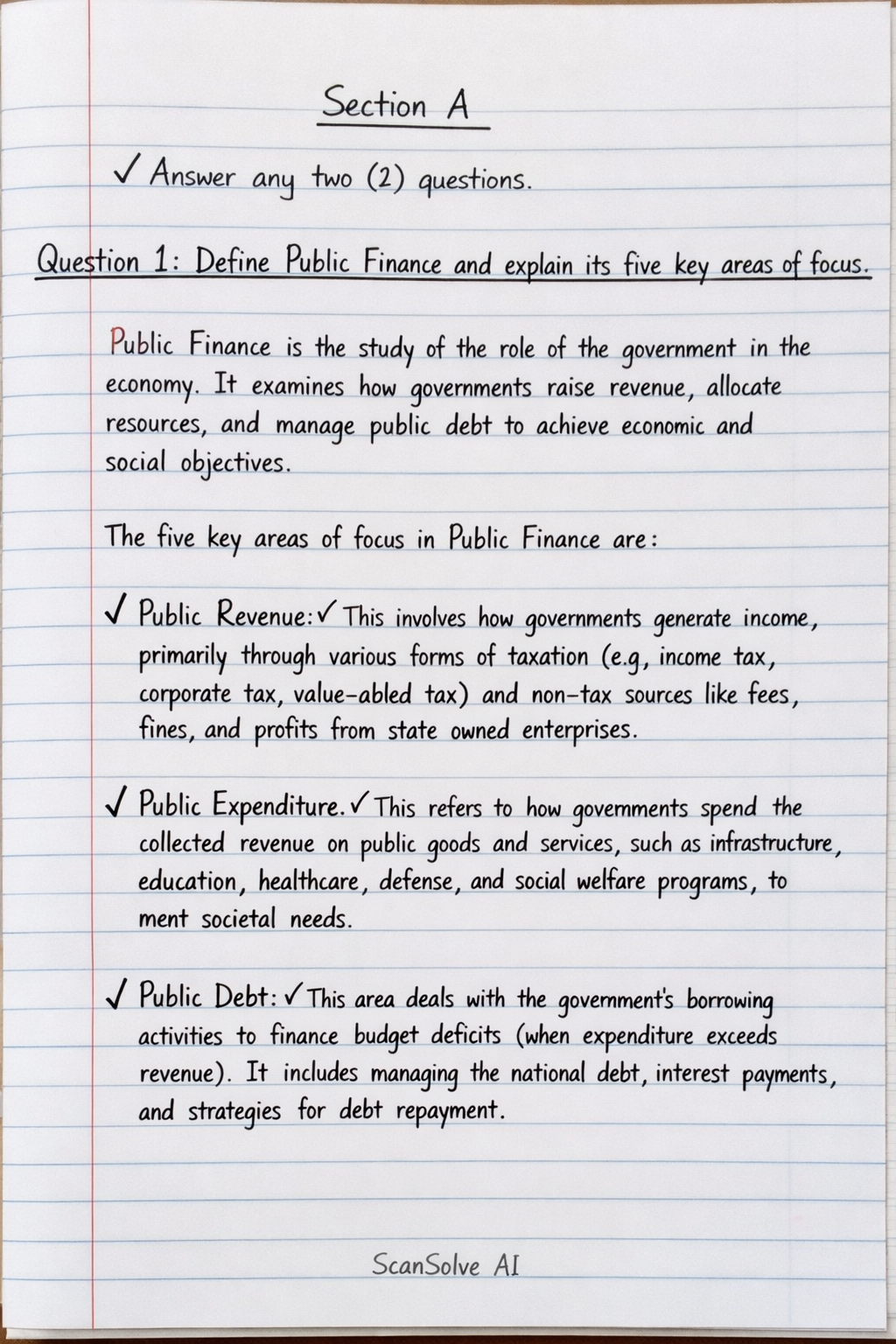
Section A
Answer any two (2) questions.
Question 1: Define Public Finance and explain its five key areas of focus.
Public Finance is the study of the role of the government in the economy. It examines how governments raise revenue, allocate resources, and manage public debt to achieve economic and social objectives.
The five key areas of focus in Public Finance are:
- Public Revenue: This involves how governments generate income, primarily through various forms of taxation (e.g., income tax, corporate tax, value-added tax) and non-tax sources like fees, fines, and profits from state-owned enterprises.
- Public Expenditure: This refers to how governments spend the collected revenue on public goods and services, such as infrastructure, education, healthcare, defense, and social welfare programs, to meet societal needs.
- Public Debt: This area deals with the government's borrowing activities to finance budget deficits (when expenditure exceeds revenue). It includes managing the national debt, interest payments, and strategies for debt repayment.
- Fiscal Policy: This is the use of government spending and taxation to influence the economy. Its objectives include achieving macroeconomic goals such as economic growth, full employment, and price stability.
- Financial Administration: This encompasses the processes and institutions involved in managing public funds, including budgeting, accounting, auditing, and financial reporting, to ensure transparency, efficiency, and accountability in government financial operations.
Question 2: Analyze the components of oil revenue as a source of government income, using Nigeria as a case study.
For Nigeria, an oil-rich nation, oil revenue is a critical component of government income, significantly influencing the national budget and economic stability. This revenue is derived from several key sources related to the exploration, production, and sale of crude oil and gas.
The main components of oil revenue for the Nigerian government include:
- Royalties: These are payments made by oil companies to the government for the right to extract crude oil and natural gas from Nigerian territory. Royalties are typically calculated as a percentage of the value or volume of petroleum produced.
- Petroleum Profit Tax (PPT): This is a direct tax levied on the profits of companies engaged in upstream petroleum operations (exploration and production) in Nigeria. It is a major source of revenue, calculated based on the taxable income of these companies.
- Rentals and Signature Bonuses: Rentals are annual payments made by oil companies for the lease of oil blocks. Signature bonuses are one-off payments made to the government upon the award of new oil prospecting licenses or oil mining leases.
- Equity Share/Joint Venture Cash Calls: The Nigerian government, primarily through the Nigerian National Petroleum Corporation (NNPC), holds equity stakes in joint ventures with international oil companies. The government's share of crude oil production from these ventures contributes directly to revenue. Cash calls represent the government's contribution to the operating costs of these joint ventures.
- Proceeds from Crude Oil Sales: The direct sale of crude oil by the NNPC on behalf of the government, both for export and domestic refining, generates substantial revenue.
- Gas Flaring Penalties: Fines imposed on oil companies for flaring (burning off) associated natural gas, which is often a byproduct of oil extraction, rather than utilizing it. These penalties aim to discourage flaring and encourage gas utilization.
Section B
Answer ALL questions.
Question 1: Public Finance primarily deals with:
b) Government revenue, expenditure, and debt management
Question 2: Which historical period saw fragmented public finance under feudal systems?
b) Medieval Period
Question 3: Nigeria's oil revenue is primarily derived from:
b) Royalties and crude oil exports
Question 4: A tax levied directly on an individual's income is called:
c) Direct tax
Still stuck on this one?
Ask a follow-up, and the answer starts from this question.
More Economics Questions
Handwritten Step-by-Step Solution
Get this as a handwritten image on WhatsApp — like a tutor wrote it for you.
Try on WhatsApp