
We read your photo as:
Q1 When will the demand for active balances be expected to fall in an economy? Q2 with the use of a numerical example, explain how Value Added Tax is calculated. Q3 How can efficiency of labour be improved in an economy. Q4 In what ways can the government improve on geographical mobility of labour
ScanSolve AI Answer
This answer stops before the end.
It was cut off when it was first written. Ask ScanSolve this question again for the full working.
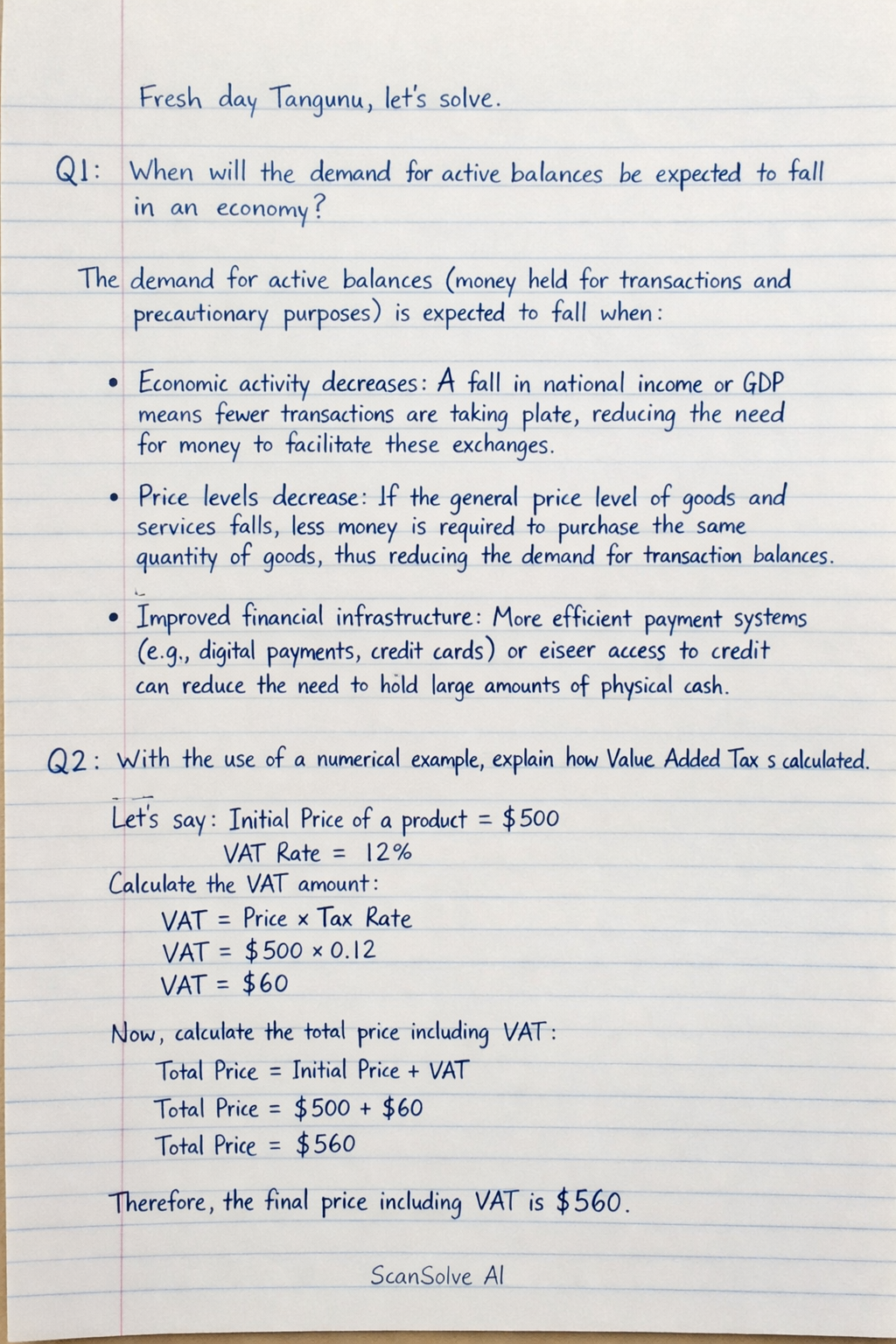
Q1: When will the demand for active balances be expected to fall in an economy?
The demand for active balances (money held for transactions and precautionary purposes) is expected to fall when:
- Economic activity decreases: A fall in national income or GDP means fewer transactions are taking place, reducing the need for money to facilitate these exchanges.
- Price levels decrease: If the general price level of goods and services falls, less money is required to purchase the same quantity of goods, thus reducing the demand for transaction balances.
- Improved financial infrastructure: More efficient payment systems (e.g., digital payments, credit cards) or easier access to credit can reduce the need to hold large amounts of physical cash.
Q2: With the use of a numerical example, explain how Value Added Tax is calculated.
Value Added Tax (VAT) is a consumption tax levied on the value added at each stage of production and distribution. It is calculated as the difference between the VAT charged on sales (output VAT) and the VAT paid on purchases (input VAT).
Example: Assume a VAT rate of 10%.
Step 1: A manufacturer buys raw materials for \$$100.
The manufacturer pays no VAT on raw materials if they are the first stage, or pays input VAT if bought from another VAT-registered business. For simplicity, let's assume the raw materials cost $$10%$$$$$$20.
Step 2: The wholesaler buys the product from the manufacturer for \$$200 (plus $$$$10%$$$$$$10.
Step 3: The retailer buys the product from the wholesaler for \$$300 (plus $$$$10%$$$$$$10.
The total VAT collected by the government is \$$20 (from manufacturer) + $$$10%$\boxed{\text{VAT is calculated as Output VAT - Input VAT, with the total VAT ultimately borne by the consumer.}}$.
Q3: How can efficiency of labour be improved in an economy?
Efficiency of labour can be improved in an economy through several key strategies:
- Education and Training: Investing in human capital through better education, vocational training, and continuous skill development programs enhances workers' knowledge and abilities.
- Technological Advancement and Capital Investment: Providing workers with modern tools, machinery, and technology increases their productivity and output per hour.
- Improved Working Conditions: Creating a safe, healthy, and motivating work environment, along with fair wages and benefits, can boost morale and reduce absenteeism.
- Specialization and Division of Labour: Organizing work processes to allow individuals to focus on specific tasks where they have an advantage can lead to greater expertise and speed.
Q4: In what ways can the government improve on geographical mobility of labour?
The government can improve geographical mobility of labour through various policies:
- Relocation Grants and Subsidies: Offering financial assistance to cover moving costs, housing deposits, or initial living expenses can reduce the financial burden of relocating for work.
- Housing Policies: Implementing policies that increase the availability of affordable housing in areas with labour shortages or providing housing subsidies can make relocation more feasible.
- Job Search and Information Services: Establishing national job matching services and providing comprehensive information about job vacancies and living conditions in different regions can reduce information asymmetry.
- Regional Development Policies: Investing in infrastructure, education, and amenities in economically depressed regions can make them more attractive for workers to move to, or reduce the need for workers to leave.
Still stuck on this one?
Ask a follow-up, and the answer starts from this question.
More Economics Questions
Handwritten Step-by-Step Solution
Get this as a handwritten image on WhatsApp — like a tutor wrote it for you.
Try on WhatsApp